Please email your comments & questions to geovisual at comcast.net. Thank you.

Peace Monuments in Benelux
(Belgium, the Netherlands
& Luxembourg)

N.B. This web page has five parts: (1) The Hague, (2) Amsterdam, (3) Rotterdam, (4) Utrecht, and (5) the remainder of Benelux.

(1) Peace Monuments in Den Haag / The Hague (Netherlands)

Right click image to enlarge.
H
A
L
L
October 1697 - Treveszaal / Truce Chamber, Binnenhof, The Hague (Netherlands). Where several peace treaties have been signed, including Treaty of Friendship & Commerce between Netherlands & USA -- first US treaty, signed by John Adams [1735-1826] on October 8, 1782, eleven months before peace treaty with Great Britain formally recognized US independence. The Dutch cabinet meets here every Friday.


C
O
N
F
E
R
E
N
C
E
1899 - First Hague Peace Conference, The Hague (Netherlands). Where held in The Hague? "The First Hague Peace Conference was not driven by the sudden conversion of Europe's rulers to pacifism, but by Russia's desire to escape the crushing burden of keeping up with Germany and England's armament pace in Western Europe. Although certain idealistic motives played roles, no progress was made on disarmament at the end of each day. Nevertheless, the Conference was not without important results: First, it produced a convention for the Pacific Settlement of Disputes-which resulted in the establishment of the Permanent Court of Arbitration [PCA]; secondly, an issue on Laws and Customs of War on Land known as 'The Hague Convention' remains as the most important source of humanitarian law today; and a third concerning Maritime Warfare. The conference adopted "Declarations" to the effect that throwing projectiles from balloons and other aircraft had an indiscriminate effect on civilians, and the use of asphyxiating gases and dum dum bullets should be forbidden because of their inhumane nature (defenders of nuclear weapons, please note). They further expressed that another conference be held to deal with the unfinished portions of the agenda." Lower image shows the Russian delegation.
C
O
N
F
E
R
E
N
C
E
June 15, 1907 - Second Hague Peace Conference, The Hague (Netherlands). Where held in The Hague? "It is a little known fact that the initiative for the Second Hague Peace Conference came from civil society in the United States. Prompted by a petition in 1903 from the American Peace Society in Boston, the Massachusetts legislature passed a resolution requesting Congress to authorize the President of the United States to invite the governments of the world to join in establishing a regular international congress to meet at stated periods to deliberate upon the various questions of common interest. The idea was taken up in St. Louis in 1904 [year of the St. Louis Worlds Fair] by the Interparliamentary Union (IPU) that recommended a conference to deal with the subjects postponed at The Hague in 1899. It led to the negotiation of a series of arbitration treaties among the various nations and the consideration of plans for a series of congresses-the kind recommended by the Massachusetts legislature. President Theodore Roosevelt [1858-1919] responded to this invitation by convening the Second Hague Peace Conference. It was held on June 15, 1907, after being formally convened by the Czar. This time, Russia proposed an agenda limited to improvements in arbitration and humanitarian law, while America suggested discussing the limitation of armaments and the use of force in the collection of debts."
P
A
L
A
C
E
August 28, 1913 - Vredespaleis / Peace Palace, Carnegieplein 2, The Hague (Netherlands). Constructed just before World War I by the Carnegie Foundation -- and still owned by the Carnegie Foundation. (Philanthropist Andrew Carnegie [1835-1919] previously paid for the Pan American Union building -- now the Organization of American States (OAS) -- in Washington, DC (USA) in 1910.) The Peace Palace is now home of the International Court of Justice (ICJ) or World Court, the Permanent Court of Arbitration (PCA), the Peace Palace Library, and the Hague Academy of International Law.
F
O
U
N
T
A
I
N
August 28, 1913 - Peace Fountain, Peace Palace, The Hague (Netherlands). Inscription names Abraham Pieter Cornelis van Karnebeek [1836-1925] & others responsible for creating the Peace Palace.
F
O
U
N
T
A
I
N
September 14, 1929 - Peace Fountain, Amsterdam Park, St. Clair Avenue W at Avenue Road, Toronto, Ontario (Canada). Inscribed: "[Replica of] the fountain at [the Peace] Palace, The Hague. Presented by H.H. Williams... as a mark of his love [for peace]."
C
O
N
F
E
R
E
N
C
E
April 28, 1915 - International Congress of Women, The Hague (Netherlands). Where held in The Hague? "Convenes on this day with more than 1,200 delegates from Britain, Germany, Austria-Hungary, Italy, Poland, Belgium, the USA, and five other countries. Dedicated to the cause of peace and a resolution of the Great War. Often referred to as the Women's Peace Congress. Resulted from an invitation by a Dutch women's suffrage organization, led by Aletta Jacobs [1853-1929], to women s rights activists around the world, on the basis of the belief that a peaceful international assemblage of women would 'have its moral effect upon the belligerent countries' (as Jacobs put it during her opening address)." Image shows US delegation, including Jane Addams, Emily Balch, and Alice Hamilton.
C
O
N
F
E
R
E
N
C
E
1915 - "International conference to stop the war through mediation," The Hague (Netherlands). Where held in The Hague? "Organized by Hendrik Coenraad Dresselhuys [1870-1926], prominent Dutch lawyer and politician, who later travelled to Germany to pursue the matter. As Secretary-General of the Dutch Red Cross, Dresselhuys greatly assisted Belgian refugees in 1918." [per PvdD 26Jun10]

M
E
M
O
R
I
A
L
1920 - Memorial to W. T. Stead, River Parapet, Victoria Embankment, London (England). Sculpted by Sir George Frampton. William Thomas Stead [1849-1912] was "the first truly modern journalist." According to Peter van den Dungen, Stead was an important figure at the 1899 and 1907 Hague peace conferences, and he died on the Titanic en route to a peace conference in the USA. One of 309 London monuments in Kershman (2007), page 123. Duplicate monument at Central Park, New York City (qv).
M
E
M
O
R
I
A
L
About 1920 - Memorial to W. T. Stead, Central Park, New York City, New York (USA). Sculpted by Sir George Frampton. William Thomas Stead [1849-1912] was "the first truly modern journalist." According to Peter van den Dungen, Stead was an important figure at the 1899 and 1907 Hague peace conferences, and he died on the Titanic en route to a peace conference in the USA. Click here for a 1907 New York Times article about Stead. Duplicate monument at River Parapet, Victoria Embankment, London (England).
M
E
M
O
R
I
A
L
1931 - Dresselhuys Peace Monument, Carnegielaan / Carnegie Avenue, The Hague (Netherlands). By artist Arend Odé [1865-1955]? Sculpted by Maurice William Eagle Tribute [1865-1955]. Hendrik Coenraad Dresselhuys [1870-1926] chaired the Nederlandsche Anti-Oorlog Raad (NAOR) / Dutch Anti-War Council 1914-1919. "At the back of the Peace Palace is the monument dedicated to Dresselhuys, and with quotations from him. He was an interesting and important politician, and peace man; after our walk, Gerard sent me his biography from the Dutch National Biography." [Per PvdD 08Jun10]. Image courtesy of Steve Fryburg.
September 28, 1966 - T.M.C. Asser Instituut, The Hague (Netherlands). "A leading research institute in the fields of Private and Public International Law, European Law and International Commercial Arbitration." Dutch jurist Tobias Michael Carel Asser [1838-1913] and Austrian pacifist Alfred Fried [1864-1921] shared the Nobel Peace Prize in 1911.
P R O T E S T
October 29, 1983 - Peace Demonstration, The Hague (Netherlands). "The biggest ever organised in the Netherlands... Aimed against the deployment [in Woensdrecht] of US cruise missiles that were destined to carry nuclear warheads, in particular neutron bombs. The demonstration drew a record 550,000 participants and was entirely non-violent, unlike other anti-nuclear protests of the era." (The deployment was cancelled in 1987 due to the Intermediate-Range Nuclear Forces Treaty.)


M
E
M
O
R
I
A
L
S
Upper Image:
1992 - Haags oorlogsmonument 1940-1945 / Hague War Memorial 1940-1945, Carneigie Square, The Hague (Netherlands). Opposite the Peace Palace. Made by Appie Drielsma. Created at the initiative of a group of former resistance fighters. The four pillars symbolize the four groups in society during World War II: Neutral, Roman Catholic, Protestant & Jewish. The stone wall symbolizes the "dike of intransigence" (literal translation). Image courtesy of Steve Fryburg. Information courtesy of Nike Liscaljet.
Lower Image:
Date? - World War II monument, The Hague (Netherlands). Near the Peace Palace. Inscription: "As a royal residence & seat of government The Hague was already on May 10, 1940, the first day of the treacherous attack on the Netherlands, under attack from the air. The first destructions took place & the first casualties fell. Following the war & occupation in May 1940 & the liberation in May 1945, almost 20,000 of our fellow citizens would lose their lives, as soldiers, Resistance, deported as a forced laborer, as a prisoner in prison or concentration camp, as a victim of bombing & of the last hunger winter, & above all as persecuted because of race & religion. Among the latter are more than 16,000 Jewish citizens that did not survive the death camps. // This monument commemorates all without distinction who had to pay with their lives for the delusions from which National-Socialism emergelickr.com/photos/22325431@N05/sets/72157619441713904/">Nationaal Gedenkteken der Joodse Martelaren van België / Mémorial National aux Martyrs Juifs de Belgique / National Monument to the Jewish Martyrs of Belgium, Square des Martyrs Juifs / Joodse Martelarensquare, Anderlecht district, Brussels (Belgium). A platform centering on a menorah made of chains & a wall bearing the names of 23,838 Belgian Jews who were killed in the Holocaust.

M
U
S
E
U
M
August 5, 1995 - Yi Jun Peace Museum, The Hague (Netherlands). Established on 50th anniversary of Korean liberation from Japan and on 88th anniversary of death of Yi Jun [1859-1907] who represented Korea at the Second Hague Peace Conference in 1907 and died in this building. Associated with the International Network of Musuems for Peace (INMP).

O
F
F
I
C
E
1997 - Organisation for the Prohibition of Chemical Weapons (OPCW), The Hague (Netherlands). "After the Chemical Weapons Convention was signed in Paris in 1993, the OPCW was established in 1997 to monitor the implementation of the Chemical Weapons Convention."
C
O
N
F
E
R
E
N
C
E
May 1999 - Third Hague Peace Conference, The Hague (Netherlands). Where held in The Hague? "The Third Conference envisioned by US Secretary of State Elihu Root [1845-1937] was held in The Hague in May 1999, at the initiative of the Russian and Dutch governments. It was not a treaty-making conference like the first two, but a centennial commemoration on the theme, 'The Peaceful Settlement of Disputes: Prospects for the Twenty-First Century.' Rather than hover in the wings of the following year's conference as in 1899 and 1907, civil society this time held its own conference, 'The Hague Appeal for Peace 1999.' It sent a clear message to the world's policy makers on issues with which they failed to address in the first two rounds: (How to eliminate the causes of war; including racism, colonialism, poverty and other human rights violations, the limitation of arsenals to a reasonable level for territorial defense, the elimination of all weapons of mass destruction including nuclear ones, the establishment and utilization of conflict resolution mechanisms (as an interim measure on the way to abolish war), improvements in humanitarian law, and most importantly, the creation of a culture of peace for the world's war-oppressed people."

F
L
A
M
E
April 18, 2002 - World Peace Flame #1, Peace Palace, The Hague (Netherlands). Later World Peace Flames in New South Wales (Australia), Tennessee (USA), Wales (UK) & elsewhere in the Netherlands (qv).

O
F
F
I
C
E
July 1, 2002 - International Criminal Court (ICC), Maanweg 174, The Hague (Netherlands). The court intends to construct permanent premises in Alexanderkazerne, to the north of The Hague, but is currently housed in interim premises on the eastern edge of The Hague (as shown in the image). Although its official seat is in The Hague, its proceedings may take place anywhere. The ICC also maintains a liaison office in New York City and field offices in places where it conducts its activities. As of 18 October 2007, the court had field offices in Kampala, Kinshasa, Bunia, Abéché and Bangui.

P
A
T
H
April 22, 2004 - World Peace Flame Pathway, Peace Palace, The Hague (Netherlands). Contains a rock from each of the 197 nations which signed the world peace agreement.

S
T
A
T
U
E
June 5, 2004 - Gandhi Statue, Hobbemaplein, The Hague (Netherlands). By artist: Karel Gomes. Part of a monument to memorize the immigration of Hindus to Suriname and to The Hague. Information courtesy of Nike Liscaljet.
M
O
D
E
L
June 2004 - Peace Palace Model, Madurodam Miniature City, Scheveningen, The Hague (Netherlands). "1:25 scale model of the famous international courthouse (qv) built in 1913 as a gift from the American, Andrew Carnagie [sic]. Even details the attached gardens and terraces." "[This is] the third since the park’s inception in 1952. Creation of a new replica had become necessary as the earlier model had detoriated in the open air theme park."
B
E
N
C
H
2004 - Peace bench, in front of the Peace Palace, The Hague (Netherlands). By artist Moki Last. One of two mosaic benches. Paid for by the Carnegie Stichting / Carnegie Foundation. Image courtesy of Steve Fryburg. Information courtesy of Nike Liscaljet.
B
E
N
C
H
Date? - Peace bench, The Hague (Netherlands).
M E M O R I A L
2006 - Children's Monument, Rabbijn Maarsenplein, The Hague (Netherlands). "A monument for 1700 Jewish children from The Hague who were killed by the Nazis in the Second World War. Consists of six chairs or stairs with the names and the ages on them of the victims. These names were handwritten by school children of today. The monument is also a playground for children."
M
U
R
A
L
Date? - Muurschildering vrede / Peace Mural, The Hague (Netherlands). "Peace Art on the city streets in The Hague." What date & precise location? Image courtesy of Steve Fryburg.

M
U
R
A
L
2007 - World in Peace(s)?, The Hague (Netherlands). In entrance hall of the new building behind the Peace Palace which holds the Peace Palace Library & the Hague Academy of International Law. Shows all countries in the world in arbitrary places. Left image courtesy of Steve Fryburg. Unofficial title courtesy of Nike Liscaljet.

February 24, 2008 - Khojaly Massacre Memorial, The Hague (Netherlands). "An initiative of Azerbaijani Diaspora & another one built in Ankara (Turkey) commemorating the Khojaly Massacre [on February 25-26, 1992, in Nagorno Karabag, Azerbaijan]. Another memorial will be constructed in Budapest (Hungary)."

O
F
F
I
C
E
February 15, 2010 - Secretariat office, International Network of Museums for Peace (INMP), Laan van Meerdervoort 70 NL-2517 AN, The Hague (Netherlands). Near the Peace Palace. First Secretariat Administrator is Ms Nike Liscaljet. Phone & fax 0031-70-3450202, email secretariat@museumsforpeace.org. Images courtesy of Steve Fryburg.
Welkom | Willkommen | Bienvenu | Bienvenida | Velkommen
B
U
I
L
D
I
N
G
November 2011 - Bertha von Suttner Gebouw / Building, Laan van Meerdervoort 70, The Hague (Netherlands). Existing building renamed by Alderman De Jong. "Bertha von Suttner [1843-1914] was in The Hague for the inauguration of the Peace Palace in 1913. In the evening, she held debates about world peace in the Kurhaus Hotel. The Hague was her city. On the eve of World War, she implored the world to peace. She already called for an international organization that would act as war threatened." The building houses "smaller international organizations" such as Equalinrights, European Association of History Educators (EUROCLIO), Global Human Rights Defence (GHRD), International Network of Museums for Peace (INMP), Netherlands Helsinki Committee (NHC), United Network of Young Peacebuilders (UNOY) & Unrepresented Nations & Peoples Organization (UNPO).


T
R
A
I
L
Future - Peace Walk, The Hague (Netherlands). From Peter van den Dungen, General Coordinaator, Inernational Network of Museums for Peace (INMP), March 17, 2010: "The city has published several brochures which are relevant and of interest, but nothing which really compares with the guides for Atlanta, Bradford, Leeds [qv]. In 1999 (during the large Hague Appeal for Peace conference), I helped organise a peace history symposium, and as part of this conducted a peace history walk in the city. The group was about 25 strong, with many leading US and European peace historians, all dear friends. Of course, the focus was very much on the famous 1899 and 1907 peace conferences. Regrettably, many of the buildings and places included had no plaques or memorials. This also applied to the building which was the first home of the Permanent Court of Arbitration (PCA), the creation of which was the most significant and lasting outcome of the 1899 conference. The Peace Palace only dates from 1913, and of course needs no plaque... I should draft a proposal for the city, and perhaps submit it on behalf of INMP, suggesting a number of plaques. Then some might be there when the city celebrates the centenary of the Peace Palace in 2013 (or the unveiling of them could be part of the celebrations)."

(2) Peace Monuments in Amsterdam (Netherlands)

Right click image to enlarge.
M
U
S
E
U
M
May 3, 1960 - Anne Frank Huis / Anne Frank House, Amsterdam (Netherlands). Hiding place of Anne Frank [1929-1945] and her family during World War II. The house was turned into a museum in 1960, and the museum was expanded in 1999.
S
T
A
T
U
E
Date? - Statue of Anne Frank, near the museum, Amsterdam (Netherlands).

March 25-31, 1969 - First "Bed-In," Presidential Suite (Room #702), Amsterdam Hilton Hotel, Amsterdam (Netherlands). "Knowing their March 20, 1969, marriage would be a huge press event, John and Yoko decided to use the publicity to promote world peace. They spent their honeymoon in the presidential suite for a week, inviting the world's press into their hotel room every day between 9 am and 9 pm." Lennon wrote "Give Peace a Chance" during this "Bed-In." When asked by a reporter what he was trying to achieve by staying in bed, Lennon had answered spontaneously "All we are saying is give peace a chance."
1993 - Nooit Meer Auschwitz / Auschwitz Memorial, Wertheimpark, Amsterdam (Netherlands). Cracked mirror by Jan Wolker.
2002 - "Shared Past, Common Future," Nationaal Monument Slavernijverleden / National Slavery Monument, Oosterpark, Amsterdam (Netherlands). By Surinamese born artist Erwin Jules de Vries. "Commemorates the abolition of slavery in the Netherlands in 1819."
2003 - "Holocaust" by Belgian artist Jan Theuninck. "An ecphrastic work by Jan Theuninck. The work is exposed at Dutch Boekgrrls."
2004 - "Wargasm," Museum for Peace & Nonviolence (a virtual museum), Amsterdam (Netherlands). By Belgian artist Jan Theuninck. "Psychoanalysis of a warrior and of a political decision maker. Acrylic on canvas."
2004 - "Yperite," Museum for Peace & Nonviolence (a virual museum), Amsterdam (Netherlands). "This painting by Jan Theuninck is an anti-war statement and a symbol of peace. The painting depicts the terror, caused by chemical warfare, and the thousands of deaths on the battlefields. It has been made in acrylic on canvas, measures are 70 x 100 cm." www.forumeerstewereldoorlog.nl/wiki/index.php/Yperite-Jan..." English translation: "Yperite. Late at night a mist fills the valley. without knowing it suffocates like a dark power. on the fields our dead bodies and under the grass a brown soil."
S
T
A
T
U
E
July 9, 2005 - Monument in memory of Anne Frank, Merwedeplein Square, Amsterdam (Netherlands). Anne Frank [1929-19458] lived on the Merwedeplein from 1933 to 1942. In 2004, bookseller Gert-Jan Jimmink proposed a monument. It was sculpted by local sculptor Jet Schepp.
March 18, 2007 - De Schreeuw / The Scream, Oosterpark, Amsterdam (Netherlands). 4.5 meter stainless steel sculpture by artist Jeroen Henneman memorializing Dutch author and film maker Theo van Gogh [1957-2004] who was assassinated November 2, 2004, by Mohammed Bouyeri, a Dutch-Moroccan Muslim. "Symbolizes freedom of speech and how Van Gogh was made speechless." One side shows a profile of Theo van Gogh, crying with mouth wide open, and the other side shows him with his mouth closed.

(3) Peace Monuments in Rotterdam (Netherlands)

Right click image to enlarge.
c.1510 - Il Figlio Prodigo / The Prodigal Son, Museum Boijmans Van Beuningen, Rotterdam (Netherlands). By Hieronymus Bosch [c1450-1516]. Also known as The Wayfarer, The Vagabond or The Pedlar.

April 30, 1622 - Standbeeld van Erasmus / Statue of Erasmus, Square in front of Sint Laurens Church, Rotterdam (Netherlands). Click here for Wikipedia article about Desiderius Erasmus [1466-1536].
S
C
H
O
O
L
1842 - Gymnasium Erasmianum / Erasmiaans Gymnasium, Rotterdam (Netherlands). Founded in 1328. Second oldest school in the Netherlands. Renamed for Erasmus in 1842. More than a century older than its namesake, and it is unclear whether Erasums attended. School motto is "Ex Pluribus Unum" / "Unity Through Diversity."

1968 - Deur "Oorlog en Vrede" / Door of Peace and War, Grote of Sint-Laurenskerk, Grotekerkplein 27, Rotterdam (Netherlands). Bronze by Italian sculptor Giacomo Manzů [1908-1991]. "Celebrates the heart of Europe destroyed by WW-II the elegy of death and the strength of life; below the wrapped forms of despair and fratricide, and the cry of innocence; in the midde a lonely cloth that marks a caesura, a sense of emptying, the fall; in the top, in an ascensional dynamism, the naturalness of existence, the cloth of life and of victory, as in a resurrection." [Maria Antonietta Malleo, Gernika, 2005]
U N I V E R S I T Y
1973 - Erasmus Universiteit Rotterdam / Erasmus University Rotterdam, Rotterdam (Netherlands).
B
R
I
D
G
E
September 6, 1996 - Erasmusbrug / Erasmus Bridge, Nieuwe Maas / New Meuse River, Rotterdam (Netherlands).
M
E
T
R
O
1997 - Erasmuslijn / Erasmus Line, Rotterdam Metro, Rotterdam (Netherlands). Oldest Metro in the Netherlands. North-South Line renamed in 1997 for Erasmus.
H O S P I T A L
Date? - Erasmus Medical Center, Burgemeester s' Jacobsplein 51, Rotterdam (Netherlands). "The largest and most authoritative scientific University Medical Center in the Netherlands. Almost 13,000 staff members work within the core tasks of patient care, education, and scientific research on the continuous improvement and enforcement of individual patient care and social healthcare."

M
U
S
E
U
M
March 2005 - Huis van Erasmus / House of Erasmus, St. Huis van Erasmus, Bergweg 279-B, Rotterdam (Netherlands). "Fulfils a platform function for the fostering of a culture of peace and active non-violence, carrying the motto ‘Peace in the world, safety in the city.' An initiative of Humanistisch Vredesberaad and Pais. The Foundation is a member of Rotterdam Vredesstad, the Platform Vredescultuur and the Humanistische Alliantie, and is a partner of People Building Peace Nederland."
M
U
S
E
U
M
October 28, 2005 - Erasmushuis Rotterdam / Erasmus House, Grotekerkplein 5, 3011 GC, Rotterdam (Netherlands). "Aims to Erasmus a clear and recognizable every Dutchman in place to provide the experience and, for visitors, in the cityscape of Rotterdam. This is facilitated by propagating the ideas of Erasmus of Rotterdam in the society and beyond."
T
R
A
I
L
2008 - Stadswandeling Erasmus in Rotterdam / Erasmus City Trail in Rotterdam, Rotterdam (Netherlands). Describes 24 points of interest related to Desiderius Erasmus [1466-1536]. Created by Stichting Erasmushuis Rotterdam.

(4) Peace Monuments in Utrecht (Netherlands):

Right click image to enlarge.


About 1946 - Monument voor de Wereldvrede / Monument for World Peace, Utrechtseweg 183 (near Ziekenhuis De Lichtenberg / Lichtenberg Hospital, Amersfoort, Province of Utrecht (Netherlands). Moved after 1953 from garden of artist Jacob N. Nieweg [1877-1955], local chairman of "Kerk en Vrede / Church and Peace," who campaigned for "No More War." Three sided pyramid inscribed in Dutch ("Wereld Vrede door Federale Wereld Regering"), English ("World Peace by Federal World Government") & Esperanto ("Mond Paco per Federacia Mond Recistaro"). Monument has a sphere (globe?) on top & a four quadrant circle (earth symbol?) above each inscription. Compare the WFBN, UWF & Japanese logos below. On December 1, 2008, an article on page 3 of the Amersfoortse Courant described the monument's 80th anniversary [sic]. Images & information courtesy of Gerard Lössbroek. Click here for article by Jojanneke Clarijs.


Date? - Twee Monuments voor de Wereldvrede / Two Monuments for World Peace, Leusden, Province of Utrecht (Netherlands). Abour 3 km from Amersfoort. One is inscribed "World / peace / by / federal / world / government" (“Wereld / vrede / door / federale / wereld / regering”). The other is inscribed "Life is sacred. / Make it a safe." (“Het leven is heilig. / Maak het ook veilig.”) in Dutch, English & Esperanto. Acording to Jojanneke Clarijs, all three monuments were constructed by Hendrik van der Kraan AC [1888-c.1967], a member of the World Federalist Movement Netherlands (Wereld Federalisten Beweging Nederland) (WFBN) and the National Propaganda Foundation for World Federal Government (Nationale Stichting Propaganda voor Federale Wereldregering) (NSPFW) and publisher of the pacifist newspaper "Ban the war, Now!" ("Ban de oorlog uit, Nu!"). Photo & all information from article by Jojanneke Clarijs.

1949 - Monument of Resistance, Domplein / Old City, Utrecht (Netherlands). Limestone statue (6-meters in height) by artist Corinne Franzén-Heslenfeld. Shows classical woman figure holding, heroicly, the burning torch of resistance. Symbolizes the resistance and the large role of Utrecht women in the resistance. Engraved in the base are four lines by poet Jan Engelman, litterally translated: "Memorial to your dead who fought the good fight in justice. Carry on their flame. They still exist. But in the glow is our new life." Image courtesy of Steve Fryburg. Inscription courtesy of Nike Liscaljet.

M
U
R
A
L
November 12, 2005 - "VREDE IS COOL," reception hall, IKV/Pax Christi, Hoog Catharijne Shopping Centre, Godebaldkwartier 74, Utrecht (Netherlands). Has sayings about peace, e.g. "Vrede is vliegen / Peace is flying," "Vrede is verbondenheid / Peace is connectedness." Painted by 7 young refugees from Utrecht Asylum Seekers Centre tutored by artist Senad Alic from Serbia-Montenegro & theatre designer Majid Hassan from Sudan, working for the National Foundation for the Promotion of Happiness in Amsterdam. (IKV (Interchurch Peace Council) established in 1966 by 9 churches.) Information & image courtesy of Gerard Lössbroek (Pax Christi International).

May 5, 2007 - "Walk of Freedom," from the Dom Tower to Parc Transwijk, Utrecht (Netherlands). "Students (age 12-15) were asked to design tiles, and the subject was freedom/peace /liberty. 120 tiles were picked and are now part of the walk." Tile in left image shows the two finger peace sign. Tile in right image says "PEACE is more than 2 fingers!!!" (The Dom is the tallest church tower in the Netherlands.) Left image courtesy of Steve Fryburg. Information courtesy of Nike Liscaljet (INMP).

(5) Peace Monuments in Remainder of Benelux
(All except The Hague, Amsterdam, Rotterdam & Utrecht)

Right click image to enlarge.

Circa 1618 - ''The Union of Earth & Water (Antwerp and the Scheldt)" by Peter Paul Rubens [1577-1640], Hermitge Museum, St Petersburg (Russia). "The alliance of Cybele, Goddess of Earth, and Neptune, God of Victory, as the important alliance of Flanders and the sea, the River Scheldt and the city of Antwerp."

1628 - The Reconcilation of King Henry III & Henry of Navarre, Memorial Art Gallery of the University of Rochester, Rochester, New York (USA). By Peter Paul Rubens [1577-1640].
B
U
S
T
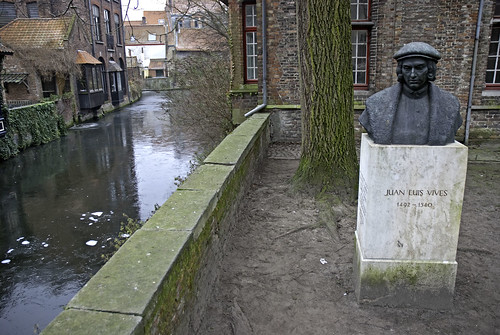
Date? - Bust of Juan Luis Vives, Bruges (Belgium). Juan Luis Vives [1492–1540] was a Valencian Spanish scholar and humanist. See statue in Madrid (Spain).
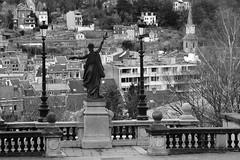
Date? - Statue de la Paix, Palais Royal, Brussels (Belgium).

B
U
S
T
Date? - Bust of Auguste Beernaert, Ostende (Belgium). Auguste Beernaert [1829-1912] was a Belgian politician and prime minister. He and Paul d'Estournelles de Constant [1852-1924] received the Nobel Peace Prize in 1909 for their work at the Permanent Court of Arbitration (PCA), which in now located at the Peace Palace in The Hague (Netherlands). Bust sculpted by Louis Mascré [1871-1929]. Info courtesy of Gerard Lössbroek.

M
U
R
A
L
S
1920-1932 - Arc de Triomphe, Cinquantenaire Park, Brussels (Belgium). "On both sides of the arch are 'galleries of the columns' with mosaics representing and glorifying the 'peace-loving nation of Belgium'. These mosaics were made between 1920 and 1932."
B
O
A
T
1923 - "Erasmus," in the "Want," near the Oranjelaan, Dordrecht, South Holland (Netherlands) "Built in 1923 as the "W.F.van der Wyck" for service between Enkhuizen and Stavoren. In 1941 she was requisitioned by the Germans as "Wilkommen," and in 1944 renamed "Regulus." She was acquired by Spido in 1955 and named "Erasmus." She was out of service in 1973, sold in 1974, and in 1976 became the 'Hollands Glorie" in Dordrecht. She remains as a stationary vessel in Dordrecht, with her engines removed."


M
U
S
E
U
M
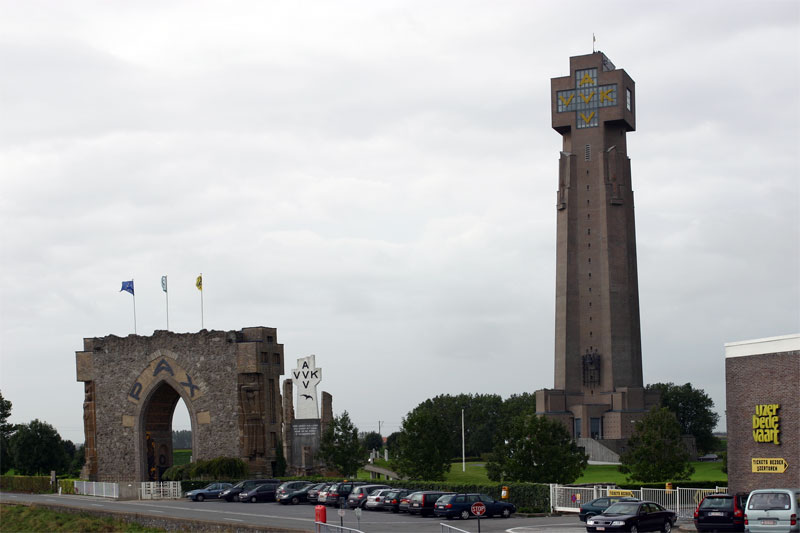
1930 - IJzertoren Museum of War, Peace & Flemish Emancipation, IJzerdijk 49, Diksmuide / Dixmude, Flanders (Belgium). IJzertoren / Yser Tower is is named after the Yser River which formed the frontline during most of World War I. The 84-meter tower was iIllegally demolished the night of March 15-16, 1946. The perpetrators were never caught but were thought to involve Belgian military and former resistance fighters in an atmosphere of post WW-II repression. Site of 4th International Conference of the International Network of Museums for Peace (INMP). Images show the rebuilt tower. Upper left image is 1929 poster. Upper right image is brochure for the 4th INMP conference in 2003. Associated with International Network of Museums for Peace (INMP).
C
H
A
P
E
L
1944 or later - Chapel, Luxembourg American Cemetery & Memorial, Hamm (Luxembourg). Three miles east of downtown Luxembourg City. "Au-dessus de la porte de la chapelle, une sculpture haute de 7 mčtres représente l'ange de la paix, sa main droite levée en signe de bénédiction, la gauche tenant une branche de laurier. Au sommet, une colombe planant sur un nuage, autre signe de paix."
1958 - "Atomium," Atomiumsquare, 1020 Laken, Brussels (Belgium). Theme structure of the 1958 Brussels Worlds Fair. Renovated in 2004-2006, and 50th anniversary celebrated in 2008. EWL visited in 1960.


Date? - Herinneringscentrum Kamp Westerbork / Memorial Center Camp Westerbork, Westerbork, Middenveld, Drenthe (Netherlands). Westerbork functioned during the WW-II to assemble Roma and Dutch Jews for transport to other Nazi concentration camps. Now a museum. Upper image shows Rails Monument, part of a former railroad track which was used during WW-II to transport people to and from the camp, including Anne Frank. Lower image shows the Appelplatz Memorial, made of a small rectangular stone for each person who had stayed at Westerbork and later died in a Nazi camp. The stones have a silver flame insignia for Roma and Sinti and a Star of David for Jewish victims. (Appelplatz means square used for roll call.)
October 7, 1983 - "Protection of Our Future," Peace Symbols Zone, Nagasaki Peace Park, Nagasaki (Japan). From the city of Middelburg, The Netherlands (Nagasaki's sister city). "Shows a mother protecting her infant child from danger, representing that we must protect not only the present generation but also the coming generation as well so that the people of the world can live in peace together."

After 1985 - "Schengen Agreement" monument, near Moselle bridge, Schengen (Luxembourg). "Three steel pillars, each with a star represent the first participant countries of the Schengen Agreement, being France, Germany and the Benelux countries, who met here in the triangle where the borders of Germany, France, and Luxembourg meet... This is a treaty signed in 1985, on the river-boat "Princesse Marie-Astrid," providing for the removal of systematic border controls between the participating countries."

P
O
R
T
R
A
I
T
1987 - Portrait of Bert Röling, "De Boom van Kennis / The Tree of Knowledge" (muurschildering / mural), Auditorium, Academy Building, University of Groningen, College Square, Groningen (Netherlands). Bert Röling [1906-1985] was a Dutch jurist who helped found the International Peace Research Association (IPRA) in 1964. Huge mural painted by his son Mathijs Röling & by Wout Muller. Lower right corner includes Röling in white hair (similar to his official portrait in the university's senate room) & what appear to be three students.

M
U
S
E
U
M
1987 - Vredescentrum van de Provincie en de Stad Antwerpen / Peace Centre of the Province & City of Antwerp, Unolaan 1, Deurne-Antwerpen (Belgium). Four permanent exhibitions: Middle Ages, World War I, inter-war period, and World War II. Associated with International Network of Museums for Peace (INMP).

M
U
S
E
U
M
Before 1988 - Maison d'Erasme / House of Erasmus, Anderleht District, Brussels (Belgium). Where Erasmus of Rotterdam [1466-1536] stayed May-October 1521 after leaving Leuven. Renovated & reopened in 1988. "After the reception room, visitors can explore five further rooms. The Chamber of Rhetoric is dedicated to Erasmus’s visit and exudes a 16th-century ambience. The wooden floors give off an ancient, musty aroma and creak with every step. Glass cabinets contain letters and academic papers written by Erasmus, and stunning paintings line the walls."

T
R
E
E
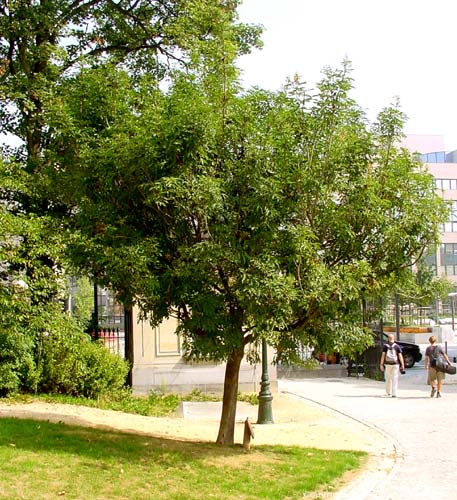
June 4, 1991 - Sri Chinmoy Peace Tree, Beliardstraat, Leopoldpark, Brussels (Belgium). Plaque: "This tree is dedicated to humanity’s aspiration for World Peace. From man’s inner realisation of peace, World Peace will grow and mankind will become a Oneness-World Peace-Family. In this process the oneness of the European nations is a significant achievement, therefore this tree is also dedicated to the United Europe. This peace tree has been planted and inaugurated on the occasion on the Sri Chinmoy Oneness-Home Peace Run on June 4 ,1991." Sri Chinmoy Kumar Ghose [1931-2007) was an Indian spiritual teacher and philosopher who emigrated to the USA in 1964. His teachings emphasize love for God, daily meditation on the heart, service to the world, and religious tolerance. (a view that "all faiths" are essentially divine).
T
O
W
E
R
1992 - De Käthe Kollwitz-toren / Käthe Kollwitz Tower, Koekelare, West Flanders (Belgium). "Ast in the old brewery was Christiaen Käthe Kollwitz-decorated tower. A number of graphic works by the renowned German artist Kathe Kollwitz [1867=1945] are viewable here. The Grieving Parents statue of the German Military Cemetery in Vladslo ([near Diksmuide] about 4 km from the Käthe Kollwitz Tower) where Käthe's son [Peter] is buried. The graphic art of Käthe Kollwitz is world famous, not only from a purely artistic standpoint, but also because her art expresses her concern with the fate and future of mankind. Through her art she stood on the side of those who were deprived of their rights, reduce poverty and exploitation were members. But she gave her work also expresses its pacifist attitude and her disapproval for the war. Käthe Kollwitz The tower holds a unique collection, an ideal opportunity to use this universal artist acquainted." [Dutch to English translation by Google] Information courtesy of Gerard Lössbroek.

C
A
M
P
M
U
S
E
U
M
Early 1990's - Joods Museum van Deportatie en Verzet / Jewish Museum of Deportation & Resistance, Mechelen (Belgium). 25 km south of Antwerp & 31 km north of Brussels. "In building previously known as the Kazerne Dossin where the Nazis established SS-Sammellager Mecheln / SS-Collection Camp Mechelen in 1942. In 1942-1944, 24,916 Jews and 351 Gypsies were transported [from here] to camps in the east. Two thirds were gassed upon arrival. At the time of the liberation, only 1.221 people had survived. Kazerne Dossin was therefore, literally, 'the waiting room for death.' The underlying theme of the Museum is to cover this dark period in our history." Click here for visit notes. Information courtesy of Robert DeRycke. "[As of 2010] a new museum is being built after the example of other Holocaust museums in Europe (Amsterdam, Berlin, Paris)."

M E M O R I A L
Date? - Nationaal Gedenkteken der Joodse Martelaren van België / Mémorial National aux Martyrs Juifs de Belgique / National Monument to the Jewish Martyrs of Belgium, Square des Martyrs Juifs / Joodse Martelarensquare, Anderlecht district, Brussels (Belgium). A platform centering on a menorah made of chains & a wall bearing the names of 23,838 Belgian Jews who were killed in the Holocaust.
S C U L P T U R E
Date? - "Non-Violence," Jean Monnet Building, Kirchberg (Luxembourg). Third in a series of nearly identical sculptures by Swedish artist Carl Fredrik Reuterswärd. ("The Jean Monnet Building was home to the ECSC Consultative Committee until it ceased to exist in July 2002. The building now houses some of the departments of the European Commission.")

M
U
S
E
U
M
1998 - "In Flanders Fields" Museum, City of Ieper, Lakenhallen Grote Markt 34, Ieper / Ypres (Belgium). In historic Lakenhallen / Cloth Hall. Depicts World War I. Associated with International Network of Museums for Peace (INMP).
P
A
R
K
November 11, 1998 - Páirc Síochána d'Oileán na h'Éireann / Island of Ireland Peace Park, Mesen / Messines, near Ypres, Flanders (Belgium). A war memorial to the soldiers of the island of Ireland who died, were wounded or are missing from World War I.Includes the Irish Peace Tower, a symbolic Irish round tower.
B
E
L
L
November 11, 1998 - Northern Ireland Peace Bell, Páirc Síochána d'Oileán na h'Éireann / Island of Ireland Peace Park, Mesen / Messines, near Ypres, Flanders (Belgium).
1998 - Mundaneum, 76 de la rue de Nimy, Mons (Belgium). "Un centre d'archives de la Communauté française. Bénéficie d'une salle d'exposition dont la scénographie a été réalisée par François Schuiten et Benoît Peeters."
C
R
O
S
S
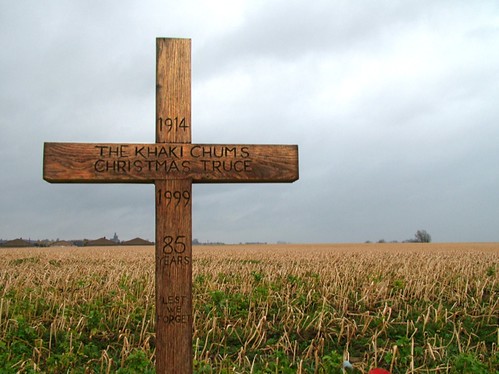
1999 - Christmas Truce Cross, Ploegstreert Wood, Ypres (Belgium). The text reads, "1914 The Khaki Chum's Christmas Truce." In 1999, the Christmas Truce of 1914 was commemorated by a small group of re-enactors who, after spending a few nights in makeshift trenches in the area near Ploegstreert Wood, left behind a wooden cross. That cross has since been fortified with a cement base by some of the local people and now stands as the only monument to the Christmas Truce of 1914. This is a sad commentary on how governments build many monuments supposedly to honor military veterans, but somehow seem to do so in ways that glorify war."

E
V
E
N
T
May 2003 - 4th International Conference of the International Network of Museums for Peace (INMP) at the IJzertoren Museum of War, Peace & Flemish Emancipation, Diksmuide, Flanders (Belgium). Theme: ""From memories of war to education for peace." "IJzertoren" = "Yser tower" is named after the Yser River which formed the frontline during most of World War I. Image is the brochure for the 4th conference. Click here for paper by Terence Duffy, University of Ulster, Magee College.
S C U L P T U R E
December 9, 2003 - Statue of Europe "Unity in Peace," Centre Erasmus, Jardin Van Maerlant. Brussels (Belgium). "Dedicated to Europe and offered to the European Commission by the French sculptor Bernard Romain. At the occasion of the year 2003 which was devoted to disabled people. Manufactured, modelled, polished and painted by children with challenged vision of different cultures under the supervision of Bernard Romain."

F
L
A
M
E
May 9, 2004 - World Peace Flame #5, Cadzand, Zeeland, (Netherlands).

F
L
A
M
E
June 5, 2005 - World Peace Flame #6, Juliana Park, Venlo, Limburg (Netherlands).

M
U
S
E
U
M
March 2005 - Huis van Erasmus / House of Erasmus, St. Huis van Erasmus, Bergweg 279-B, Rotterdam (Netherlands). "Fulfils a platform function for the fostering of a culture of peace and active non-violence, carrying the motto ‘Peace in the world, safety in the city.' An initiative of Humanistisch Vredesberaad and Pais. The Foundation is a member of Rotterdam Vredesstad, the Platform Vredescultuur and the Humanistische Alliantie, and is a partner of People Building Peace Nederland."
K
I
O
S
K
July 7, 2006 - First Mayors for Peace Peace Pillar , Ypres (Belgium). Marked the opening of the international 2020 Vision campaign secretariat in the Ypres City Hall. Inaugurated by the mayors of Hiroshima and Ypres.
Date? - Sentinels of Venlo, River Maas / Meuse, Venlo, Limburg (Netherlands). "The bridge that connects Venlo and Blerick is guarded by four colossal statues by Shinkichi Tajiri." "Include bases nine meters high, warn against continued aggression, violence and war. They act as symbolic guardians of the Second World War on both sides of the heavily devastated city."
August 17, 2008 - Youth Library, Chateau Park, Zonnebeke, Flanders (Belgium). The words on the side of the library are the poessay "Tyne Cot" by artist Jan Theuninck. A "poessay" is a combination of the poem and essay forms. The title refers to Tyne Cot Cemetery, the largest cemetery for Commonwealth forces on the continent. English translation: " Tyne Cot. When you left for the front you were living heroes and now you are on top of the hill where only poppies blow.........."

Future - Mahrishi Tower of Invincibility, Meru (Netherlands). "The founder of the Global Country of World Peace, His Holiness Maharishi Mahesh Yogi [1918-2008], who has touched the lives of millions of people around the world, and who is loved and acclaimed from ever quarter of society, has achieved the fulfilment of his teaching. After working tirelessly for over fifty years to fulfil his universal mission to bring enlightenment, peace, and invincibility to the whole family of man, he announced in January 2008 that his work is complete and fulfilled. On the fiftieth anniversary of Maharishi’s inauguration of the Spiritual Regeneration Movement, the Rajas of the Global Country of World Peace wanted to offer a gift to commorate Maharishi’s world wide achievements, a gift of appreciation for all that he has done for each individual and all nations, by building the first Maharishi Tower of Invincibility in Meru, The Netherlands, which will become a place of world pilgrimage."

Please email your comments & questions to geovisual at comcast.net. Thank you.

Return to Peace Monuments main page.