
|
|
| 23 Peace Monuments Related to All Genocides |
Click here for chart rank ordering the holocaust & other human tragedies. |
Click here for Wikipedia's article on genocide.
Click here for Wikipedia's list of holocaust memorials & museums. |
Chick here for another on-line list of holocaust memorials. | Click here for Wikipedia list of Holocaust films.
Click here for "The Secular Word "HOLOCAUST:"
Scholarly Sacralization, Twentieth Century Meanings" by Jon Petrie (jon_petrie@yahoo.com). This is a long essay on the evolution of the words "holocaust," "Holocaust," and "shoah."
 = Historic site.
 = Associated with International Network of Museums for Peace (INMP), The Hague (Netherlands). Created in 1992.
 = Associated with International Coalition of Sites of Conscience (ICSC), New York City (USA). Created in 1999. Received ICOM-US Award in 2010.
 = Associated with Federation of International Human Rights Museums (FIHRM), Liverpool (England). Created in 2010.
Right click image to enlarge.
O RD |  1944 - "Raphael Lemkin [1990-1959], a lawyer and a Polish Jew, coined the word genocide in 1944. It is a combination of a Greek word genos (meaning 'race,' 'group,' or 'tribe') and a Latin ending ...cide (meaning 'killing')." (per Holocaust: An end to innocence" by Seymour Rossel.) 1944 - "Raphael Lemkin [1990-1959], a lawyer and a Polish Jew, coined the word genocide in 1944. It is a combination of a Greek word genos (meaning 'race,' 'group,' or 'tribe') and a Latin ending ...cide (meaning 'killing')." (per Holocaust: An end to innocence" by Seymour Rossel.)
|

|   April 1968 - Armenian Genocide Martyrs Monument, Montebello, California (USA). "In Los Angeles metropolitan area. Better known as Montebello Genocide Memorial. Dedicated to the victims of the Armenian Genocide of 1915. A tower of eight arches supported on 75-foot-tall (23 m) white concrete columns. Designed by Hrant Agbabian. The oldest & largest memorial in the USA dedicated to the Armenian Genocide victims." April 1968 - Armenian Genocide Martyrs Monument, Montebello, California (USA). "In Los Angeles metropolitan area. Better known as Montebello Genocide Memorial. Dedicated to the victims of the Armenian Genocide of 1915. A tower of eight arches supported on 75-foot-tall (23 m) white concrete columns. Designed by Hrant Agbabian. The oldest & largest memorial in the USA dedicated to the Armenian Genocide victims."
|


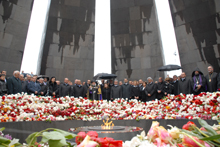
| M E M O R I A L 1968 - Tsitsernakapert Erevan / Tsitsernakaberd Armenian Genocide Memorial, Yerevan (Armenia). "44 meter stele symbolizing the national rebirth of Armenians. 12 slabs are positioned in a circle, representing the 12 lost provinces in present day Turkey. In the center of the circle, at a depth of 1.5 meters, there is an eternal flame." "Sits on the site of a Iron Age fortress, all above-ground trace of which seems to have disappeared." Ceremony marking 95th anniversry of the genocide took place here on April 23, 2010 (right image)." 1968 - Tsitsernakapert Erevan / Tsitsernakaberd Armenian Genocide Memorial, Yerevan (Armenia). "44 meter stele symbolizing the national rebirth of Armenians. 12 slabs are positioned in a circle, representing the 12 lost provinces in present day Turkey. In the center of the circle, at a depth of 1.5 meters, there is an eternal flame." "Sits on the site of a Iron Age fortress, all above-ground trace of which seems to have disappeared." Ceremony marking 95th anniversry of the genocide took place here on April 23, 2010 (right image)."
|

| U S E U M |
 1980 - Tuol Sleng Genocide Museum, Phnom Penh (Cambodia). "Site is a former high school which was used as the notorious Security Prison 21 (S-21) by the Khmer Rouge communist regime from its rise to power in 1975 to its fall in 1979. Tuol Sleng means 'Hill of the Poisonous Trees' or'Strychnine Hill.'" See Video & Website. 1980 - Tuol Sleng Genocide Museum, Phnom Penh (Cambodia). "Site is a former high school which was used as the notorious Security Prison 21 (S-21) by the Khmer Rouge communist regime from its rise to power in 1975 to its fall in 1979. Tuol Sleng means 'Hill of the Poisonous Trees' or'Strychnine Hill.'" See Video & Website.
| 
 
| E M O R I A L | Date? - Killing Fields Memorial, Choeung Ek, near Phnom Penh (Cambodia). About 17,000 people were killed at Choeung Ek (a former orchard) during the Cambodian genocide (1975-1979). The memorial pagoda contains more thatn 8,000 skulls. "Apart from the stupa, the visitor can see the pits from which the bodies of the 8,000 victims were exhumed. Human bones still litter the site (lower image). There is also a souvenir shop which strikes some visitors as being in poor taste."
|
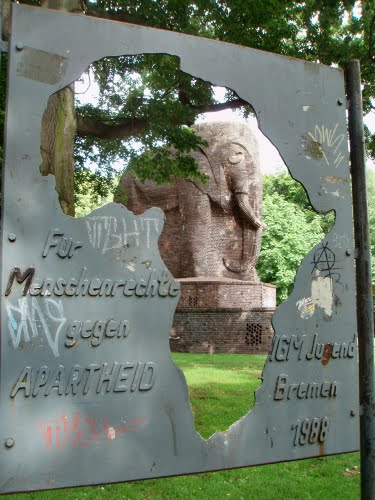 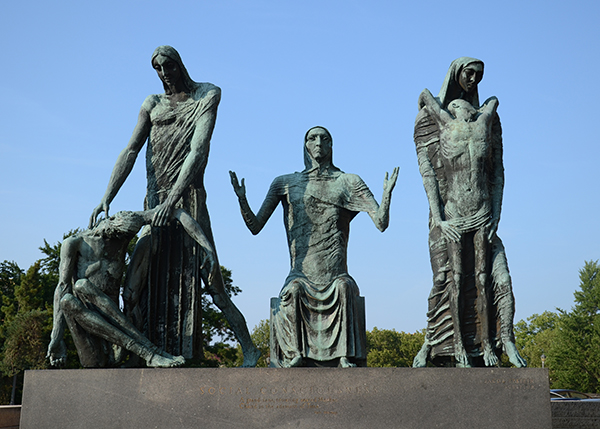
|  1988-1990-2009 - Reichs[anti]kolonialehrendenkmal, Bremen (Germany). "This ten-meter high structure was completed in 1931 as a monument to the German colonies which then included Cameroon, Togo, Deutsch-Ostafrika [Tanzania], Deutsch-Südwestafrika [Namibia] & several islands. For decades the Reichskolonialehrendenkmal / ______ stood as a powerful symbol of German colonial ambition. The allied forces chiseled off the inscriptions on the outside, but the plaques on the inside of “der elefant” remained, including a list of 1,400 colonial soldiers & officials who died defending the German empire. In 1988, a metal sign was created next to the elephant by the youth wing of the Bremen metal workers union in support of the Anti-Apartheid movement. In 1990, with the celebration of Namibian independence from South Africa, the elephant itself was re-dedicated as the “Bremen anti colonial monument” thereby attempting to invert its historical meaning yet retaining the original design. And in 2009 a new monument was created next to the elephant to the victims of German genocide. /// This is "Monday's Monument" #69. 1988-1990-2009 - Reichs[anti]kolonialehrendenkmal, Bremen (Germany). "This ten-meter high structure was completed in 1931 as a monument to the German colonies which then included Cameroon, Togo, Deutsch-Ostafrika [Tanzania], Deutsch-Südwestafrika [Namibia] & several islands. For decades the Reichskolonialehrendenkmal / ______ stood as a powerful symbol of German colonial ambition. The allied forces chiseled off the inscriptions on the outside, but the plaques on the inside of “der elefant” remained, including a list of 1,400 colonial soldiers & officials who died defending the German empire. In 1988, a metal sign was created next to the elephant by the youth wing of the Bremen metal workers union in support of the Anti-Apartheid movement. In 1990, with the celebration of Namibian independence from South Africa, the elephant itself was re-dedicated as the “Bremen anti colonial monument” thereby attempting to invert its historical meaning yet retaining the original design. And in 2009 a new monument was created next to the elephant to the victims of German genocide. /// This is "Monday's Monument" #69.
|

| U S E U M |  1988-2008 - America’s Black Holocaust Museum (ABHM), Milwaukee, Wisconsin (USA). "Existed to educate the public of injustices suffered by people of African American heritage, while providing visitors with an opportunity to rethink their assumptions about race and racism... The only memorial dedicated specifically to the victims of the enslavement of Africans in the United States. It was founded by James Cameron [1914-2006], America's last living survivor of a lynching. In 2008, the museum's board of directors announced that the museum would be closed temporarily because of financial problems. It has not re-opened since." 1988-2008 - America’s Black Holocaust Museum (ABHM), Milwaukee, Wisconsin (USA). "Existed to educate the public of injustices suffered by people of African American heritage, while providing visitors with an opportunity to rethink their assumptions about race and racism... The only memorial dedicated specifically to the victims of the enslavement of Africans in the United States. It was founded by James Cameron [1914-2006], America's last living survivor of a lynching. In 2008, the museum's board of directors announced that the museum would be closed temporarily because of financial problems. It has not re-opened since."
|

| 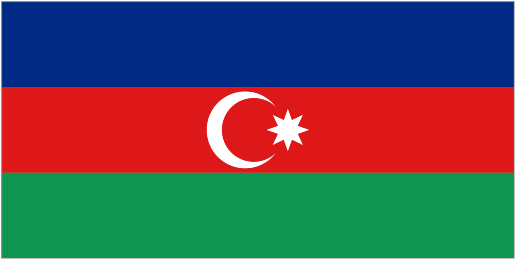 After 1992 - Genocide Memorial, Lenkoran (Azerbaijan).
Dedicated to the victims of the Khojali Massacre. After 1992 - Genocide Memorial, Lenkoran (Azerbaijan).
Dedicated to the victims of the Khojali Massacre.
| 
| Date? - Genocide Monument, Quba City (Azerbaijan). Click here for information about the Azerbaijan genocide.
|

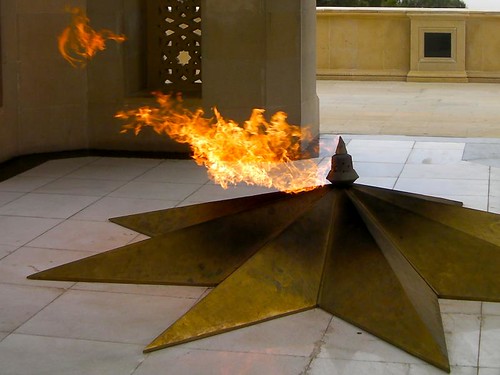
| Date? - Azerbaijani Genocide Memorial, Baku (Azerbaijan).
| 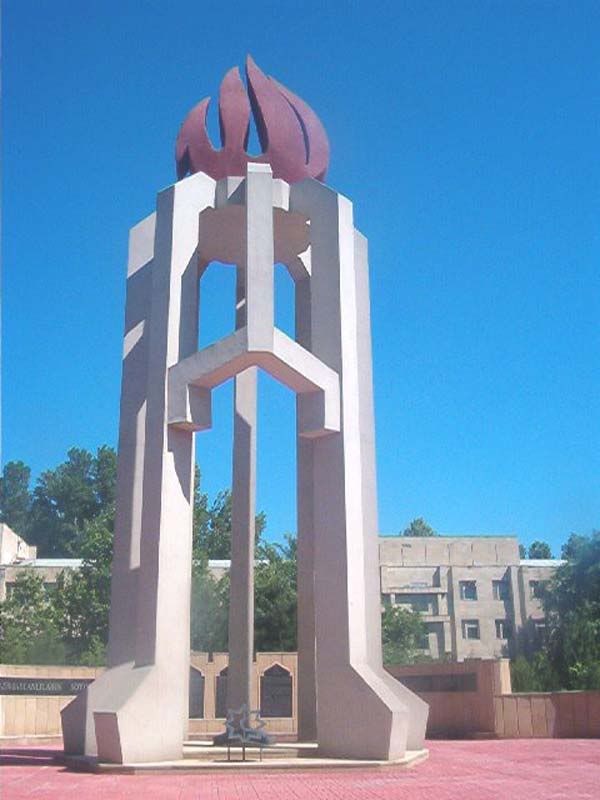
| Date? - Genocide Monument, city? (Azerbaijan).
| 
| Date? - Monument in memory of genocide victims, Nakhchivan City (Azerbaijan).
|
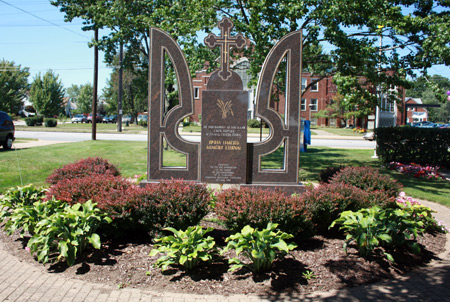
| M E M O R I A L  1993 - Holodomor Ukrainian Famine Memorial,
St. Vladimirs Ukrainian Orthodox Cathedral, Parma, Cleveland, Ohio (USA). English inscription: "1932-1933
In memory of the over 7 million victims
of the man-made famine in Ukraine." "There are many memorials to the Ukrainian Famine [Holodomor]." 1993 - Holodomor Ukrainian Famine Memorial,
St. Vladimirs Ukrainian Orthodox Cathedral, Parma, Cleveland, Ohio (USA). English inscription: "1932-1933
In memory of the over 7 million victims
of the man-made famine in Ukraine." "There are many memorials to the Ukrainian Famine [Holodomor]." 
| 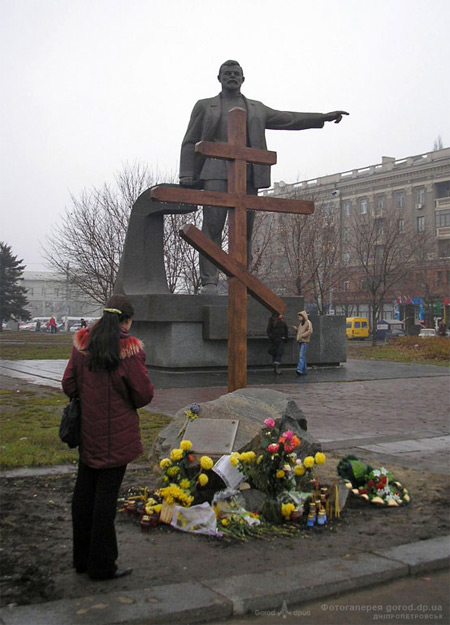
| M E M O R I A L Date? - Famine Memorial cross, Dnipropetrovsk (Ukraine).
|
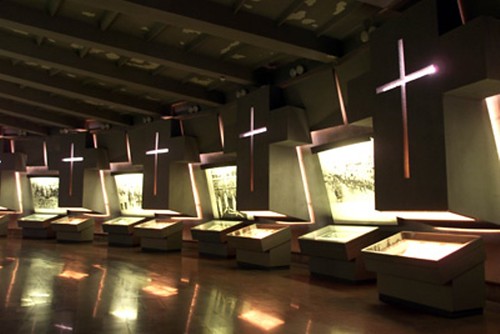
| M U S E U M + M E M O R I A L 1995 -
Armenian Genocide Museum & Institute (AGMI), Tsitsernakaberd ("Swallow Castle"), Yerevan, Central Armenia (Armenia). "Testimony to the 1915 destruction." See Video & Website. "Adjacent to Genocide Memorial -- twelve shields of grey basalt, leaning inwards toward a flame set in a sunken bowl."
|

| U R A L |  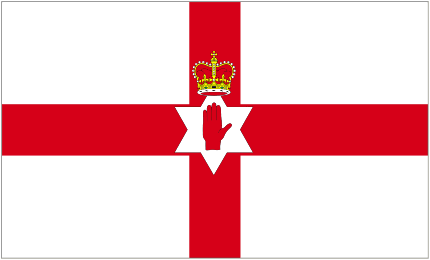 1999 - Ireland's Holocaust Mural, Whiterock Road, Ballymurphy, West Belfast (Northern Ireland). Mural says, "An Gorta Mór, Britain's genocide by starvation, Ireland's holocaust 1845–1849." "Reminds the Nationalist/Republican community of what has been seared into the Irish collective memory as the holocaust that cost millions of lives because of British indifference or cold calculation." "Britain's cover-up of its 1845-1850 holocaust in Ireland [is] the most successful Big Lie in all of history... As no Jewish person would ever refer to the 'Jewish Oxygen Famine of 1939-1945,' so no Irish person ought ever refer to the Irish Holocaust as a famine." 1999 - Ireland's Holocaust Mural, Whiterock Road, Ballymurphy, West Belfast (Northern Ireland). Mural says, "An Gorta Mór, Britain's genocide by starvation, Ireland's holocaust 1845–1849." "Reminds the Nationalist/Republican community of what has been seared into the Irish collective memory as the holocaust that cost millions of lives because of British indifference or cold calculation." "Britain's cover-up of its 1845-1850 holocaust in Ireland [is] the most successful Big Lie in all of history... As no Jewish person would ever refer to the 'Jewish Oxygen Famine of 1939-1945,' so no Irish person ought ever refer to the Irish Holocaust as a famine." 
|

| U S E U M |  2003? - Cambodian Cultural Museum & Killing Fields Memorial, 9809-16th Avenue SW, White Center, Seattle, Washington (USA). "Patterned after the Holocaust museums that commemorate the murder of 6 million Jews by the Nazis." "Founded by Dara Duong, a survivor from the 1975-1979 Killing Fields of Cambodia. There were five family members including his father that were killed by the Khmer Rouge (Pol Pot) regime when he was 5 years old. He resettled in the US in 1999 [and] wanted to share the story of his life under the Khmer Rouge with the world, so it would not happen again. At the same time Dara wanted the children of Cambodian immigrants, who have grown up in the US, not to forget about Cambodia’s recent history, great culture, traditions and literature.
It's started from the garage in SeaTac. The museum moved to White Center in May 14, 2004." Connected to the Wing Luke Asian Museum (qv). One of 27 US museums in "Museums for Peace Worldwide" edited by Kazuyo Yamane (2008). 2003? - Cambodian Cultural Museum & Killing Fields Memorial, 9809-16th Avenue SW, White Center, Seattle, Washington (USA). "Patterned after the Holocaust museums that commemorate the murder of 6 million Jews by the Nazis." "Founded by Dara Duong, a survivor from the 1975-1979 Killing Fields of Cambodia. There were five family members including his father that were killed by the Khmer Rouge (Pol Pot) regime when he was 5 years old. He resettled in the US in 1999 [and] wanted to share the story of his life under the Khmer Rouge with the world, so it would not happen again. At the same time Dara wanted the children of Cambodian immigrants, who have grown up in the US, not to forget about Cambodia’s recent history, great culture, traditions and literature.
It's started from the garage in SeaTac. The museum moved to White Center in May 14, 2004." Connected to the Wing Luke Asian Museum (qv). One of 27 US museums in "Museums for Peace Worldwide" edited by Kazuyo Yamane (2008).
|


| U S E U M |
 September 2003 - Halabja Martyrs Monument & Museum, Halabja (Iraq). A 100-foot-tall modern structure with a museum inside. Honors the thousands of [Kurds] killed in 1988 when Saddam Hussein's army infamously attacked the town with chemical weapons. Opened just six months after the US invasion of Iraq. Secretary of State Colin Powell & other US dignitaries attended opening ceremony and were received by cheering crowds in the streets. Demonstrators set the monument on fire March 16, 2006, in protest against lack of government assistance. See Video & Website. Affiliated with International Network of Museums for Peace (INMP). September 2003 - Halabja Martyrs Monument & Museum, Halabja (Iraq). A 100-foot-tall modern structure with a museum inside. Honors the thousands of [Kurds] killed in 1988 when Saddam Hussein's army infamously attacked the town with chemical weapons. Opened just six months after the US invasion of Iraq. Secretary of State Colin Powell & other US dignitaries attended opening ceremony and were received by cheering crowds in the streets. Demonstrators set the monument on fire March 16, 2006, in protest against lack of government assistance. See Video & Website. Affiliated with International Network of Museums for Peace (INMP).
|

|  September 20, 2003 - Srebrenica Genocide Memorial, Potocari, Srebrenica
(Bosnia & Herzegovina). "Officially known as the Srebrenica-Potocari Memorial & Cemetery for the Victims of the 1995 Genocide, is the memorial-cemetery complex in Srebrenica set up to honour the victims of the 1995 Srebrenica genocide. The victims were Bosnian Muslims & Croats.
As of July 2012, 6,838 genocide victims have been identified through DNA analysis of body parts recovered from mass graves & 5,657 victims have been buried.
The $5.8 million memorial-cemetery complex paid for with donations from private groups and governments. The United States provided $1 million toward the project. The memorial was opened by the former US President, Bill Clinton." September 20, 2003 - Srebrenica Genocide Memorial, Potocari, Srebrenica
(Bosnia & Herzegovina). "Officially known as the Srebrenica-Potocari Memorial & Cemetery for the Victims of the 1995 Genocide, is the memorial-cemetery complex in Srebrenica set up to honour the victims of the 1995 Srebrenica genocide. The victims were Bosnian Muslims & Croats.
As of July 2012, 6,838 genocide victims have been identified through DNA analysis of body parts recovered from mass graves & 5,657 victims have been buried.
The $5.8 million memorial-cemetery complex paid for with donations from private groups and governments. The United States provided $1 million toward the project. The memorial was opened by the former US President, Bill Clinton."
|

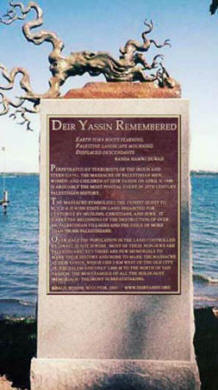
| R E E |  September 24, 2003 - "Deir Yassin Remembered," Seneca Lake (western shore), New York, New York (USA). Bronze sculpture of an uprooted olive tree by [political cartoonist] Khalil Bendib. Inscription: "Earth torn roots yearning, Palestine landscape mourning displaced descendants. Randa Hamwi Duwaji. Perpetrated by terrorists of the Irgun and Stern Gang, the massacre of Palestinian men, women, and children at Deir Yassin on April 9, 1948 is arguably the most pivotal event in 20th century Palestinian history. // The massacre symbolizes the Zionist quest to build a Jewish state on land inhabited for centuries by Muslims, Christians, and Jews. It marks the begining of the descruction of over 400 Palestinian villages and the exile of more than 700,000 Palestinians. // Over half the population in the land controlled by Israel is not Jewish. Most of these non-Jews are Palestinians. Yet there are few memorails to mark their history and none to mark the massacre at Deir Yassin, which lies 3 km west of the Old City of Jerusalem and only 1,400 m to the north of Yad Vashem, the most famous of all the Holocaust memorials. The irony is breathtaking. // Khalil Bendib, Sculptor, 2003. www.deiryassin.org" September 24, 2003 - "Deir Yassin Remembered," Seneca Lake (western shore), New York, New York (USA). Bronze sculpture of an uprooted olive tree by [political cartoonist] Khalil Bendib. Inscription: "Earth torn roots yearning, Palestine landscape mourning displaced descendants. Randa Hamwi Duwaji. Perpetrated by terrorists of the Irgun and Stern Gang, the massacre of Palestinian men, women, and children at Deir Yassin on April 9, 1948 is arguably the most pivotal event in 20th century Palestinian history. // The massacre symbolizes the Zionist quest to build a Jewish state on land inhabited for centuries by Muslims, Christians, and Jews. It marks the begining of the descruction of over 400 Palestinian villages and the exile of more than 700,000 Palestinians. // Over half the population in the land controlled by Israel is not Jewish. Most of these non-Jews are Palestinians. Yet there are few memorails to mark their history and none to mark the massacre at Deir Yassin, which lies 3 km west of the Old City of Jerusalem and only 1,400 m to the north of Yad Vashem, the most famous of all the Holocaust memorials. The irony is breathtaking. // Khalil Bendib, Sculptor, 2003. www.deiryassin.org"
| 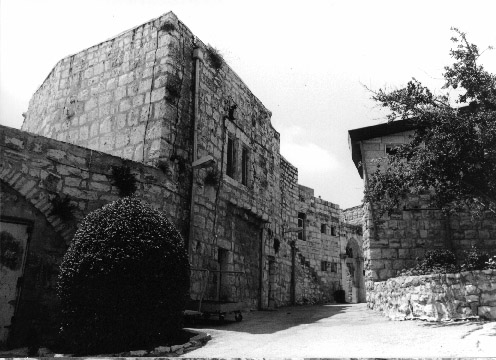
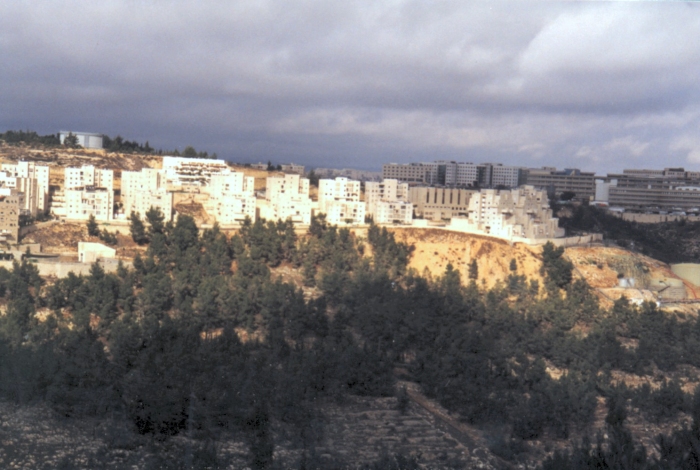
| I L L A G E |  April 9, 1948 - Palestinian Village of Deir Yassin (Israel). Unintentional monument. Scene of the Deir Yassin Massacre. Lower photo is Deir Yassin as seen from Yad Vashem; the village lies in the green trees to the right of the water tower. April 9, 1948 - Palestinian Village of Deir Yassin (Israel). Unintentional monument. Scene of the Deir Yassin Massacre. Lower photo is Deir Yassin as seen from Yad Vashem; the village lies in the green trees to the right of the water tower.
|


| U S E U M |  April 2004 - Kigali Memorial Centre, Kigali (Rwanda). "A reminder of the horrors of genocide in an attempt to stop history from repeating itself. The first floor retraces the events leading up to the 1994 genocide and details the heinous event itself. On the second floor is an area devoted to children who were killed in the genocide. Outside are the graves of over 250,000 people, and more are still being created as remains continue to be found."
See Video & Website. April 2004 - Kigali Memorial Centre, Kigali (Rwanda). "A reminder of the horrors of genocide in an attempt to stop history from repeating itself. The first floor retraces the events leading up to the 1994 genocide and details the heinous event itself. On the second floor is an area devoted to children who were killed in the genocide. Outside are the graves of over 250,000 people, and more are still being created as remains continue to be found."
See Video & Website.
| A P E R | Date? - "Sixteen Years Later: Remembering the Rwandan Genocide in the Kigali Memorial Center" by Amy Sodaro. (See bibliography.)
|


| U S E U M |  November 23, 2008 - National Sikh Heritage Centre & Holocaust Museum, Princes Street, Pear Tree, Derby (England).
"A modern, packed, multi-channel museum with real artefacts that allow the visitor to appreciate the rich and complex heritage of the Sikhs in a story of courage, sacrifice and bloody genocide." "One hopes we will see similar initiatives in the US and Canada as well."
See Video & Website. November 23, 2008 - National Sikh Heritage Centre & Holocaust Museum, Princes Street, Pear Tree, Derby (England).
"A modern, packed, multi-channel museum with real artefacts that allow the visitor to appreciate the rich and complex heritage of the Sikhs in a story of courage, sacrifice and bloody genocide." "One hopes we will see similar initiatives in the US and Canada as well."
See Video & Website. 
|

|  2010 - Peace Monument, Bazdarana, Prizren (Kosovo). "Kosovo Albanian separatists have erected a NATO monument in Serbian city of Prizren thankful to that military organization for facilitating ethnic cleansing of Serbs & destruction of Serbian heritage.
The monument is erected in the Prizren suburb of Bazdarana where a road for Suva Reka begins.
Separatists have paid 54,651 EUROS for the pile of steel & concrete, and it is called Monument of Peace (kudos to Pavle Dejanovic from Belgrade for the info).
Given the name of this monument, it stands to reason that any organized & premeditated murdering of Serbs or facilitation thereof is described as 'peace' by the perpetrators.
Guess we are still waiting for the Monument of War to commemorate all the Serbs murdered by Albanian separatists & NATO." 2010 - Peace Monument, Bazdarana, Prizren (Kosovo). "Kosovo Albanian separatists have erected a NATO monument in Serbian city of Prizren thankful to that military organization for facilitating ethnic cleansing of Serbs & destruction of Serbian heritage.
The monument is erected in the Prizren suburb of Bazdarana where a road for Suva Reka begins.
Separatists have paid 54,651 EUROS for the pile of steel & concrete, and it is called Monument of Peace (kudos to Pavle Dejanovic from Belgrade for the info).
Given the name of this monument, it stands to reason that any organized & premeditated murdering of Serbs or facilitation thereof is described as 'peace' by the perpetrators.
Guess we are still waiting for the Monument of War to commemorate all the Serbs murdered by Albanian separatists & NATO."
|
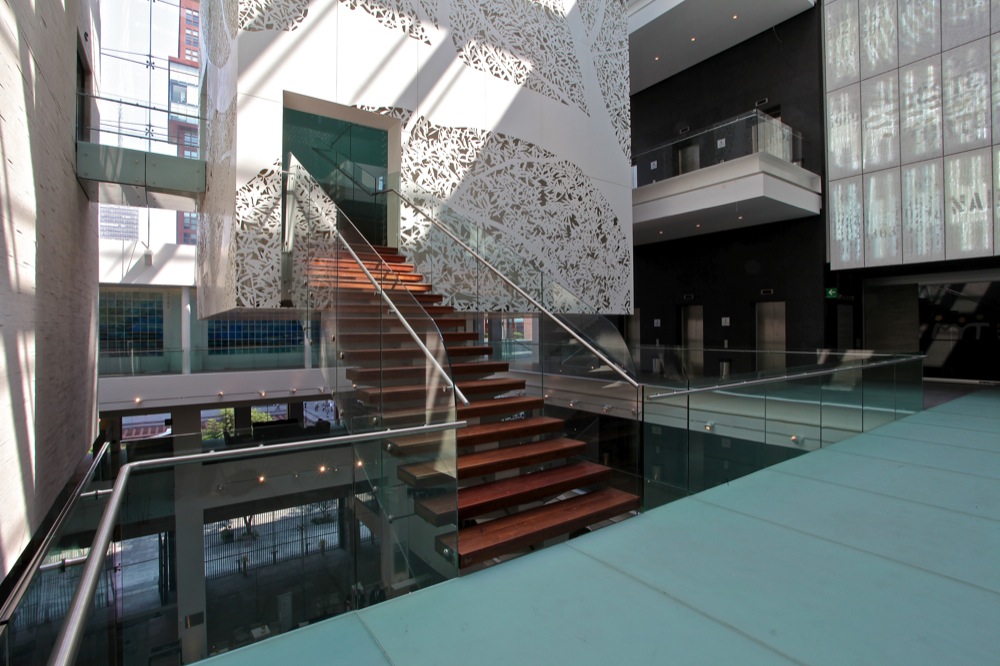
 | U S E U M |  October 2010 - Museo Memoria y Tolerancia / Museum of Memory & Tolerance, Plaza Juarez, Centro Historico | Frente al Hemiciclo a Juárez de la Alameda central, Mexico City (Mexico). "Dedicated to two topics. The first 'Memory' part tells horrible story of Nazi Hollocaust. This is followed by stories of genocides in Rwanda, Bosnia, Armenia & others. The second section on 'Tolearance' makes you think about current issues and encourages more tolerance." October 2010 - Museo Memoria y Tolerancia / Museum of Memory & Tolerance, Plaza Juarez, Centro Historico | Frente al Hemiciclo a Juárez de la Alameda central, Mexico City (Mexico). "Dedicated to two topics. The first 'Memory' part tells horrible story of Nazi Hollocaust. This is followed by stories of genocides in Rwanda, Bosnia, Armenia & others. The second section on 'Tolearance' makes you think about current issues and encourages more tolerance."
|
 | April 23, 2015 - Armenian Genocide Monument, south of the Satellite Student Union, Fresno State University, Fresno, California (USA). "Designed by Fresno architect Paul Halajian. Embodies symbols of cultural meaning to the Armenian people. Its principal components, a series of pillars, are arranged in a circular pattern & angled inwards, reminiscent of Tzitzernagapert / Armenian Martyrs Monument in Yerevan (Armenia). Built from béton brut and Tufa stones, the nine pillars represent the six provinces of historic Western Armenia—Van, Bitlis, Dikranagerd, Kharpert, Sepastia, and Erzerum—Cilicia, the Diaspora, and the Republic of Armenia. They gradually descend in height around the circle, with the first measuring 19 feet high and the last 15 feet to underscore the significance of the year 1915. An incomplete halo will be set above on top of the pillars, symbolizing both the fracture left by the Genocide & the unity of the Armenian people. /// The unveiling ceremony is organized by the Armenian Genocide Centennial—Fresno Committee, an association of local organizations that is promoting a series of centennial events in the Central Valley."
|
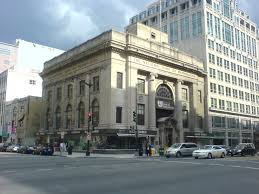
| U S E U M |  "Before 2011" - Armenian Genocide Museum of America (AGMA), 615-14th Street, NW, Washington, DC (USA). "Will be the premier institution in the USA dedicated to educating American and international audiences about the Armenian Genocide and its continuing consequences. Visitors will come to understand the Armenian Genocide as the prototype for modern crimes against humanity, including the Holocaust, Cambodia, Rwanda, and Darfur." See Video & Website. "Before 2011" - Armenian Genocide Museum of America (AGMA), 615-14th Street, NW, Washington, DC (USA). "Will be the premier institution in the USA dedicated to educating American and international audiences about the Armenian Genocide and its continuing consequences. Visitors will come to understand the Armenian Genocide as the prototype for modern crimes against humanity, including the Holocaust, Cambodia, Rwanda, and Darfur." See Video & Website.
|

 | E M O R I A L | US E U M |
 2018? - Memorial to Peace and Justice, Montgomery, Alabama (USA). A national memorial to victims of lynching & a museum that explores African American history "from enslavement to mass incarceration"
will be situated within 150 yards of one of the South's most prominent slave auction sites & the Alabama River dock & rail station where tens of thousands of enslaved black people were trafficked. To be built & operated by The Equal Justice Initiative (EJI) (headed by Bryan Stevenson). Will contain high-tech exhibits, artifacts, recordings & films, as well as comprehensive data & information on lynching & racial segregation [&] will connect the history of racial inequality with contemporary issues of mass incarceration, excessive punishment & police violence." /// Right image shows sites of 4,075 racial terror lynchings of African Americans in 12 southern states between 1877 & 1950. 2018? - Memorial to Peace and Justice, Montgomery, Alabama (USA). A national memorial to victims of lynching & a museum that explores African American history "from enslavement to mass incarceration"
will be situated within 150 yards of one of the South's most prominent slave auction sites & the Alabama River dock & rail station where tens of thousands of enslaved black people were trafficked. To be built & operated by The Equal Justice Initiative (EJI) (headed by Bryan Stevenson). Will contain high-tech exhibits, artifacts, recordings & films, as well as comprehensive data & information on lynching & racial segregation [&] will connect the history of racial inequality with contemporary issues of mass incarceration, excessive punishment & police violence." /// Right image shows sites of 4,075 racial terror lynchings of African Americans in 12 southern states between 1877 & 1950.

|