82 Peace Monuments
Related to World War II
Also click to see the following web pages:
Monuments in Germany related to desertion during World War II.
Monuments in Hiroshima. Hiroshima monuments not in Hiroshima.
Monuments in Nagasaki, Nagasaki monuments not in Nagasaki.
Monuments in Okinawa. Monuments on Pacific Islands.
Holocaust monuments. United Nations.Right click image to enlarge.


M
U
SE
U
M&
B
O
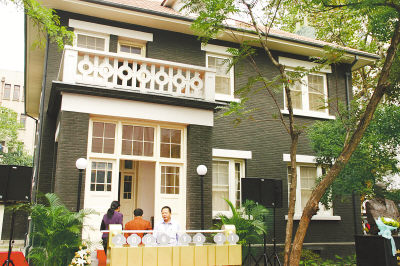
AT1925 - Anti-Kriegs-Museum (AKM) / Anti-War Museum on Parochialstrasse, Berlin. Opened by anarchist & pacifist Ernst Friedrich [1894-1967], whose 1924 picture book "Krieg dem Kriege! / War against War!" documented the horrors of WW-I (upper left image). Friedrich also owned the pleasure boat "Pax Vobiscum" on the River Spree. In March 1933, Nazi storm troopers (SA) destroyed the AKM and seized the "Pax Vobiscum." Friedrich was arrested, then emigrated to Belgium & France. In 1982 (15 years after the death of its founder), AKM was reopened by his grandson Tommy Spree (sic); its current address is Brusseler Strasse 21, Berlin. Lower image of "Pax Vobiscum" courtesy of Peter Nias who photographed it from Friedrich's 1935 book, "Von Friedens - Museum zum Hitler - Kaserne / From Peace Museum to Hitler Barracks" (upper right image)


B
A
NN
E
R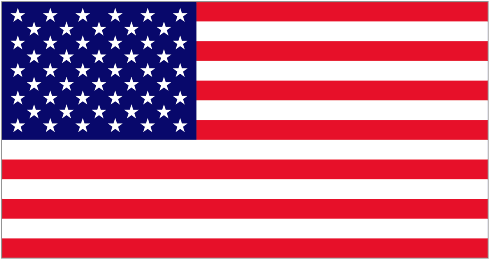
April 15, 1935 - Banner of Peace, Washington, DC (USA). The Roerich Pact was proposed by Russian artist and humanitarian Nicholas Roerich [1874-1947] in response to the destruction of World War I and the Russian Revolution. It was signed by 21 nations of the Americas in the White House, in the presence of President Franklin Delano Roosevelt (and later by other countries) The pact calls for an internationally recognized Banner of Peace to protect monuments of cultural and historic imporance.

P
A
LA
C
E1936 - Palais des Nations / Palace of Nations, Geneva (Switzerland). Built for the League of Nations. Since the 1950s, it has served as the home of the UN Office at Geneva.
T
R
EEApril 26, 1937 - Gernikako Arbola / Oak of Guernica, Guernika-Lumo (Spain). Unintentional monument. Survived the bombing of Guernica on April 26, 1937. Now used as a symbol of the city.
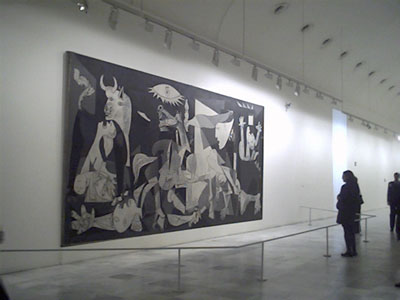
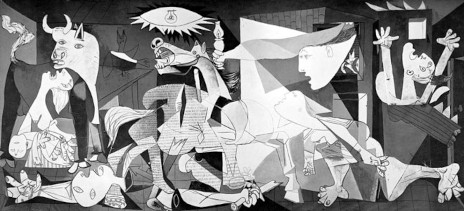
P A I N T I N G

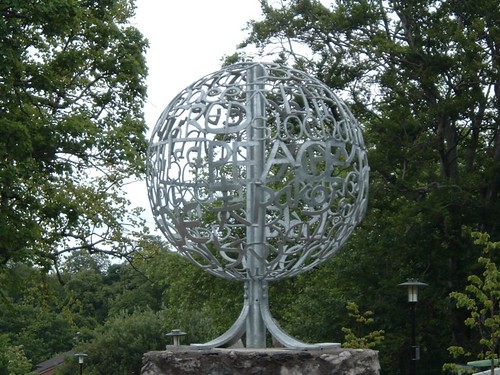
1938 - Peace Cairn, Bellahouston Park, Glasgow, Scotland (UK). "Erected for the 1938 Empire Exhibition. Has numerous shaped blocks of stone within it, on which are engraved the names of the organisations & clans that attended the exhibition which were deeply concerned with the real possibility of war. The modern steel globe on top was added in July 2004 & features [the word] 'Peace' in different languages. It was designed by Elspeth Bennie, Ironhorse Studios, as part of the 'Grounds for Play' project."

S C U L P T U R E 
N.B. All monuments shown above were conceived before WW-II.
T
O
W
E
R


1940 - Peace Tower, Heiwadai Koen / Park, 6146 Koshigasako, Shimokitakatamachi, Miyazaki-shi, Miyazaki, Kyushu Island (Japan). 37-meter tower. Promotes "the unification of the eight corners of the world under one roof" (hakko ichiu) and celebrates the 2,600th anniversary of the mythological foundation of Japan. "Purportedly contains artifacts that once belonged to the first emperor. Pedestal made with stones donated by Japanese expatriates from all over the world. Copper door created with coins donated by Japanese children. It may seem ironic that a peace tower was erected at a time when Japan was busy colonizing much of Asia; [but] the intention was to show that the world could live peaceably, albeit with Japan as leader. Figures on the tower depict the guardians of fishery, agriculture, self-defense, and commerce." Ten Yen note shows Imperial chrysanthemum (no longer used on currency after WW-II).

1944 - Lidice Memorial, Phillips, Wisconsin (USA). "A tribute to the village of Lidice (Czechoslovakia). In 1942, the village was destroyed & nearly all of its citizens were killed by the Ordnungspolizei of Nazi Germany in response to Operation Anthropoid, the assassination of Reinhard Heydrich [1904-1942]. Added to the National Register of Historic Places in 2006."

B
A
T
T
L
E
S
H
IPM
U
SE
U
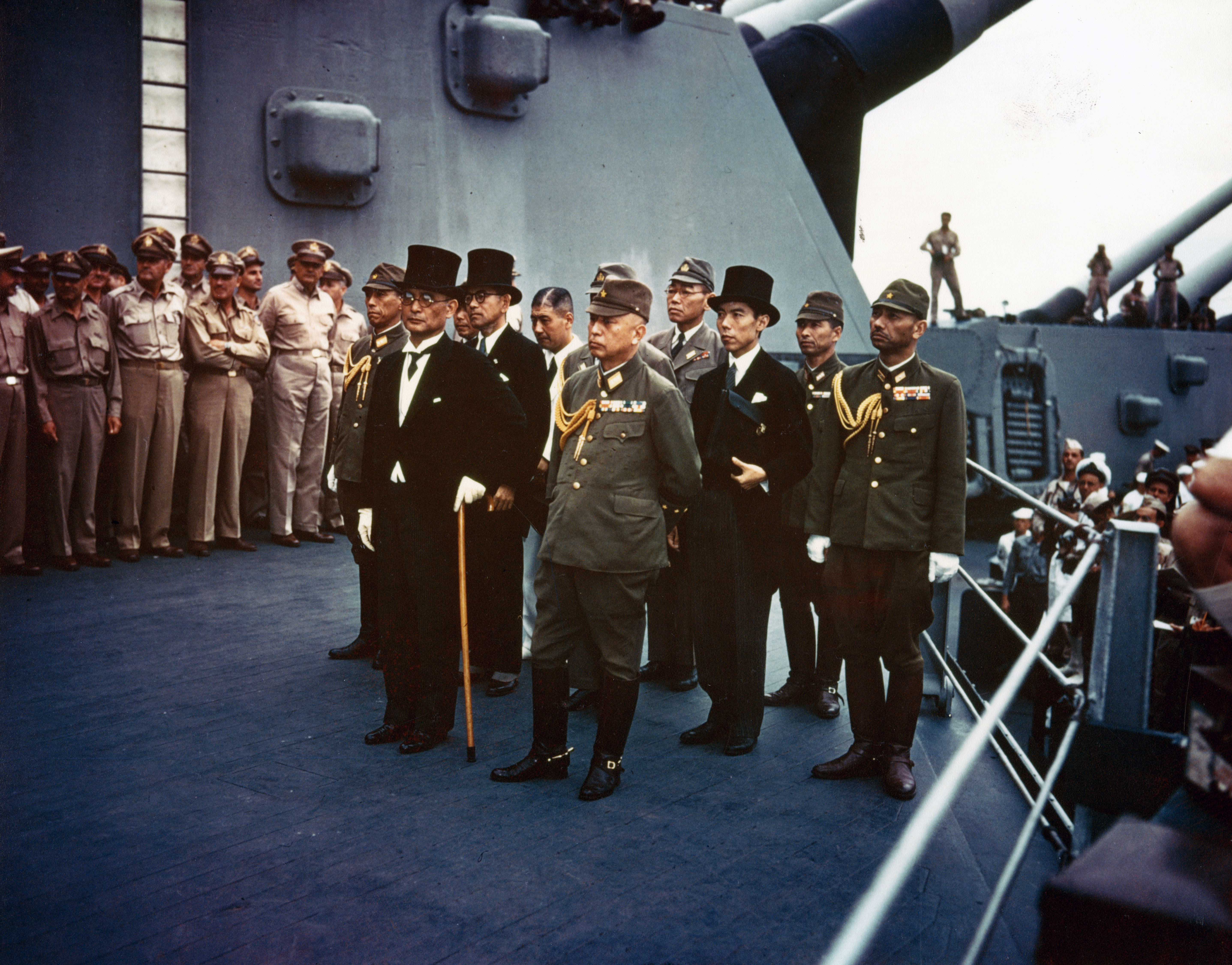
MSeptember 2, 1945 (VJ Day) - USS Missouri, Pearl Harbor, Hololulu, Hawaii (USA). Became an unintentional monument with the signing on its deck in Tokyo Bay of the Japanese Instrument of Surender, thus ending World War II (1939-1945). Ordered in 1940 and commissioned in June 1944, the Missouri (aka "Mighty Mo") was the last battleship built by the USA. It was opened as museum on January 29, 1999. Lower image shows the Japanese delegation on board the Missouri just prior to the signing.


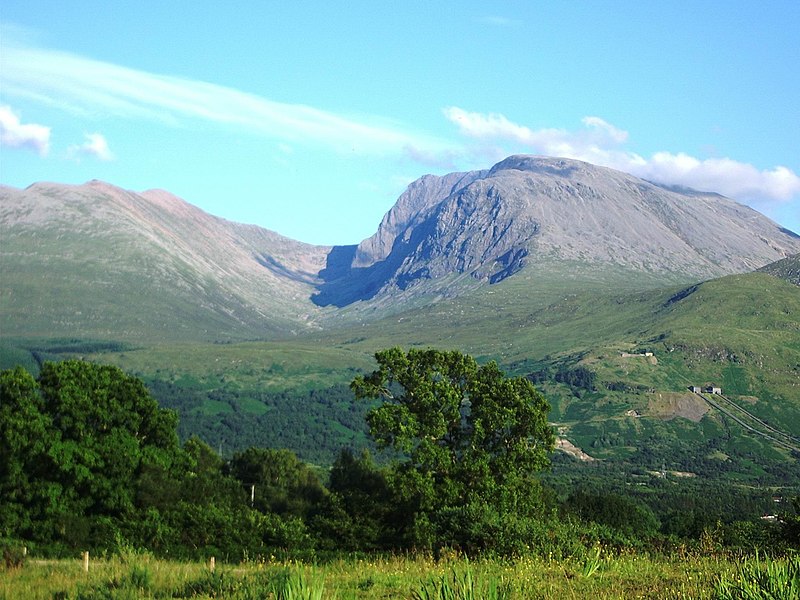
2001 - Monument to Bert Bissell, Coronation Gardens, Priory Road, Dudley, Black Country (England). "Bert Bissell [1902-1998] was holder of the Methodist peace prize, president of Vicar Street Bible class in Dudley & founder of the Peace Cairn on Ben Nevis mountain [on VJ Day, 1945]."
N.B.: All monuments shown below were constructed after WW-II.


S
T
O
N
E

B
O
O
K
S
H
O
P

M
U
S
E
U
M1946 - Dutch National War & Resistance Museum, Liberty Park, Overloon (The Netherlands). "Presents the history of the Second World War -- how it came to be that, in a period of five years, more than fifty million people lost their lives. But also how the oppressed population managed to cope with restrictions and shortages in a resourceful way. Attention is given to the resistance in those days, but also to the persecution. And finally, of course, to the liberation, with special attention to the Battle at Oveloon [Sept. 30-Oct. 18, 1944]."

S
T
A
T
U
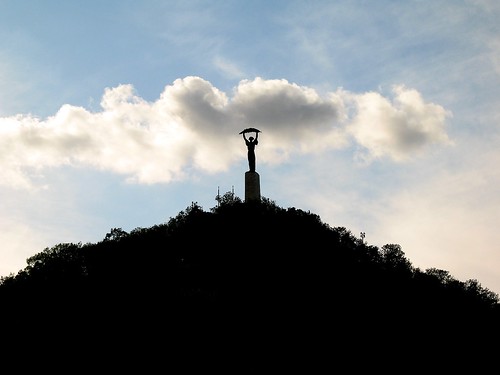
E1947 - Peace Statue, Castle Hill, Budapest (Hungary). Overlooks the city. 14 meter tall bronze statue atop a 26 meter pedestal. Female figure holds a palm branch overhead. Designed by Zsigmond Kisfaludi to commemorate the liberation of Hungary during WW-II by the Soviets and originally called Szabadság-szobor / Liberty Statue. Today a symbol of peace.


B
R
I
D
G
E


P
A
RK1953 - October 21 Memorial Park, Desankin venac, Kragujevac (Serbia). At the site of the Kragujevac Massacre where 2,796 men, women and children were killed on October 21, 1941, by German occupation forces. Includes "Broken Wing" Monument (left image) & Genocide Museum (right image) which opened in 1976, Stanisa Brkic, curator. Click here for Wikipedia article. Info courtesy of Gerard Lössbroek.

H
I
LLC
R
OS
S

W
A
L
L

M
U
S
E
U
M
S
T
A
T
U
E

S
H
RI
N
E
S
T
O
N
E

M
U
S
E
U
M1966 - Norway's Resistance Museum, Akershus Castle, Oslo (Norway). "Housed in an old protected building in Oslo, adjoining the memorial at the spot where Norwegian patriots were executed by the Germans during the second world war... Contribute to the presentation of a true and authentic picture of the occupation by means of objects, pictures, printed matter, etc., collected preserved and exhibited with a view to giving the young people of today and coming generations a true to life impression of the evil represented by occupation and foreign rule."


S
C
U
LP
T
U
R
E

P
A
R
K

M
U
S
E
U
M


P
A
R
KT
O
W
E
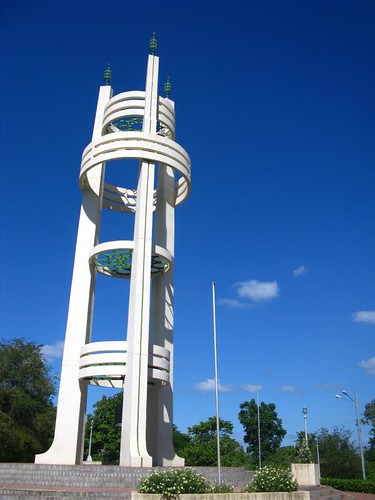
RMay 1970 - South Pacific Memorial Peace Park, Yigo, Northern (US Territory of Guam). "On the site where Japanese General Hideyoshi Obata [1890-1944] constructed his underground command post during the waning days of WW-II. Centerpiece is a 50-foot tall monument that abstractly depicts hands clasped in prayer praying for peace. Beneath this monument lie the remains of Japanese soldiers. Built and is maintained by donations from Japanese citizens and serves as a symbolic gesture of peace."

T
O
WE
RB
E
LLApril 8, 1975 - Friendship Tower, Bagac (Philippines). Built by Rissho Kosei-kai of Japan as a sign of friendship and peace between the Philippines and Japan. Helps mark the places where the Bataan Death March started in 1942 (one in Bagac and the other in Mariveles). Dedication coincided with date on which Rissho Kosei-kai celebrates the birth of the Buddha Shakyamuni, founder of Buddhism.

M
U
SE
U
M
M
U
SE
U
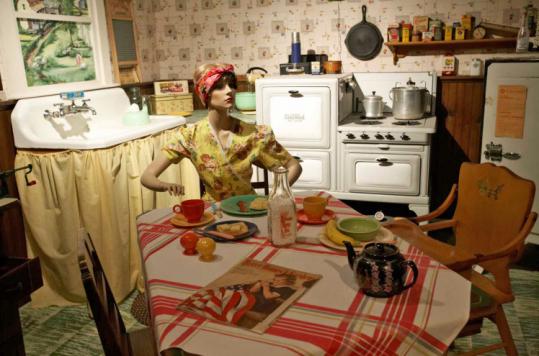
M1977 - E. Stanley Wright Museum of World War II, 77 Center Street, Wolfeboro, New Hampshire (USA) "Preserves and shares the stories of America's Greatest Generation for the benefit of generations to come. As a one-of-a-kind non-profit institution, the Wright Museum collects and displays artifacts that illustrate the Second World War's significant and lasting impact on American life."

S T A T U E 


M
U
SE
U
M

S
T
ON
E

M
U
SE
U
M

M
U
S
E
U
M


B
E
L
L

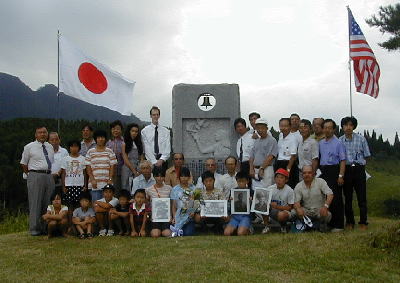
S C U L P T U R E 1987 - Japanese Peace Monument, Attu Island, Aleutian Islands, Alaska (USA). Erected by Japan at site of only battle on US soil during World War II.

M
U
SE
U
M
M
U
SE
U
M

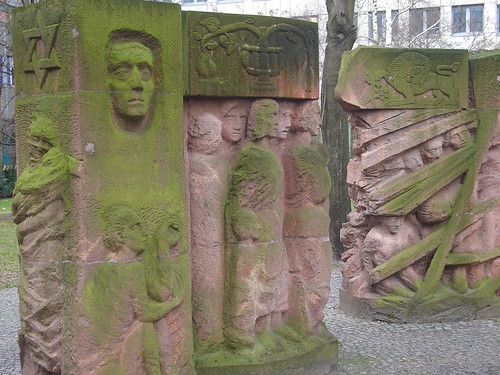
S C U L P T U R E November 24, 1988 - Mahnmal gegen Krieg und Faschismus / Monument Against War and Fascism, Albertinaplatz, Vienna (Austria). This square is the site of a massacre on March 12, 1945, when a bomb killed an unknown number of civilians taking shelter in the basement of a building.


H
O
US
E
M
U
SE
U
M


M
U
SE
U
M

M
U
S
E
U
M


M
U
SE
U
M
M
U
S
E
U
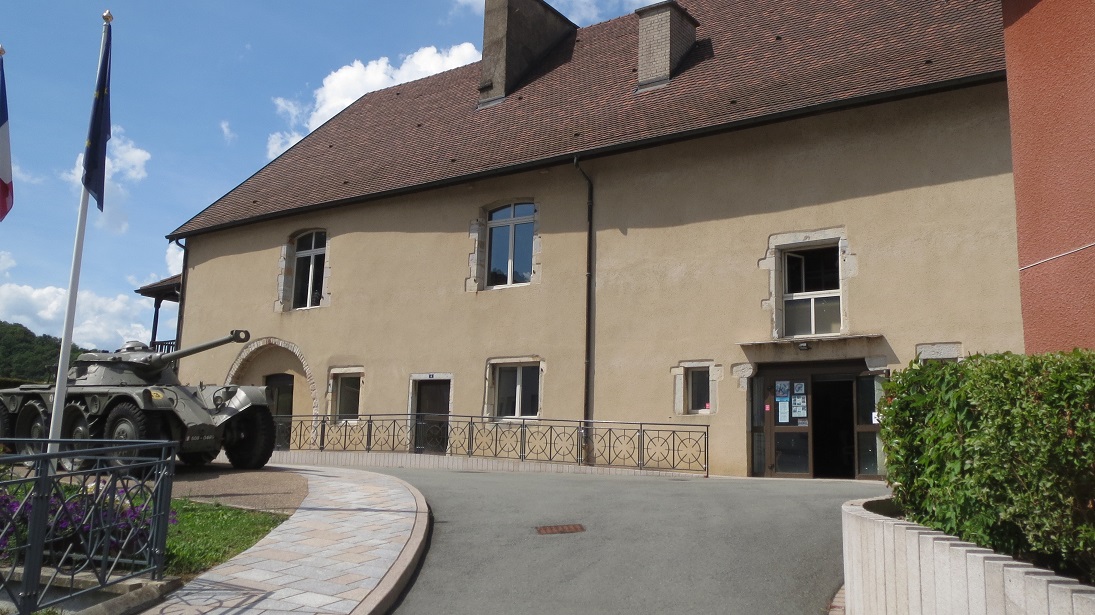
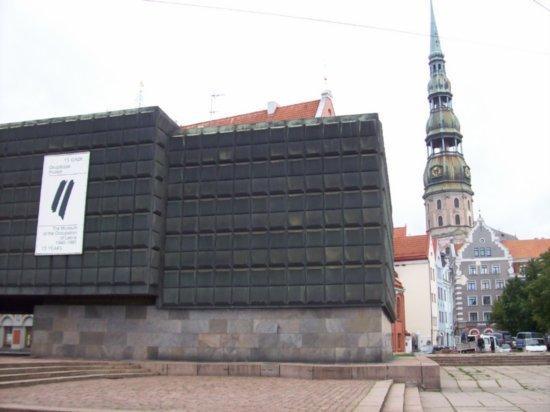
M1993 - Museum of the Occupation of Latvia, Strelnieku laukums 1, Riga (Latvia) "Shows what happened to Latvia, its land and people under two occupyng totalitarian regimes from 1940 to 1991. Reminds the world of the crimes committed by foreign powers against the state and people of Latriva. Remembes the victims of the occupation, those who perished, were persecuted, forcefully deported or fled the terror of the occuption regimes."


P
I
LL
A
R
S

M E M O R I A L March 21, 1994 - India Peace Memorial, Tiddim Road, Red Hill, Maibam Lokpa Ching, Manipur State (India). "A hillock about 17 kms. south of Imphal City was an action-packed location where a fierce battle took place between Allied and Japanese forces in World War II. Japanese war veterans constructed a monument at the foot of this hill ,and it was significantly named 'India Peace Memorial.'"
P L A Q U E


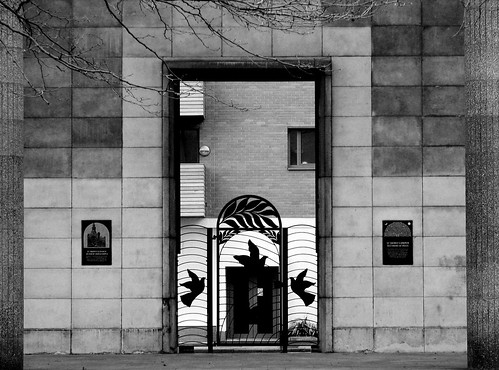
On May, 8 1995 - Gingko Boom / Gingko Tree, Kriegsgräberstätte / Germany War Cemetery, Timmermannsweg 75,Ysselsteyn, Province of Limburg (Netherlands). "A so-called Gingko tree was planted at the entrance area of the graveyard on the occasion of the 50th remembrance of the end of World War II. This was a signal against war & violence. This kind of tree was the first that begun to blossom again after the dropping of the atomic bombs over Hiroshima & Nagasaki in 1945. That way it became a symbol of hope - hope for peace in a better world... Close to the German border, this is the only German military cemetery in the whole Netherlands. 85 killed soldiers from the First World War & almost 32.000 from the Second World War are buried here on a territory of 28 hectares. For each killed soldier one cross has been placed. The data (name, grave location, dates of birth and death, rank - if known) have been written on the crosses with white color. There are approximately 5000 unknown soldiers buried on this cemetery. These are buried in graves with crosses on which it reads "Ein Deutscher Soldat". Information courtest of Peter van den Dungen 18Nov2014.

M E M O R I A L
S T AT U E
M E M O R I A L
M E M O R I A L


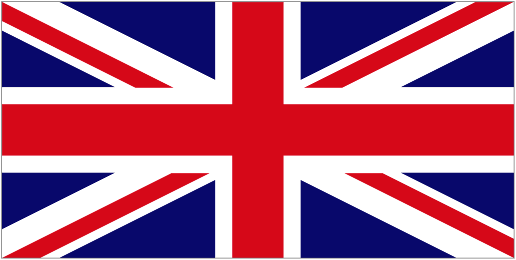
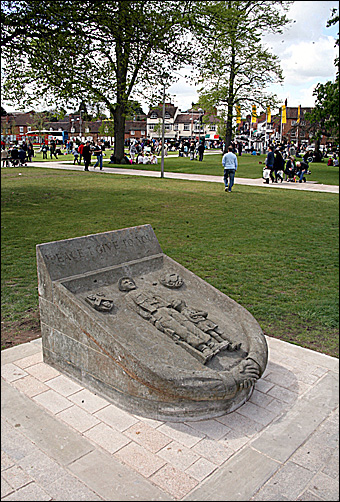
September 5, 1995 - Liberation Square, St. Helier (Isle of Jersey). "Developed to mark the 50th Anniversary of Jersey's Liberation. To the north of the square stands the Pomme D’Or Hotel, which was used by the Nazis as their Headquarters during the Occupation. The hotel's original balcony was the focal point for celebrations when the island was liberated by British forces on May 9, 1945. At the centre of the square is Philip Jackson’s sculpture depicting a group [of 7 figures] holding the Union Flag at the centre of a fountain. Twelve water jets in the pool symbolise Jersey's 12 parishes. As the island celebrated "Liberation 60" on May 9 2005, Surgeon Captain McDonald, the man who originally draped the Union Flag from the Harbour Office in 1945 (now the Jersey Tourism Office), again unfurled Great Britain's colours from the same window as he had 60 years previously. It was also from the rear of the Tourism Office that in 1942 over 1,000 people were deported to civilian internment camps in Germany. Most of the deportees were destined to be held at the Bad Wurzach camp in southern Germany for the remainder of the war. Today, St. Helier is twinned with Bad Wurzach & participates in a programme of cultural visits & exchanges designed to promote friendship, understanding & reconciliation. A plaque can be seen on the Esplanade (northern) side of the building commemorating this event." Information courtesy of Prof. Jeffrey Jackson 16Oct17.

B
EL
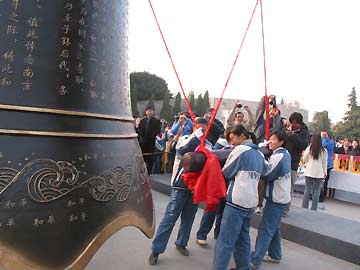
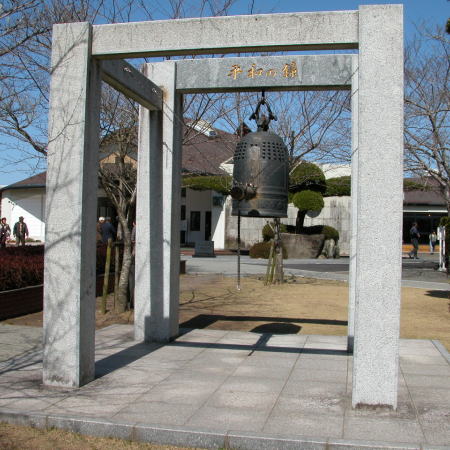
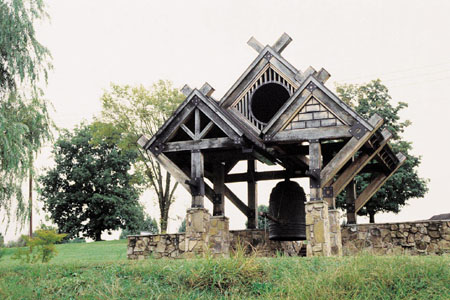
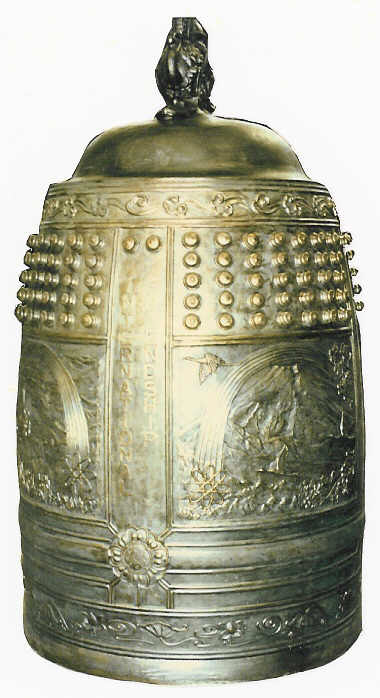
LMay 3, 1996 - International Friendship Bell, Oak Ridge, Tennessee, USA. Represents 50th anniversary of the City of Oak Ridge. Paid for in part by contributons by the people of sister city Naka-Machi (Japan). Only inscriptions on the bell are PEACE, INTERNATIONAL FRIENDSHIP, and the dates of Pearl Harbor, Hiroshima, Nagasaki, and VJ Day. Bell cast by Sotetsu Iwazawa in Kyoto (Japan). Pavilion designed by Professor Jon Coddington. The uranium for the Hiroshima bomb was secretly separated in Oak Ridge.

P L A Q U E

M
U
S
E
U
M

M E M O R I A L Date? - "Nigdy Wiecej Wojny / Never Again War," Westerplatte Peninsula, Gdansk (Poland). Where the German war against Poland began on September 1, 1939. Seventieth anniversary ceremony here notably lacked high-level US representation.
B
U
STB
E
NC
HDate? - Minnie Vautrin Memorial, Secor Community Building, Secor, Illinois (USA). Bench & plaque memorializing Minnie Vautrin [1886-1941], an American missionary born in Secor, IL (population 379).


M
U
SE
U
M
M
U
S
E
U
M2002 - Fondazione Scuola di Pace di Monte Sole / Peace School Foundation, Parco Storico, Monte Sole (Italy). Site of the Marzabatto Massacre by Waffen SS troops in October 1944.

B
E
L
LB
E
L
L

M
U
S
E
U
M

S
T
A
T
U
E
S
T
A
T
U
E

T
O
W
E
R
M
U
SE
U
M

M
U
S
E
U
M
M
U
SE
U
M.svg/2000px-Flag_of_the_NSDAP_(1920%E2%80%931945).svg.png)

BE
L
L
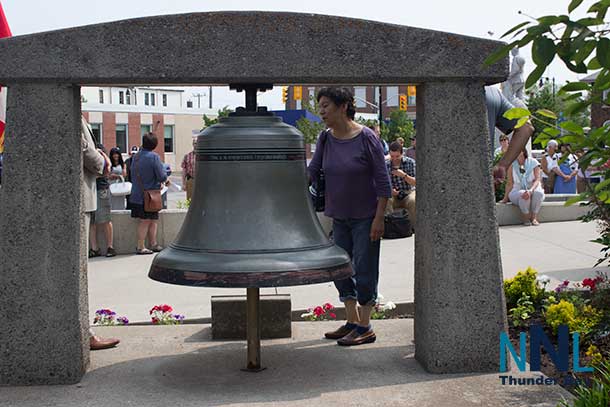
2007? - Peace Bell, City Hall, 500 Donald Street East, Thunder Bay, Ontario (Canada). "Thunder Bay & Gifu City (Japan) have had a formal Sister City relationship since 2007. On July 9 every year, the anniversary of the day in which air raids occurred in Gifu, the Peace Bell is rung in the hope of creating a world of mutual harmony & prosperity,” Shigemitsu Hosoe, [Mayor of] Gifu City, said in a statement. 'I hope that you & those in your city can share our wish, and that the ringing of the Peace Bell opens up an opportunity to tell the future generations of the importance of peace.' /// Commented Mayor Keith Hobbs [of Thunder Bay], 'Every year, we celebrate [the sister city] relationship, as well as call for world peace, during this ceremony, held at the same time in Thunder Bay & Gifu City. As our peace bell rings throughout our downtown south core, the tolling of Gifu City’s peace bell sounds throughout their streets, as well.'"


C
E
NO
T
A
P
H


June 2016 - "Embracing Peace," Memorial Park, Woodward & 13 Mile, Royal Oak, near Detroit, Michigan (USA). "...a sculpture depicting the famous Life Magazine cover photo taken on VJ Day (August 15, 1945) in Times Square, New York City, of a sailor dipping a nurse & planting a kiss for all time. The statue, on loan for six months, is intended to draw attention to a $3 million fundraising campaign for a permanent Michigan World War II Legacy Memorial..." /// "The statue is one of four by artist Seward Johnson; the others are permanently in Sarasota, Florida.; San Diego, California; and Normandy, France. This piece was previously in New York City for the 70th anniversary of V-J Day.

San Diego, CA




 1988 -