|
| 113 Peace Monuments |
Click here for monuments related to the US Foreign Service (& Department of State). | Click here for visit to Washington, DC, Oct. 30-Nov. 2, 2011. | Click here for James M. Goode's dcMemorials.com - "Washington D.C. memorials, monuments, statues & other outdoor art."
 = National Park Service (NPS) |
  = Smithsonian Institution |
  = Nobel Peace Prize
Right click image to enlarge.

| About 1783 -
"Peace of Paris, 1783", Diplomatic Reception Rooms (Top Floor), U.S. Department of State, Washington, DC (USA). "Painting by Benjamin West [1738-1820] of the American delegation at the Treaty of Paris: John Jay, John Adams, Benjamin Franklin, Henry Laurens [1724-1792], and William Temple Franklin [1760-1823]. The British delegation refused to pose, and the painting was never completed." (The preliminary articles signed in Paris on November 30, 1782, were only effective when a similar treaty was signed by Britain and France, which French Foreign Minister Charles Gravier, Comte de Vergennes [1717-1787], quickly negotiated. France signed preliminary articles of peace with Great Britain on January 20, 1783, which were followed by a formal Peace of Paris signed on September 3, 1783.)
 
|


| 1806-1860 - Tripoli Monument or Peace Monument, Navy Yard, Washington, DC (USA). Made in Italy by Charles Micali. Damaged by fire during the War of 1812. Moved to West Grounds of the US Capitol in 1831. Moved to US Naval Academy (USNA), Annapolis, Maryland (USA) in 1861 (qv). Plaque: "The oldest military monument in the United States honors heroes of the War against the Barbary Coast Pirates [1801-1805], the new republic's first war..." Renovated in June 2000.  
|

| Circa 1815 - "Peace" (Allegory of the Treaty of Ghent) by John Rubens Smith [1775-1849], Library of Congress, Washington, DC (USA). The Treaty of Ghent (now in Belgium) was signed December 24, 1814, and ended the War of 1812 between the USA and Great Britain. 
|

| 1827 - "Fame and Peace Crowning George Washington" by Antonio Capellano, East Central Portico (above the Rotunda doors), Capitol, Washignton, DC (USA). Fame on the right holds a trumpet, peace on the left a palm branch.
|
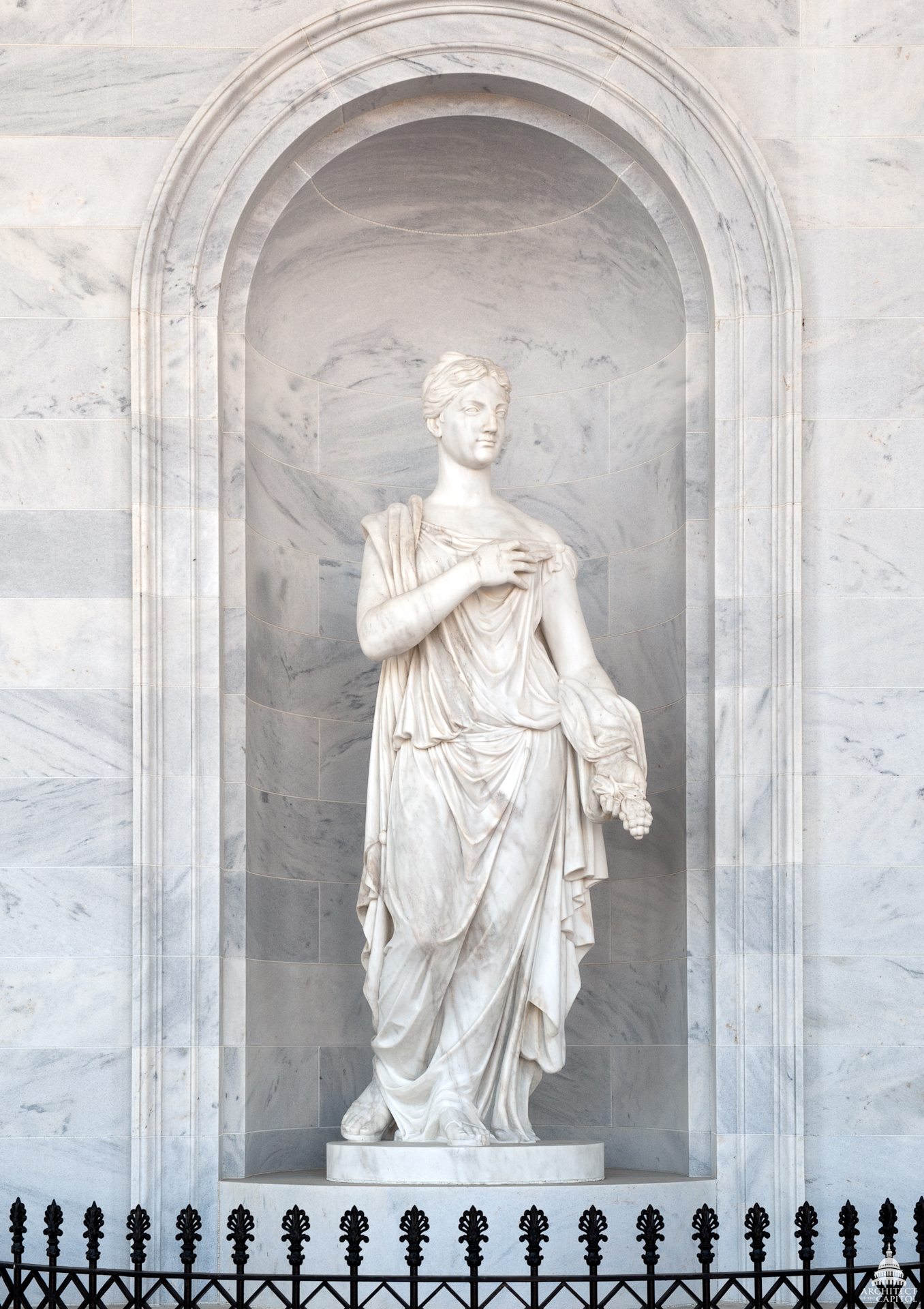
| 1858 - Statue of Peace, East front portico (to the right of the Columbus doors), US Capitol, Washington, DC (USA). Marble sculpture by George Gianetti, (after Luigi Persico). Draped in simple flowing robes, Peace holds an olive branch in her left hand.
|

| R E E | c1862-Early 1930's - Peace Tree, US Botanic Garden, Washington, DC (USA). Overcup oak marking the spot where Kentucky Senator John J. Crittenden [1787-1863] made an address in an effort to avert the Civil War. Transplanted about 1920 to make way for the Grant Memorial [image]. "Probably succumbed in the early 1930's when the Botanic Garden was finally leveled..." Crittenden had sons fighting on opposite sides of the Civil War & tried to forge a compromise on the eve of war, but it was narrowly rejected. Info from Savage (2009), pp. 94, 181-6.
|

| U S E U M | April 14, 1865 - Ford's Theater, Ford's Theater National Nistoric Site, National Park Service (NPS), 511 10th Street, NW, Washington, DC (USA). Unintentional monument. Became iconic the moment President Lincoln was assassinated in the theater on April 14, 1865. Now a National Historic Site & Museum.
|


| April 14, 1876 - Emancipation Memorial, Lincoln Park, East Capitol Avenue & 12th Street, Capitol Hill, Washington, DC (USA). Dedicated by Frederick Douglass & President Ulysses Grant. Sculpted by Thomas Ball. "Depicts Abraham Lincoln holding his Emancipation Proclamation and standing over Archer Alexander [1828-1880?] breaking the chains of slavery. Alexander was the last slave captured under the Fugitive Slave Act of 1850." Right image shows this monument on the cover of "Standing soldiers, kneeling slaves: Race, war, and monument in nineteenth-century America," by Kirk Savage (1999).
|

| 1878 - Naval Peace Monument, The Mall, Washington, DC (USA). Commemorates role of US Navy during the Civil War. Facing the US Capitol is Peace, a classical figure draped from the waist down and holding an olive sprig. The monuments's other alegorical figures are Grief, History & Victory. Grief is weaping, and History holds a book.
|

| 1879 - Indian Treaty Room, Eisenhower Executive Office Building, Washington, DC (USA). Originally the Navy Department Library & Reception Room, the Navy vacated the building between 1918 & 1921. By 1930 the building was renamed for the Department of State, and by 1949 it was renamed the Executive Office Building. The Treaty Room was used for presidential press conferences 1955-1961. The name "Indian Treaty Room" came about sometime during the 1930's, and it is still not clear why, despite extensive research. Some say it's because the War Department stored papers there in the 1930's, including treaties with the American Indian nations. Treaties signed in this room include Bretton Woods (establishing the IMF), peace treaties with Rumania, Italy & Hungary after WW-II, and the UN Charter. 
|
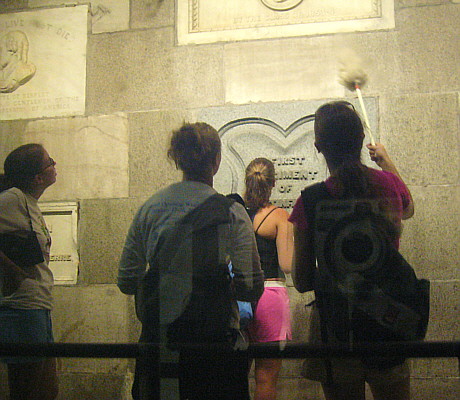
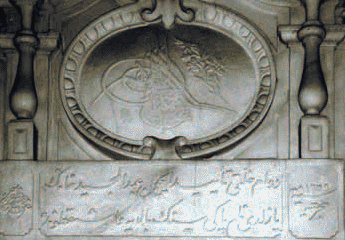
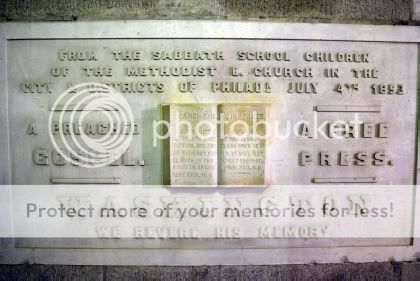
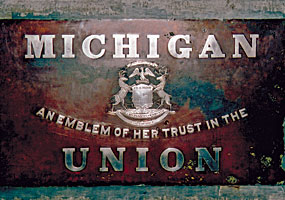
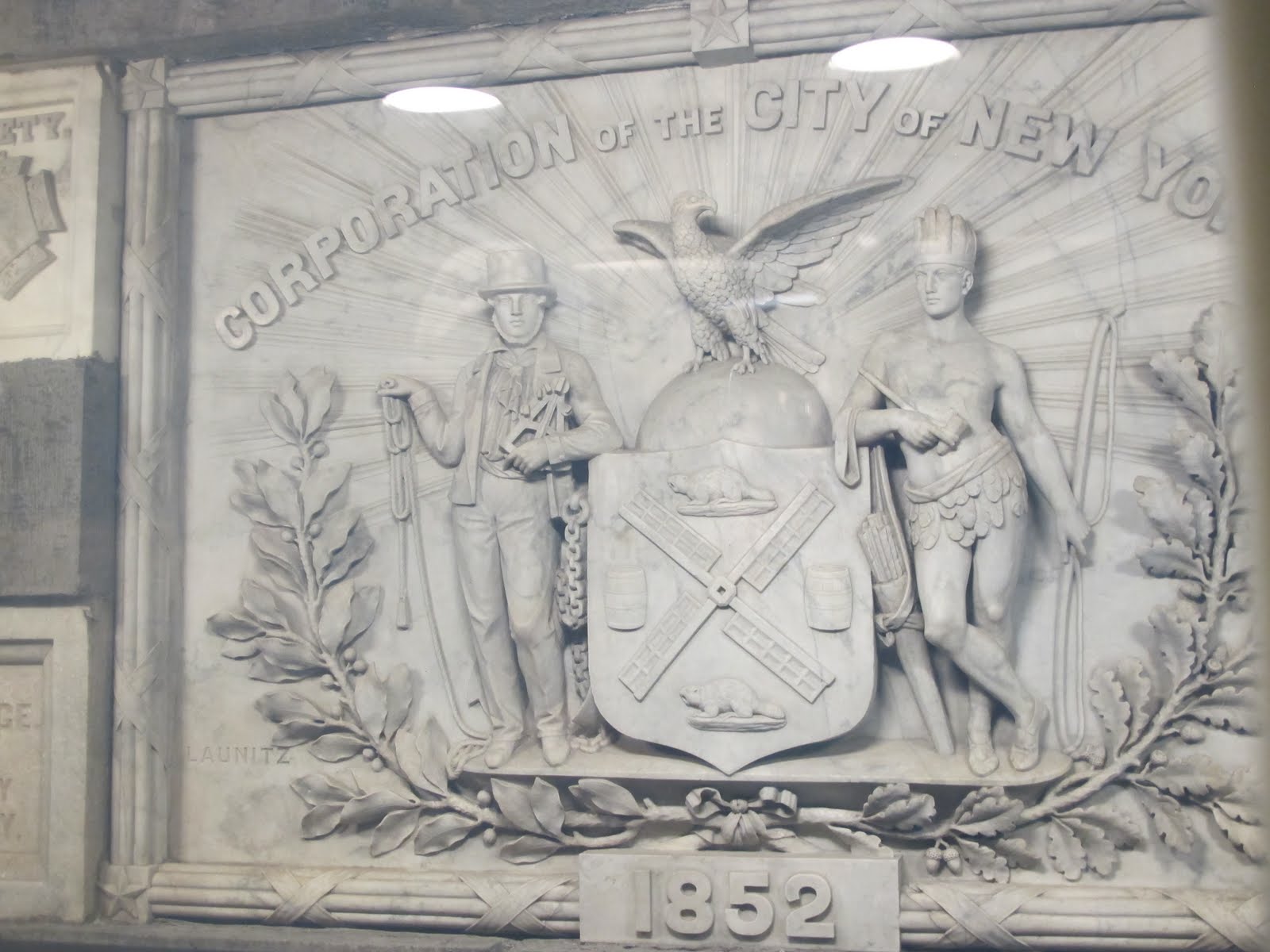
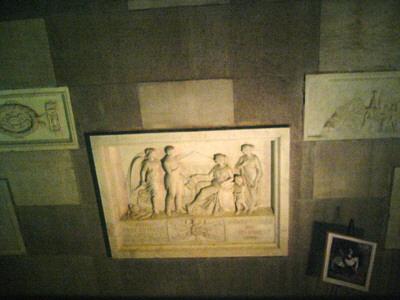
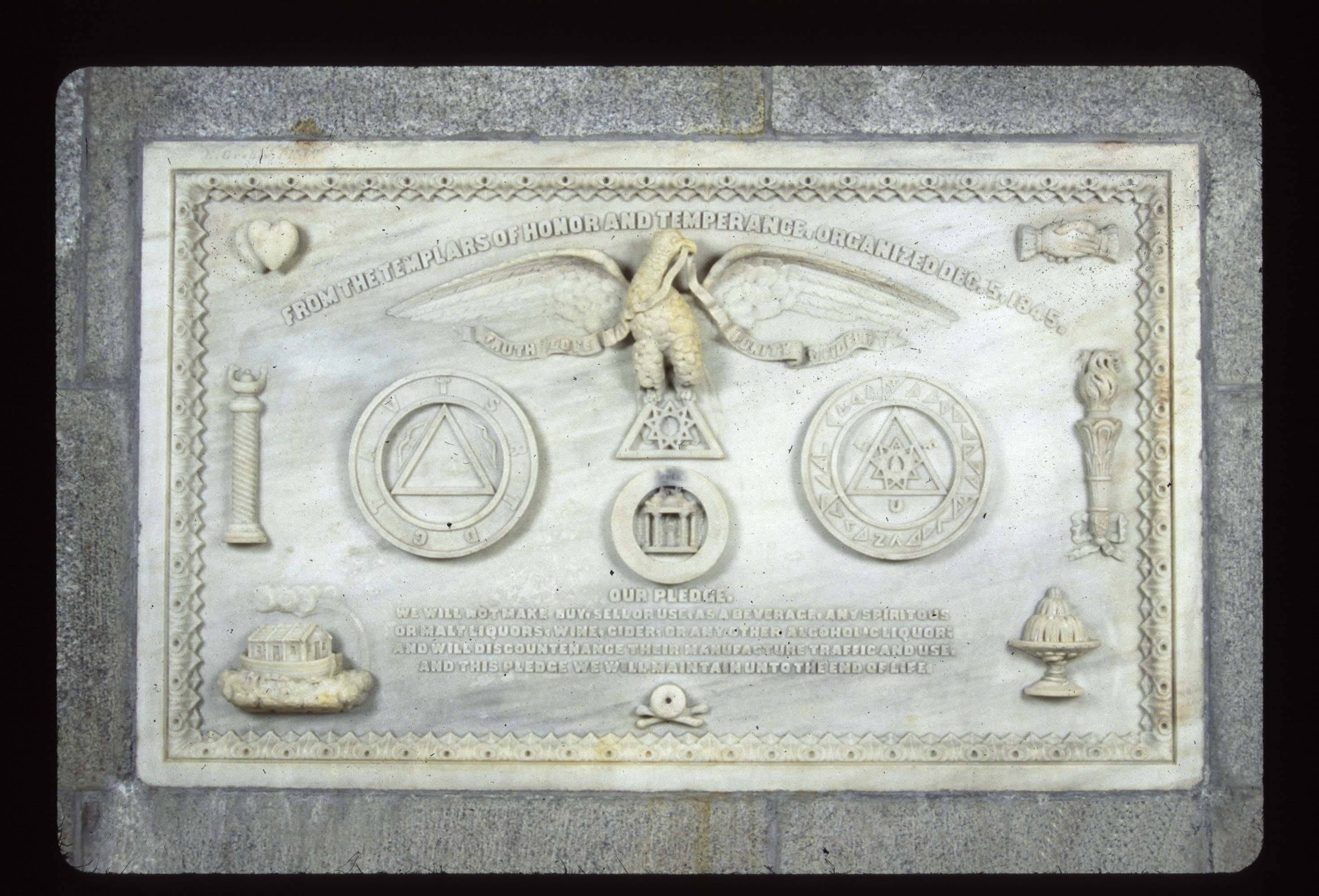
 | B E L I S K | L A Q U E S | February 21, 1885 - Washington Monument, The Mall, Washington, DC (USA). Construction began in 1845. 555 feet tall. World's tallest obelisk. World's tallest masonry structure. Exterior is plain, but interior stairway (no longer accessible to public) contains 193 plaques from every state & from many foreign countries. (One plaque is said to have been donated by the pope but was ripped out & trashed by US soldiers.).







|

| U S E U M | 1887 - National Museum of of Health & Medicine, Armed Forces Institute of Pathology, 6900 Georgia Avenue, NW, Washington, DC (USA). Sucessor to the Army Medical Musuem which stood on the National Mall from 1887 until the 1960's.
|

| U S E U M | 1895 - Frederick Douglass National Historic Site, National Park Service (NPS), 1411 W Street, SE, Washngton, DC (USA). Home of former slave Frederick Douglass [1818-1895], "the most famous 19th century African American." Unintentional monument at least since Douglass' death in 1895. Now a National Historic Site & Museum. Described on page 21 of "A Traveller's Guide to the Civil Rights Movement" by Jim Carrier (2004).
|
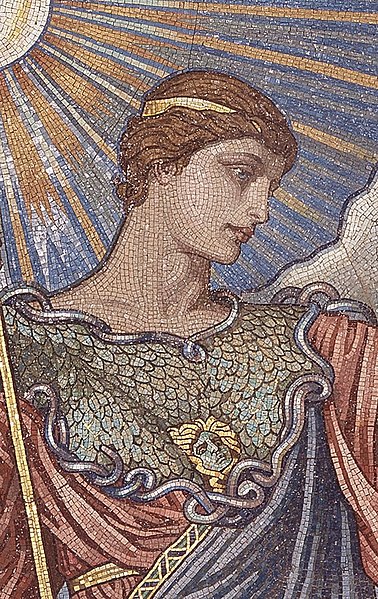
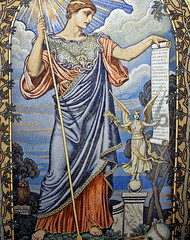
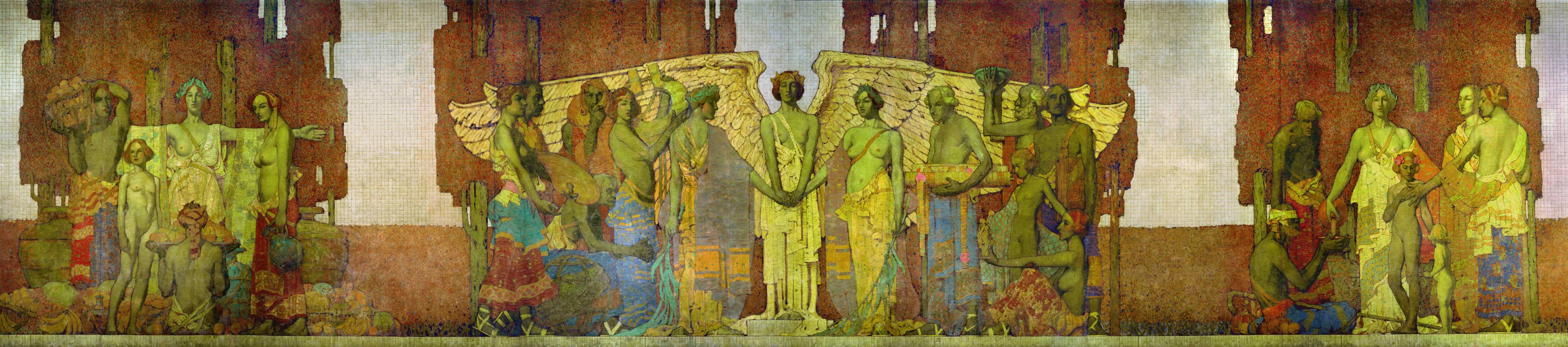
| 1896 - "Minerva of Peace," Library of Congress, Washington, DC (USA). By Elihu Vedder [1836-1923]. As photographed by Carol M. Highsmith. "Minerva was the Roman goddess whom Romans from the 2nd century BC onwards equated with the Greek goddess Athena. She was the virgin goddess of poetry, medicine, wisdom, commerce, weaving, crafts & magic. She is often depicted with her sacred creature, an owl usually named as the 'owl of Minerva,' which symbolizes her ties to wisdom." A statue of Minerva is atop the dome of the US Capitol Building. Her image is on the Seal of the State of California.
|
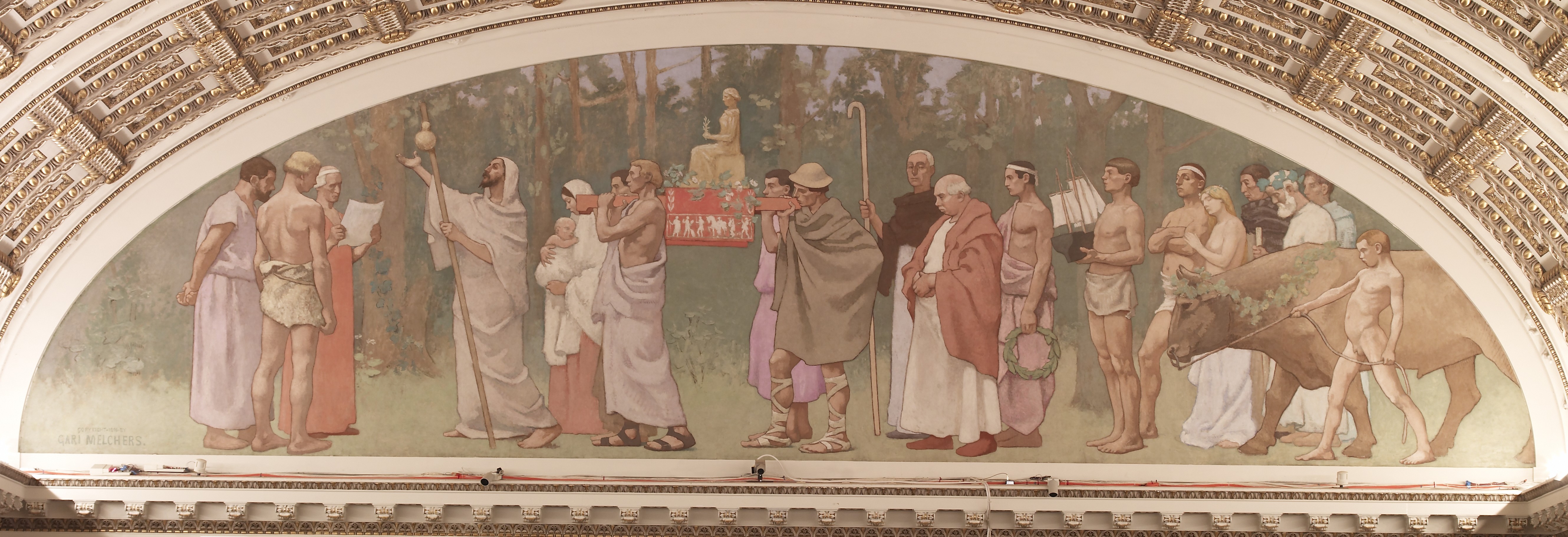
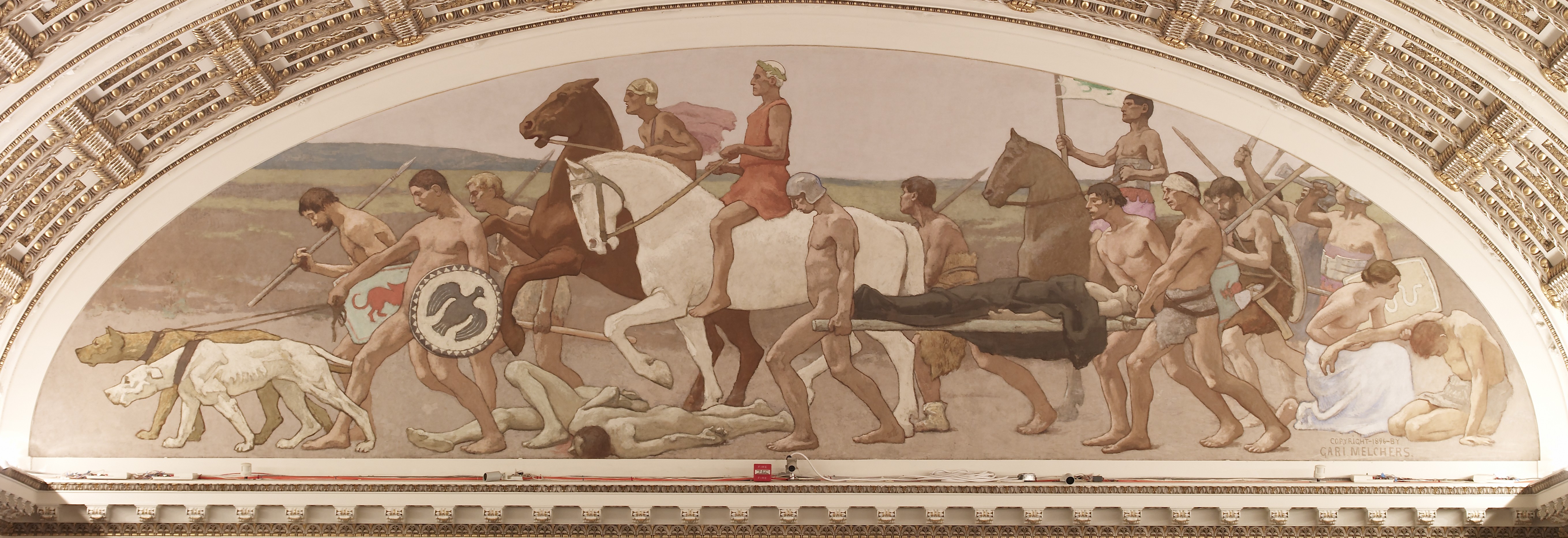
| 1896
Murals of Peace & War, Second Floor, Northwest Gallery, Thomas Jefferson Building, Library of Congress, Washington, DC (USA).
By Gari Melchers [1860-1932].
| 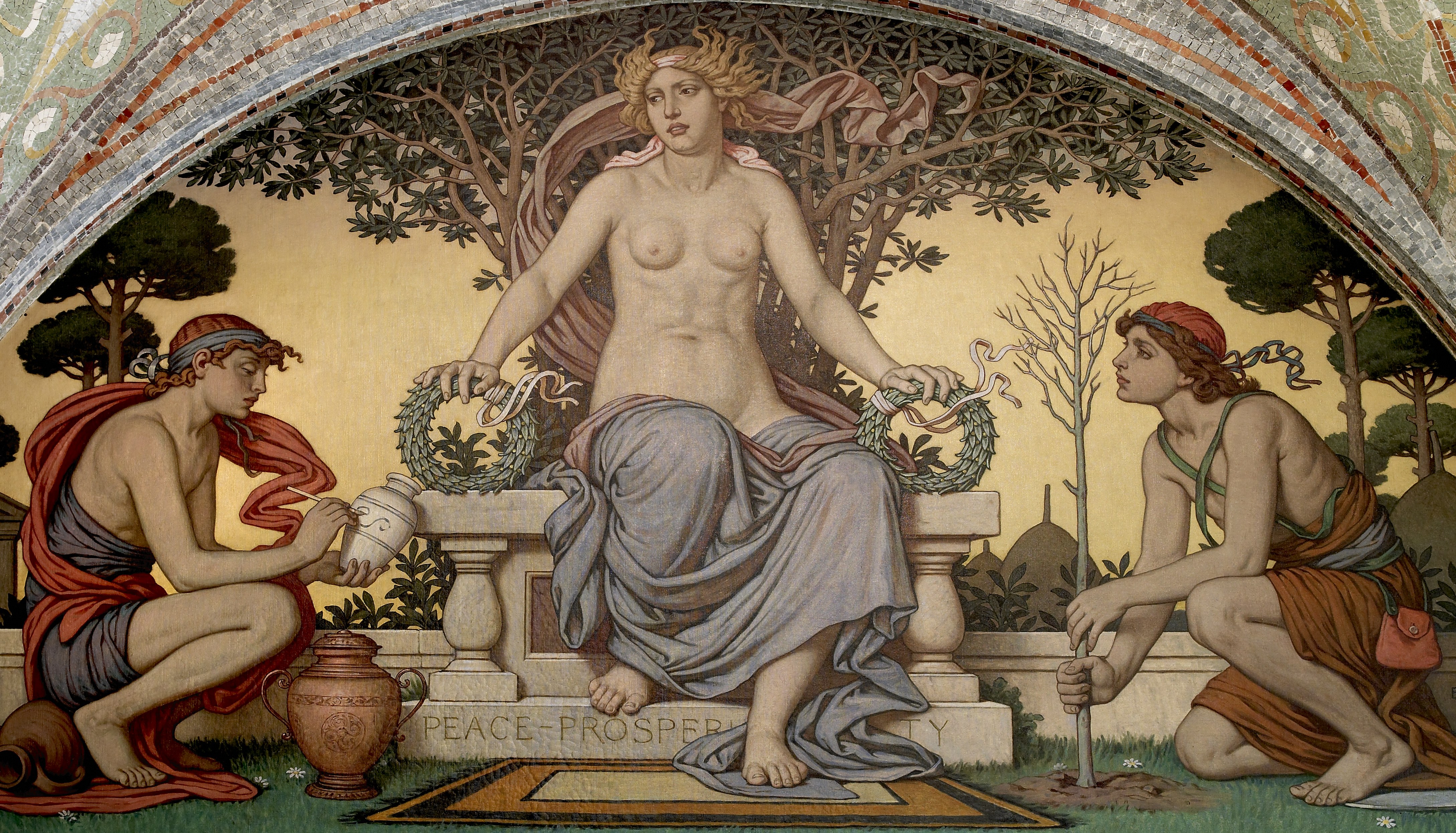 | 1896
Peace & Prosperity, Thomas Jefferson Building, Library of Congress, Washington, DC (USA).
By Elihu Vedder [1836-1923].
|
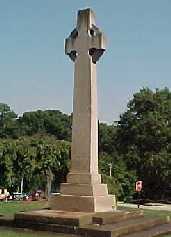
| October 23, 1898 - Peace Cross, Massachusetts & Wisconsin Avenues, Cleveland Park, Washington, DC (USA). "Dedicated by President McKinley to mark the coming end of the Spanish-American War. It is located near the former location of the residence where the first meetings were held to plan Washington National Cathedral" (constructed 1907-1990). Also known as "Stone Cross."
|
1900 - A critic of Washington's monuments refers to "this sculptured militarism." According to Savage (2009), "the city streets of Washington were becoming an outdoor version of indoor military pantheons such as St. Paul's Cathedral in London, though without the planning & coherence that European states brought to such commemorative projects."

| June 1904 - Statue of Benjamin Rush, Navy Bureau of Medicine and Surgery, across from the entrance to the old Naval Observatory, Foggy Bottom, Washington, DC (USA). The larger-than-life, bronze statue. Honors Benjamin Rush M.D. [1745-1813], Philadelphia physician, medical educator and signer of the Declaration of Independence. Rush proposed a Peace-Office for the USA in 1798. 
|
 
| L D G | April 26, 1910 - Organization of American States (OAS), 17th Street & Constitution Avenue, NW, Washington, DC (USA). "On April 14, 1890, delegates created the International Union of American Republics 'for the prompt collection and distribution of commercial information.' They also established the Commercial Bureau of the American Republics in Washington as the Union's secretariat, with the participation of 18 Western Hemisphere nations, including the USA. In 1910, the Commercial Bureau became the Pan American Union, and American philanthropist Andrew Carnegie [1835-1919] donated $5 million to construct a permanent headquarters in Washington, DC, which is today the historic OAS building." Lower image shows interior courtyard. 
|
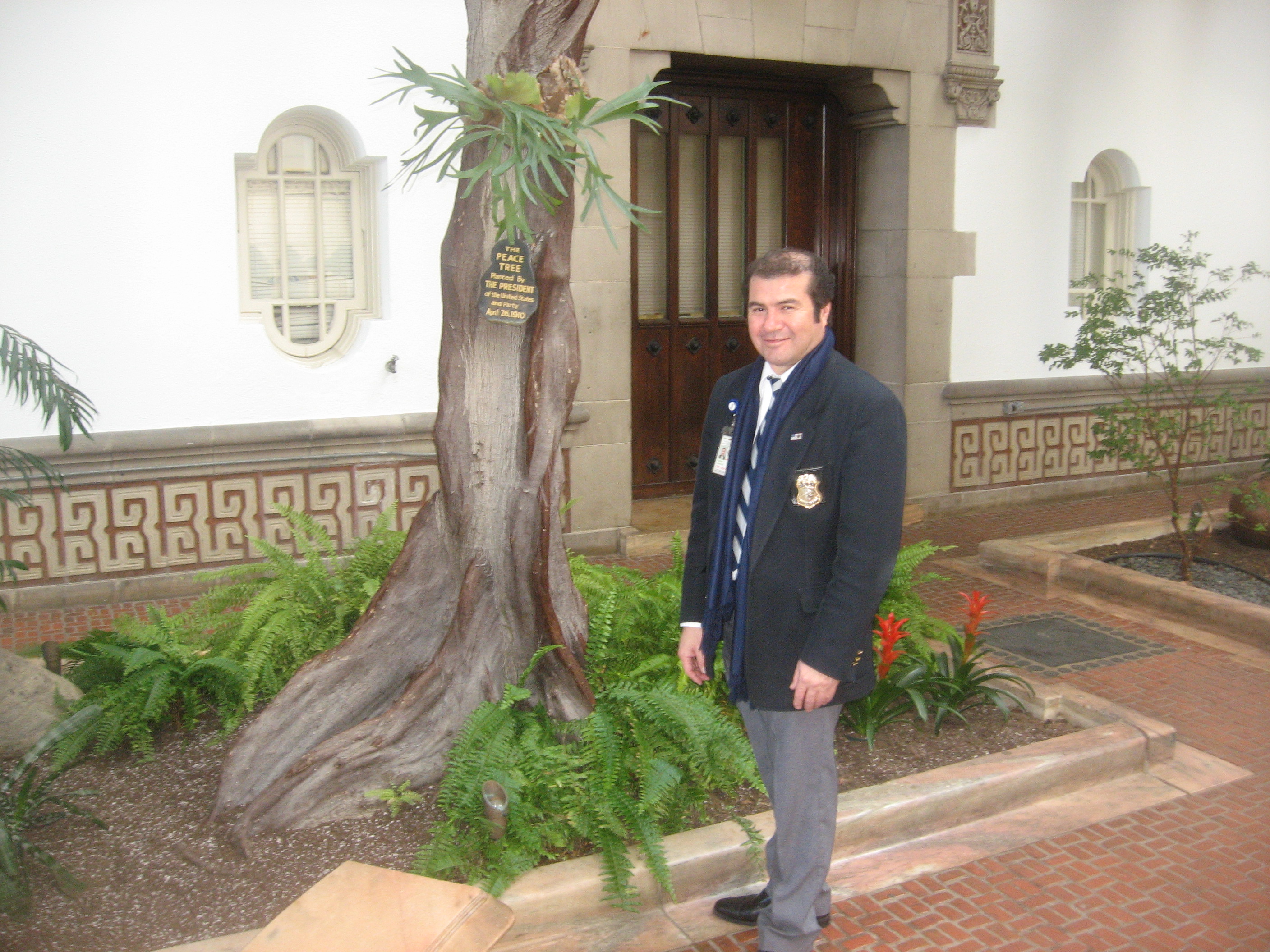
| R E E | April 26, 1910 - Peace Tree, Organization of American States (OAS), 17th Street & Constitution Avenue, NW, Washington, DC (USA). "Prominent among the lush vegetation of the OAS patio. A hybrid of fig and rubber. Planted by President William Howard Taft [1857-1930] during the building's dedication ceremonies in 1910." Image shows John Barret (Director General), Bishop Harding, Amb. de la Barra (México), Andrew Carnegie, President Taft, Philander O. Knox (Secretary of State), Senator Elihu Root, James Cardinal Gibbons & Frederick D. Owen. On April 26, 2010, President Barak Obama "planted a new 'Peace Tree' as a symbol of the OAS’s renewed dedication to its core values of good faith and solidarity for the next 100 years." Left image made 01Nov1011 by
EWL.
|

| O U S E | 1911-1948 - American Peace Society House, 734 Jackson Place, NW, Washington, DC (USA). A Late Victorian 3-story brick house with a hexagonal bay that was the headquarters of the American Peace Society from 1911 to 1948. Constructed in 1878 for financier & philanthropist Charles C. Glover [1846-1936]. Declared a National Historic Landmark in 1974. Included in the Lafayette Square Historic District. Currently used as offices for the White House Council on Environmental Quality. (The American Peace Society was founded in 1828 and moved to Washington from Boston in 1911. What happened in 1948?)
|
|
| 1914 - Inscription, National Postal Museum,
Massachusetts Avenue at North Capitol Street, NE, Washington, DC (USA). Across the street from Union Station (1907), this building was the "District of Columbia General Post Office" & became the National Postal Museum in 1993. Text of full inscription:
"Messenger of Sympathy and Love.
Servant of Parted Friends.
Consoler of the Lonely.
Bond of the Scattered Family.
Enlarger of the Common Life.
Carrier of News and Knowledge.
Instrument of Trade and Industry.
Promoter of Mutual Acquaintance,
Of Peace and of Goodwill Among Men and Nations."
/// "The original of this inscription was called 'The Letter' & was written by Dr. Charles William Eliot [1834-1926], former
president of Harvard University. President Woodrow Wilson changed the text slightly before the
inscription was carved in the white granite of the Post Office." /// Thie is Monday's Monument #135.
|

| 1917 - Headquarters Building, American Red Cross (ARC), 430-17th Street, Washington, DC (USA). Dedicated "in memory of the heroic women of the Civil War." The building still contains Red Cross offices and a museum. The ARC was established in Washington, DC, on May 21, 1881 by Clara Barton [1821-1912] who became its first president. See Clara Barton National Historic Site (1975). 
|

| 1917 - Tiffany Windows, American Red Cross (ARC), 430-17th Street, Washington, DC (USA). Depict the most significant values of the Red Cross: Hope, faith, charity and love. Designed & constructed by the renowned studio of Louis Comfort Tiffany [1848-1933], son of the New York City jeweler. Reputed to be the largest set of windows still in their original state.
|
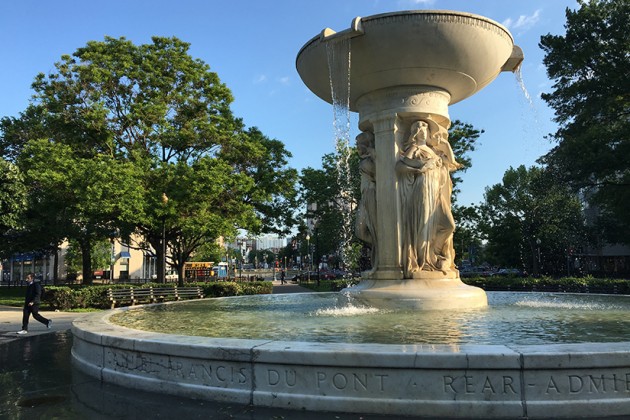
| 1921 - Fountain, DuPont Circle, Washington, DC (USA). Features carvings of three classical figures symbolizing the sea, the stars & the wind. Designed by Daniel Chester French [1850-1931] & architect Henry Bacon, the co-creators of the Lincoln Memorial. Inscribed "Erected by the Congress of the United States." Replaced an 1884 statue of Samuel Francis Du Pont [1803-1865], a rear admiral during the Civil War. (The statue was moved to Rockford Park in Wilmington, Delaware, seat of the DuPont family.)
|


|  May 30, 1922 - Lincoln Memorial, Washington, DC (USA). Contains famous seated statue of Abraham Lincoln by Daniel Chester French [1850-1931].
Memorial has engraved texts of the Gettysburg Address & the Second Inaugural Address. The latter concludes, "...to do all which may achieve and cherish a just and lasting peace among ourselves and with all nations." May 30, 1922 - Lincoln Memorial, Washington, DC (USA). Contains famous seated statue of Abraham Lincoln by Daniel Chester French [1850-1931].
Memorial has engraved texts of the Gettysburg Address & the Second Inaugural Address. The latter concludes, "...to do all which may achieve and cherish a just and lasting peace among ourselves and with all nations."
|
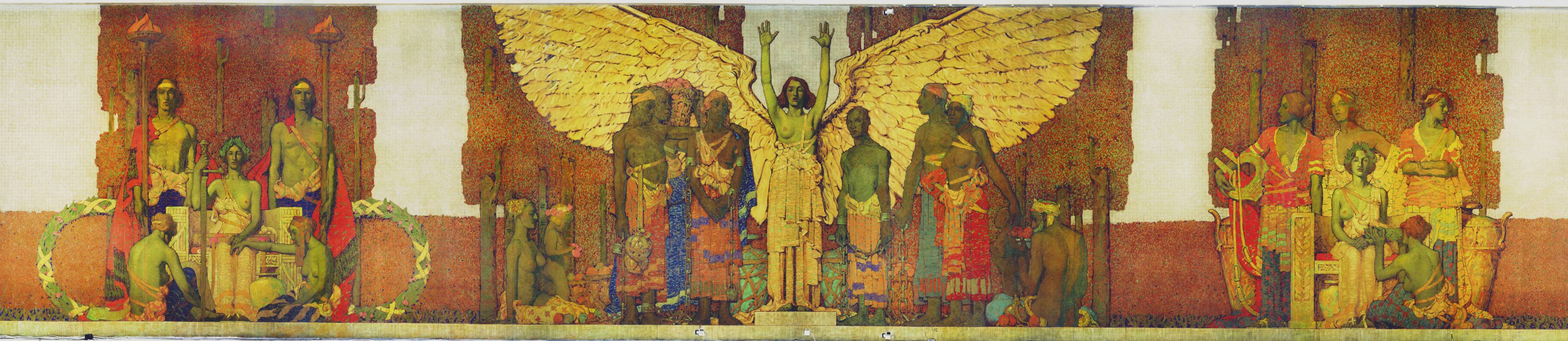
| May 30, 1922 - Murals "Emancipation of a Race" & "Unification," Lincoln Memorial, Washington, DC (USA). By Jules Guerin [1866-1946]. Above the texts of the two addresses.
| 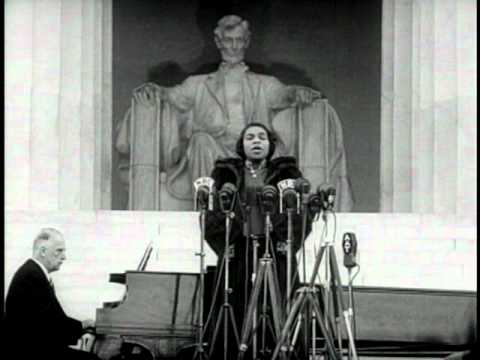 | April 9, 1939 - Marion Anderson singing at the Lincoln Memorial, Washington, DC (USA). 
|    | August 28, 1963 - Inscription, Steps of the Lincoln Memorial, Washington, DC (USA). Marks where Martin Luther King, Jr., stood when he delivered his famous "I have a dream" speech on August 28, 1963.
|

| October 12, 1922 - Statue of Edmund Burke, Massachusetts Avenue, NW, Washington, DC (USA). Copy of a bronze full length statue by British artist James Havard Thomas in Bristol (England). Inscribed "BVRKE
1729-1797. 'Magnanimity in politics is not seldom the trvest wisdom.'" Edmund Burke [1729-1797] was an Irish statesman, author, orator, political theorist & philosopher who supported the American Revolution & opposed the French Revolution.

| 
|  1894 - Statue of Edmund Burke,
Colston Avenue, City Centre, Bristol (England). Inscribed: "Burke 1774-1780. 'I wish to be a Member of Parliament to have my share of doing good and resisting evil.' Speech at Bristol 1780." Bullet holes were found in the statue in 2008. 1894 - Statue of Edmund Burke,
Colston Avenue, City Centre, Bristol (England). Inscribed: "Burke 1774-1780. 'I wish to be a Member of Parliament to have my share of doing good and resisting evil.' Speech at Bristol 1780." Bullet holes were found in the statue in 2008.
|


| 1924 - Civil War Nurses, M Street & Rhode Island Avenue, Washington, DC (USA). Bas relief flanked by statues of Patriotism (with shield) & Peace (with wings). Sculpted by Irish sculptor Jerome Connor [1874-1943]. Also called 'The Nuns of the Battlefield.' Inscribed, 'They comforted the dying, nursed the wounded, carried hope to the imprisoned, gave in His name a drink of water to the thirsty.' Raised by the Ladies Auxiliary of the Ancient Order of Hibernians (AOH), the memorial was originally designed for Arlington Cemetery, until the War Department objected. It was then proposed for location behind the Pan American Union building ... but the Fine Arts Commission objected to that. Finally, Connor downscaled the size of the memorial and got permission to build it at its present site. Then he had to sue the Ancient Order for payment."
|
 |  July 13, 1925 - Peace Cross, US Highway 1, Bladensburg, Maryland (USA). 40-foot cross of cement & marble constructed by the Snyder-Farmer Post of the American Legion to recall the 49 men of Prince George’s County who died in World War I. Towers above the convergence of Baltimore Avenue, Bladensburg Road & Annapolis Road (a primary entrance to Washington, DC, before the construction of interstate highways). /// N.B.: A court ruled in November 2017 that this monument favors religion & is therefore unconstitutional. July 13, 1925 - Peace Cross, US Highway 1, Bladensburg, Maryland (USA). 40-foot cross of cement & marble constructed by the Snyder-Farmer Post of the American Legion to recall the 49 men of Prince George’s County who died in World War I. Towers above the convergence of Baltimore Avenue, Bladensburg Road & Annapolis Road (a primary entrance to Washington, DC, before the construction of interstate highways). /// N.B.: A court ruled in November 2017 that this monument favors religion & is therefore unconstitutional.
|
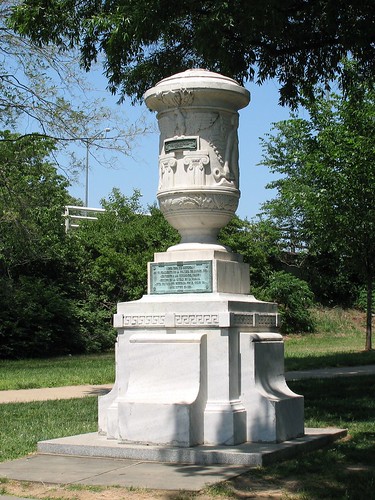
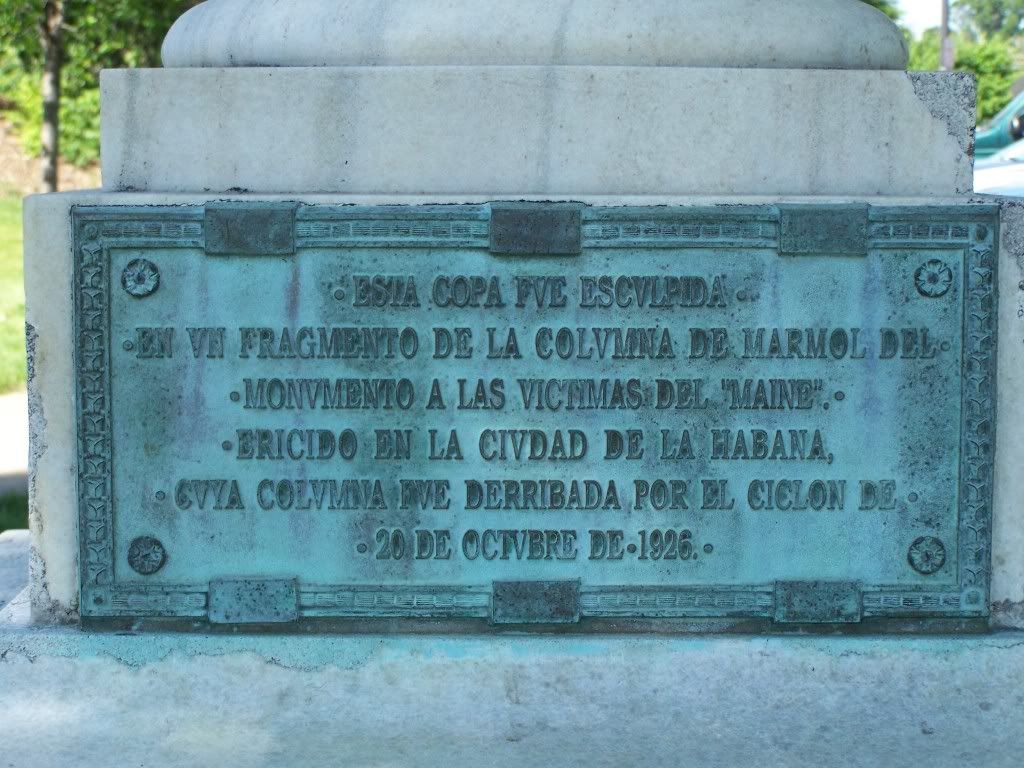
| 1926 - Cuban American Friendship Urn, Potomac Park, 14th Street & Ohio Drive, Washington, DC (USA). "Also called the 'Maine Memorial.' Most obscure memorial in Washington, DC. Location out of the way; the main dedicatory plaque is difficult to see, has small print, and is located eight feet off the ground; and, having climbed up the sides of the memorial to read the plaques, one discovers they are written in Spanish. The marble urn on top once stood atop a column of marble in Havana (Cuba) to commemorate the sailors who lost their lives aboard the USS Maine [in 1898] and the friendship between Cuba and the US. A hurricane in October 1926 knocked the marble column over and the urn was added to this marble plinth and sent to the US. For a number of years it stood outside the Cuban Embassy; then, when relations between the U.S. and Cuba deteriorated [in 1959?], the memorial was moved to this location." 
|

| U S E U M | 1929 - Sewall-Belmont House & Museum, 144 Constitution Avenue, NE, Washington, DC (USA). "Explores the evolving role of women & their contributions to society through the continuing, and often untold, story of women's pursuit for equality. The museum is the headquarters of the historic National Woman's Party (NWP) and was the Washington home of its founder and Equal Rights Amendment (ERA) author Alice Paul [1885-1977].
|

|  April 1932 - Peace, Victory & Valor, Tomb of the Unkinown Soldier, Arlington National Cemetery, Arlington, Virginia (USA). "On the East face of the Tomb...the face most visitors do not see. Peace (the figure on the left) is holding a dove in her left hand, while holding the right hand of Victory. Valor (on the right) is holding a broken sword in his hands & is facing Victory. Victory (in the middle) is holding the hand of Peace & extending an olive branch towards Valor." /// "There are two parallel horizontal cracks, both of which have grown in width & length over the years, despite patching in 1975 & 1989, the cemetery says. One crack is 28.4 feet long; the other is 16.2 feet long. Neither is superficial... A retired Colorado car dealer, John Haines, offered to pay for a new stone to be cut from Loesby's quarry. Haines eventually shelled out $31,000. The stone was cut and ever since has been sitting on a flatbed tractor-trailer at the quarry awaiting conclusion of the debate.
Haines said it's been frustrating. He owns a huge block of marble that he just wants to give to the government. 'They don't even have to be gracious,' he said. 'They just have to accept it.'
But the block might sit awhile longer.
Public sentiment [seems] strongly against replacement.
'To me this is what our country's about,' said John Zachara of Chicago. 'The Liberty Bell cracked. They didn't throw it away, did they?'" April 1932 - Peace, Victory & Valor, Tomb of the Unkinown Soldier, Arlington National Cemetery, Arlington, Virginia (USA). "On the East face of the Tomb...the face most visitors do not see. Peace (the figure on the left) is holding a dove in her left hand, while holding the right hand of Victory. Valor (on the right) is holding a broken sword in his hands & is facing Victory. Victory (in the middle) is holding the hand of Peace & extending an olive branch towards Valor." /// "There are two parallel horizontal cracks, both of which have grown in width & length over the years, despite patching in 1975 & 1989, the cemetery says. One crack is 28.4 feet long; the other is 16.2 feet long. Neither is superficial... A retired Colorado car dealer, John Haines, offered to pay for a new stone to be cut from Loesby's quarry. Haines eventually shelled out $31,000. The stone was cut and ever since has been sitting on a flatbed tractor-trailer at the quarry awaiting conclusion of the debate.
Haines said it's been frustrating. He owns a huge block of marble that he just wants to give to the government. 'They don't even have to be gracious,' he said. 'They just have to accept it.'
But the block might sit awhile longer.
Public sentiment [seems] strongly against replacement.
'To me this is what our country's about,' said John Zachara of Chicago. 'The Liberty Bell cracked. They didn't throw it away, did they?'"
|
 | April 29, 1935 - Rush-Bagot Memorial Tablet, Columbia Residences (former Columbia Hospital for Women), 2425 L Street, NW, Washington, DC (USA). Marks place where the Rush-Bagot agreement was signed April 18-19, 1817, to bring about the removal of armed vessels from the Great Lakes. Erected by Kiwanis International. One of 40 peace monuments on Zonia Baber's world map c.1948. Entry #1162 in the "Peace Movement Directory" by James Richard Bennett (2001). 
|  | 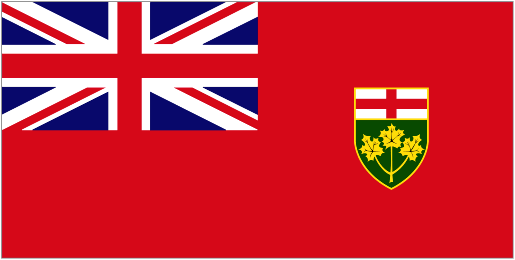 Date? - Rush-Bagot Treaty plaque, Royal Military College of Canada, General Crerar Crescent & Valour Road, Point Frederick, Kingston, Ontario (Canada). Placed by Ontario Heritage Trust. Date? - Rush-Bagot Treaty plaque, Royal Military College of Canada, General Crerar Crescent & Valour Road, Point Frederick, Kingston, Ontario (Canada). Placed by Ontario Heritage Trust.
|

| 1935 - Frederick Douglass Memorial Hall, 2441 6th-Street, NW, Howard University, Washington, DC (USA). "Named in honor of
abolitionist, diplomat & university trustee Frederick Douglass [1818-1895]. Completed under the direction of university architect Albert I. Cassell [1895-1969]. The U-shaped Neoclassical building looks out upon the main yard of the university." Click here for all Douglass monuments.
|
1941-1945 - World War II
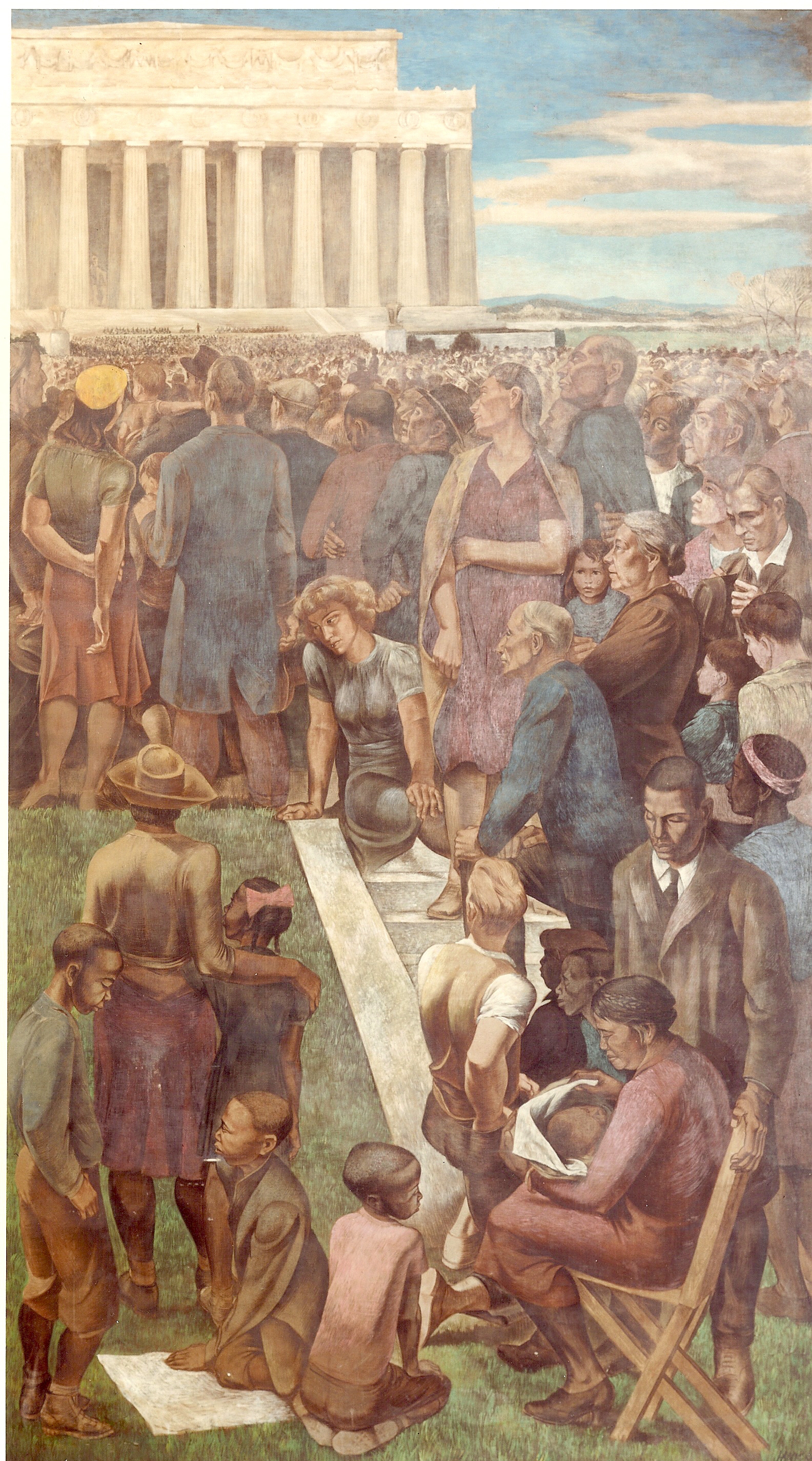
| 1942 - "An Incident in Contemporary American Life," Main Interior Building, Washington, DC (USA).
Said to be the first civil rights monument. /// "In 1940, "before World War II, Secretary of the Interior Harold Ickes [1874-1952] commissioned Mitchell Jamieson [1915-1976] to paint a mural for the new Interior [Department] Building depicting the Marian Anderson [1897-1993] concert on the National Mall [on Easter Sunday, April 9, 1939]... Ickes & First Lady Eleanor Roosevelt had organized this concert after Anderson was denied [by the DAR] singing at Constitution Hall due to the color of her skin. In the mural, Jamieson concentrates on the [biracial] crowd, even giving us portraits of individuals that we would be standing next to, straining to hear the concert which inaugurated the use of the Lincoln Memorial as a sight for civil rights protests." /// "Ickes was a strong supporter of both civil rights & civil liberties. He had been the president of the Chicago National Association for the Advancement of Colored People.
He encouraged private contractors working for the Public Works Administration (PWA) to hire both skilled & unskilled blacks... In 1933, Ickes ended segregation in the cafeteria & rest rooms of his department, including the national parks around the country.
In a news conference on the eve of Thanksgiving 1938, Ickes proposed offering Alaska as a 'haven for Jewish refugees from Germany and other areas in Europe where the Jews are subjected to oppressive restrictions.' The proposal was designed to bypass normal immigration quotas, because Alaska was not [yet] a state... [In 1939, Ickes] supported African American contralto Marian Anderson when the Daughters of the American Revolution [DAR] prohibited her from performing in DAR Constitution Hall. Ickes was the organizer & master of ceremonies at Anderson's subsequent concert at the Lincoln Memorial... In 1945, As an official delegate to the founding United Nations conference in San Francisco, Ickes advocated for stronger language promoting self-rule & eventual independence for the world's colonies."
|


| 1951 - "Arts of Peace" Equestrian Statues, Arlington Memorial Bridge, Washington, DC (USA). By American sculptor James Earle Fraser [1876-1953]. "Music & Harvest" (left) is a winged Pegasus between a male figure with a bundle of wheat & a sickle & a woman with a harp. "Aspiration & Literature" (right) is another Pegasus flanked by figures holding a book & a bow. The guilded bronze statues are approximately 17 feet tall atop granite pedestals. They were commissioned in l925 & their designs approved in 1933, but the statues were not erected until after WW-II when they were cast & gilded by Italy as a gift to the USA.
|

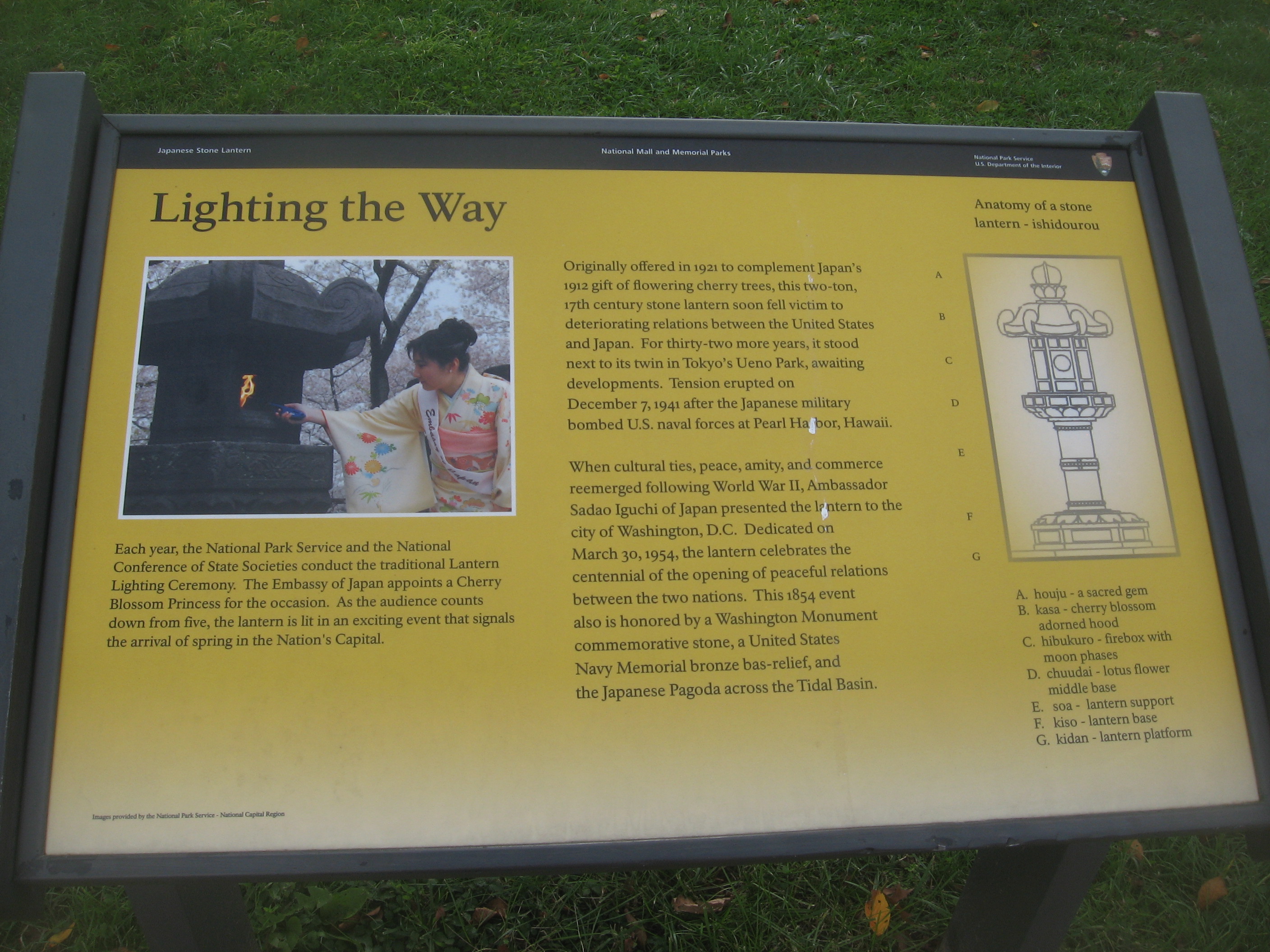
| 1954 - Japanese Stone Lantern, Tidal Basin, Washington, DC (USA). Made in 17th century. Weighs 20 tons. NPS interpretive panel explains that it was offered to the USA as a token of friendship in 1921 but not immediately delivered and remained in Tokyo's Ueno Park until 1954, when it was dedicated in celebration of a century of "peaceful" relations. 
|
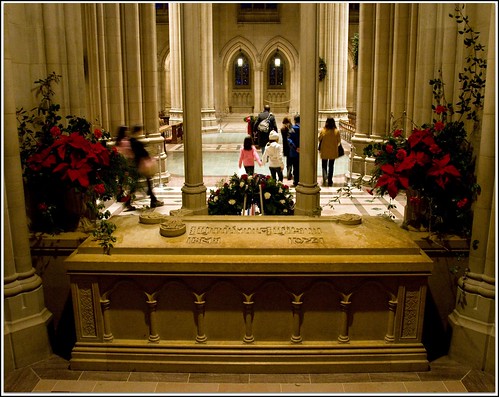
| 1956 - Sarcophagus of Woodrow Wilson, Washington National Cathedral, Cleveland Park, Massachusetts & Wisconsin Avenues, NW, Washington, DC (USA). "Woodrow Wilson [1856-1924] was the 28th President of the US and winner of the 1919 Nobel Peace Prize. Only president buried in DC proper. Originally buried in the Bethlehem Chapel in the crypt of Washington National Cathedral. In 1956, celebrating the centennial of his birth, the Cathedral arranged for his removal to this sarcophagus in the south aisle of the nave proper. It is decorated with symbols of Princeton University (of which he was president), the state of New Jersey (of which he was governor), and the Seal of the USA. Windows of the Wilson Bay depict war and peace, commemorating his service as president during WW-I, as does the sword on the top of the sarcophagus."
|
 | April 18, 1958 -
Japanese Pagoda, West Potomac Park, Washington, DC (USA). Stone statue located next to the Tidal Basin, & the Franklin Delano Roosevelt Memorial. A gift from the mayor of Yokohama in 1957.
|

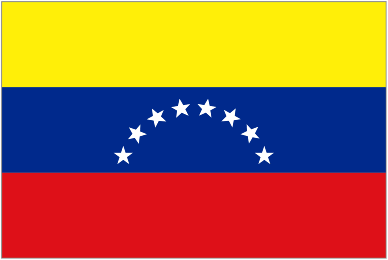
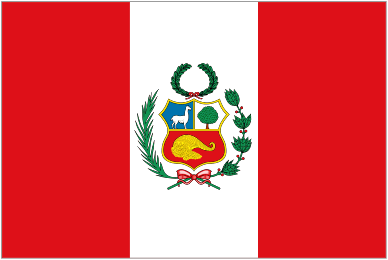
| 1958 - Statue of Simon Bolivar, Virginia Avenue, E Street & 18th Street, NW, Washington, DC (USA). "The height of the tip of the sword touching 27 feet makes this eight-ton statue technically the tallest in town. Simon Bolivar [1783-1830] liberated what are now Venezuela, Peru, Bolivia and Ecuador. Bolivia was named in his honor. Although he was hated at the time of his death, he has since become recognized and honored as the liberator of much of South America." Statue by Felix de Weldon [1906-2003] whoa lso sculpted the Iwo Jima Memorial in Arlington, Virginia.
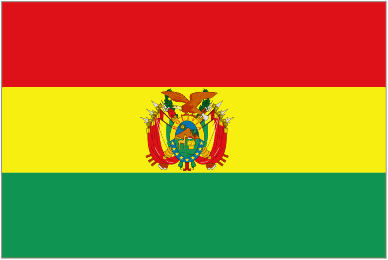
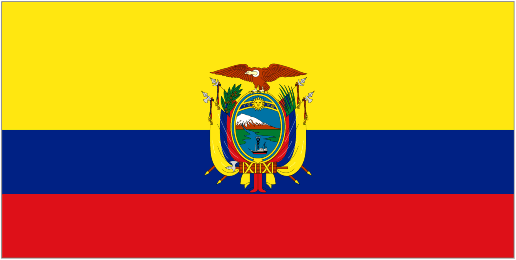
|
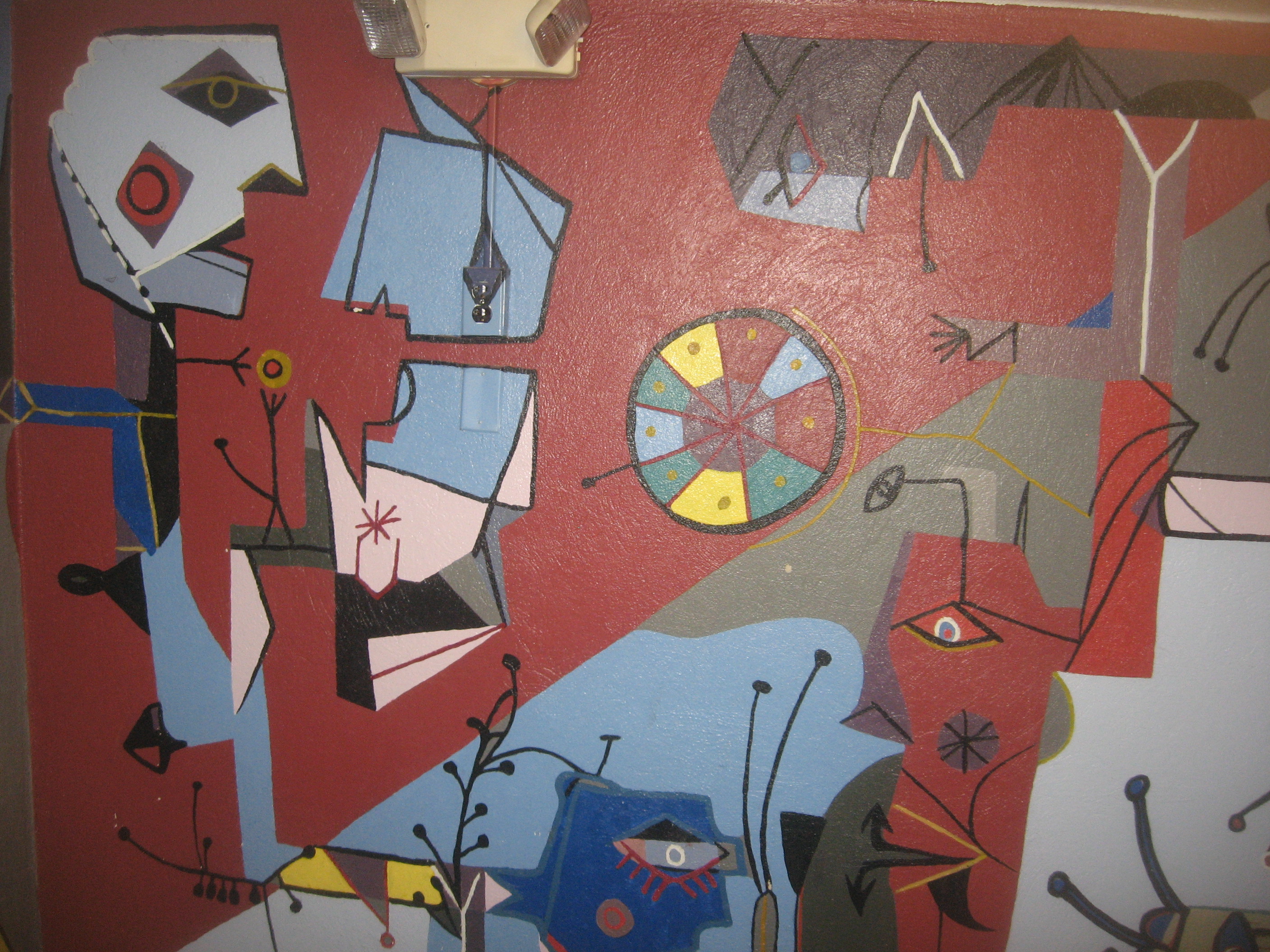
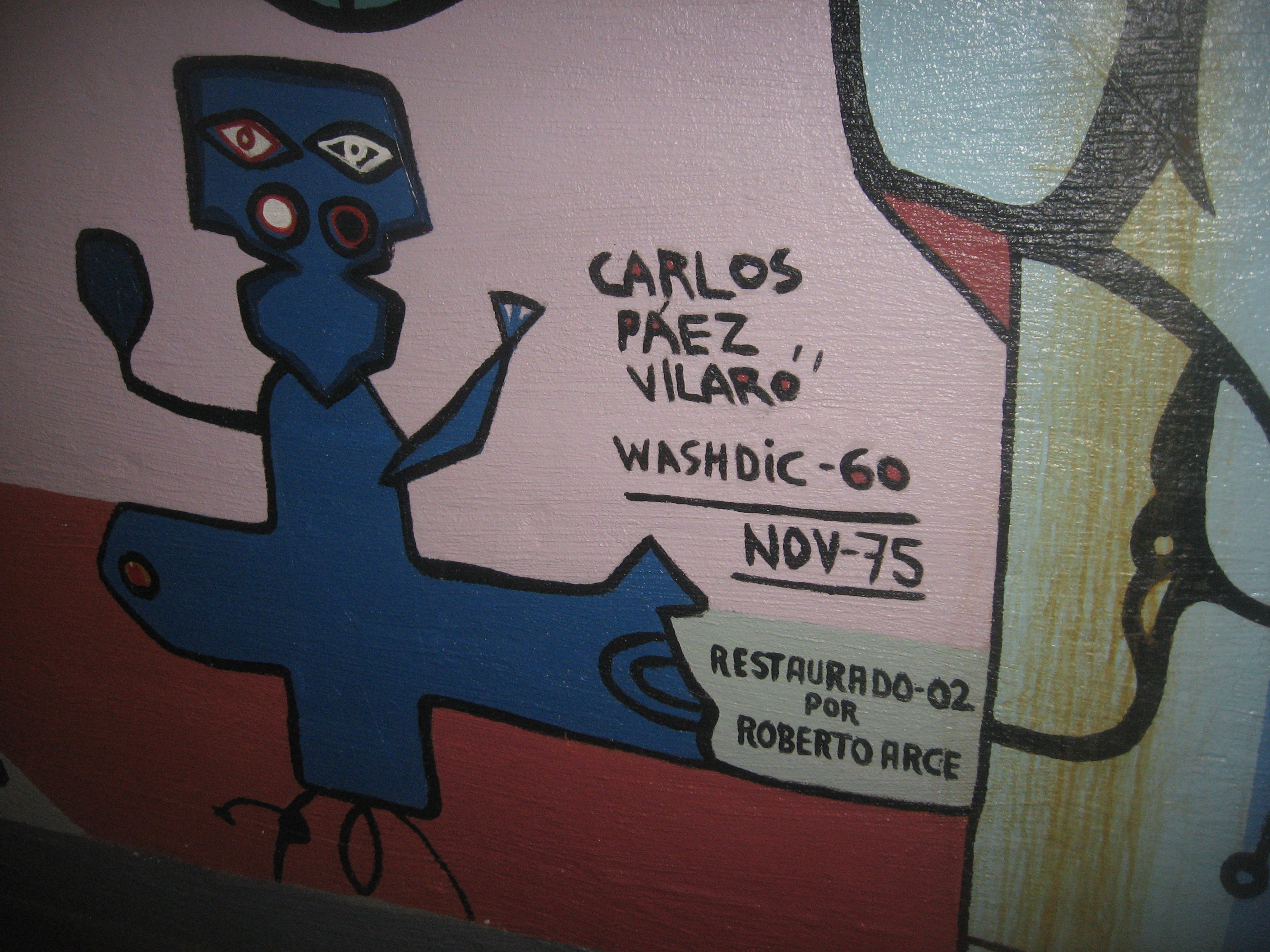 | December 1960-November 1975 - "Raíces de la Paz" / "The Roots of Peace," Organization of American States (OAS), 17th Street & Constitution Avenue, NW, Washington, DC (USA). "In the tunnel connecting the OAS Building with its Administration Building two blocks away is a 162-meter [sic] / 200-foot mural depicting various themes of peace & development in the Americas. World's widest mural? Painted by Uruguayan artist Carlos Paez Vilaró [b.1923] who also painted a mural for the UN building in New York City." Restored in 2002 by Roberto Arce. Both photos by EWL. 
|
 Date? - Headquarters, International Monetary Fund (IMF), Washington, DC (USA).
| 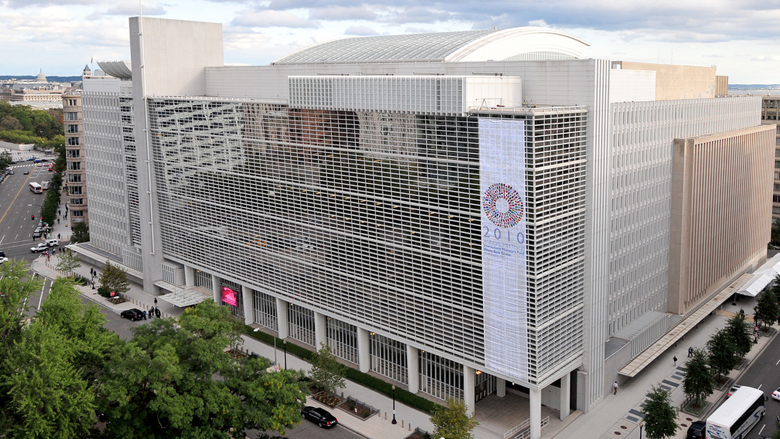 Date? - Headquarters, World Bank, Washington, DC (USA). Original name: International Bank for Reconstruction & Development (IBRD). Date? - Headquarters, World Bank, Washington, DC (USA). Original name: International Bank for Reconstruction & Development (IBRD). 
| 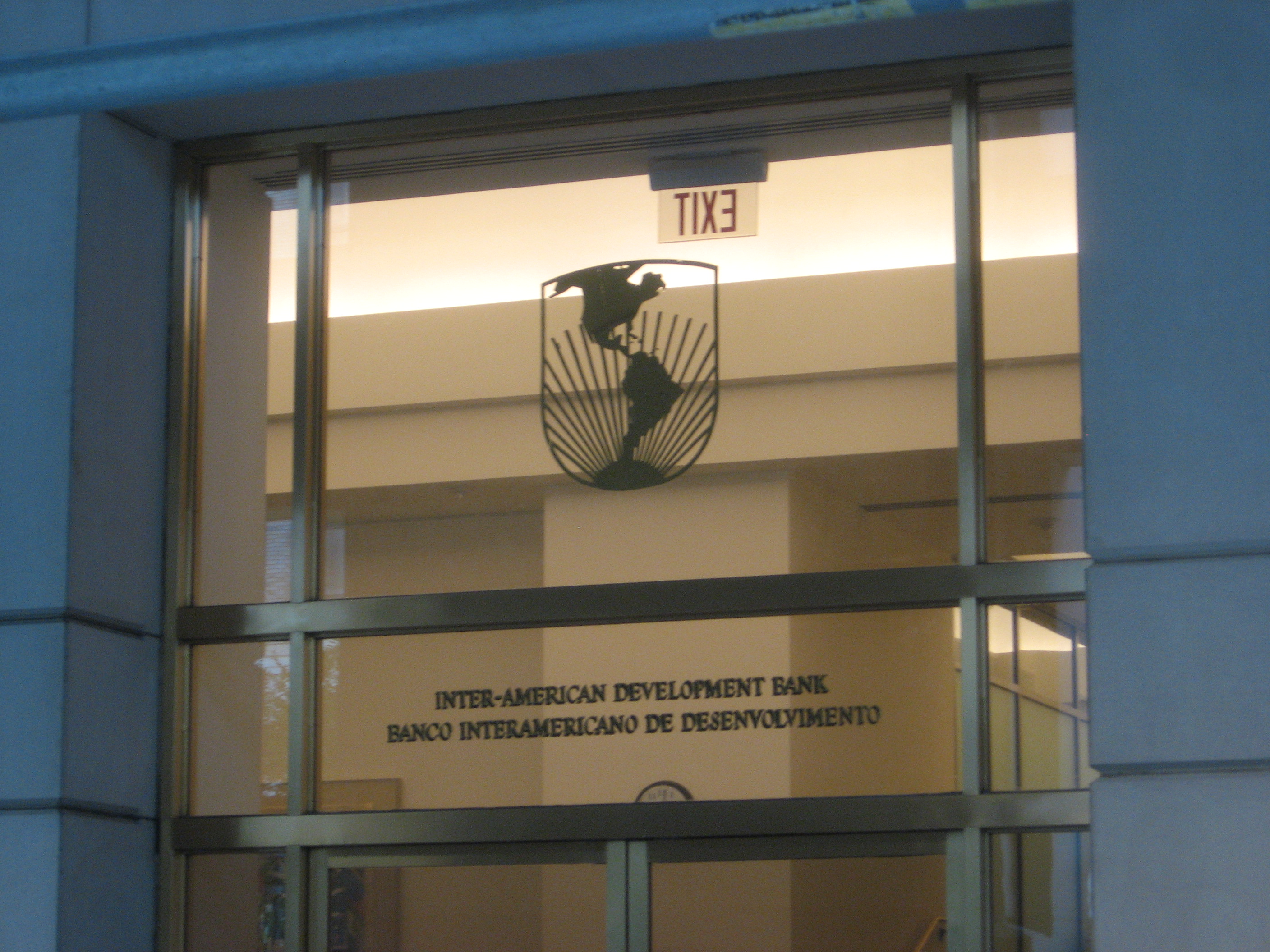 Date? - Inter-American Development Bank / Banco Interamericano de Desarrollo (IADB), Washington, DC (USA). Photo by EWL.
|
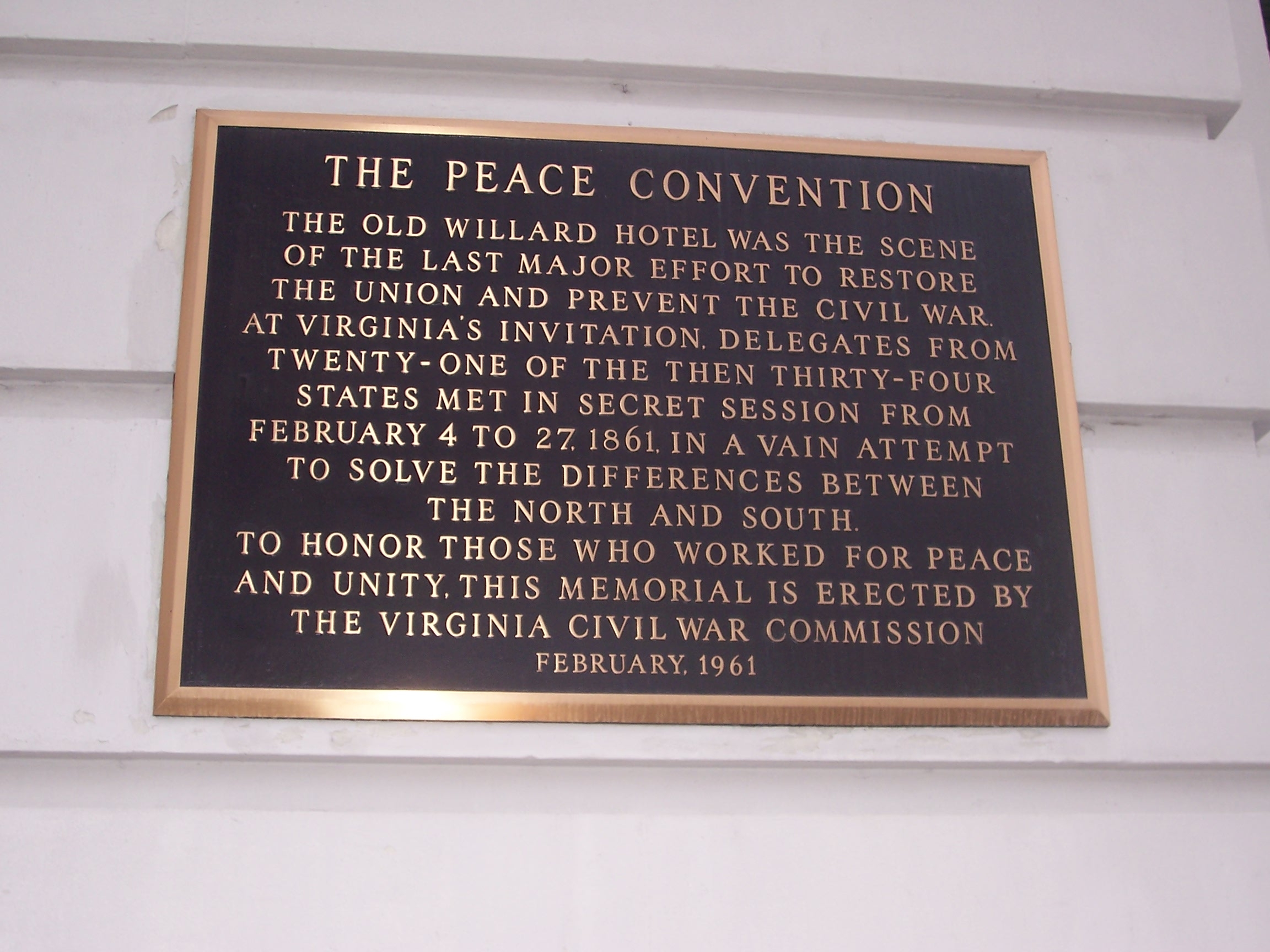
| February 1961 - Peace Commission Plaque, Willard Hotel, Pennsylvania Avenue at 15th Street, NW, Washington, DC (USA). Text: "THE PEACE CONVENTION. The old Willard Hotel was the scene of the last major effort to restore the Union and prevent the Civil War. At Virginia's invitation, delegates from twenty-one of the then thirty-four states met in secret session from February 4 to 27, 1861, in a vain attempt to solve the differences between the North and South. To honor those who worked for peace and unity, this memorial is erected by the Virginia Civil War Commission, February 1961." Sadly, the meeting failed. By the time Lincoln was inaugurated five days later, seven states had resolved to secede from the Union. Less than two months later, the Civil War began. Click here for alternative source of information.
|
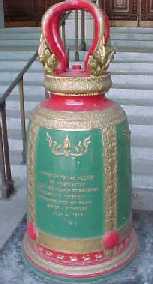
| 1961 - Thai Bell, John Wilson District Building, Federal Triangle, Pennsylvania Avenue at 14th Street, Washington, DC (USA). Presented to the people of Washington by the people of sister city Bangkok (Thailand). 
|

| U S E U M | December 28, 1961 - Woodrow Wilson House Museum, National Trust for Historic Preservation, 2340 S Street, NW, Kalorama, Washington, DC (USA). "Only presidential museum in DC." Home of Woodrow Wilson [1856-1924] from 1921 until his death in 1924. He received the Nobel Peace Prize in 1919 and died in this house on February 3, 1924. His widow Edith lived here until her death on December 28, 1961. She bequeathed the property & many of its furnishings to the National Trust. Inset shows celebration on Armistice Day, November 11, 1918. One of 27 US museums in "Museums for Peace Worldwide" edited by Kazuyo Yamane (2008).
|

| R I D G E | December 28, 1961 - Woodrow Wilson Memorial Bridge, Potomac River, between Alexandria, Virginia, & Oxon Hill, Maryland (USA). Woodrow Wilson [1856-1924] was president of Princeton University 1902-1910 & president of the USA 1913-1921. He received the 1919 Nobel Peace Prize. Bridge carries Interstate Highways 95 & 95 and opens for ships. Reconstructed 2006-2008. Wilson's widow died the same day that she was scheduled to dedicate the original bridge.
|

| C U L P T |
1963 - "Expanding Universe" Fountain, Foreign Service Court, Harry S. Truman Building, US Department of State, Washington, DC (USA). By Marshall M. Fredericks & commissioned for the US Government by the General Services Administration (GSA). According to Fredericks, the sculpture "represents this age of great interest, exploration and discovery in outer space...[and] the immensity, order & mystery of the universe." Marshall M. Fredericks [1908-1998] sculpted the "Spirit of Detroit," "Peace Arising from the Flames of War" in Cleveland & "Freedom of the Human Spirit" for the 1964 Worlds Fair in New York City & many other works. Saginaw Valley State University maintains the Marshall M. Fredericks Sculpture Museum which includes the plaster model of "Expanding Universe."
|
| After August 28, 1963 - Inscription, Steps of the Lincoln Memorial, Washington, DC (USA). Marks where Martin Luther King, Jr., stood when he delivered his famous "I have a dream" speech on August 28, 1963.
|
| R I D G E |
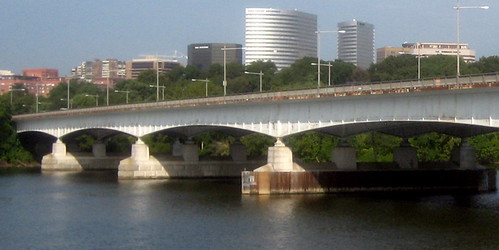
June 23, 1964 - Theodore Roosevelt Bridge, Potomac River, between Washington, DC, & Arlington, Virginia (USA).
Theodore Roosevelt [1858-1919] was US President 1901-1909 and received the 1906 Nobel Peace Prize.
| 

|
October 27, 1967 - Theodore Roosevelt Island National Memorial, Potomac River, Washington, DC (USA).
Theodore Roosevelt [1858-1919] was US President 1901-1909 and received the 1906 Nobel Peace Prize.
|
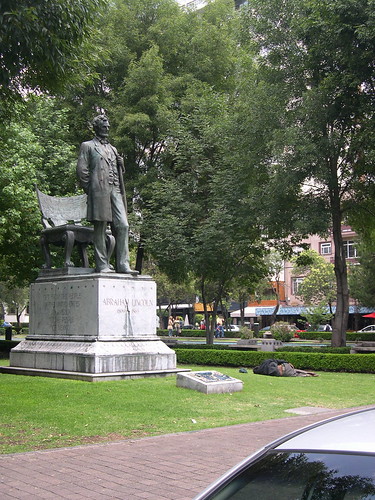 |  April 15, 1966 - Statue of Abraham Lincoln, Luis G. Urbina Park (since renamed Parque Lincoln), Polanco, Mexico City (Mexico). Gift of the United States presented by President Lyndon B. Johnson. Reproduction of a satue made in 1887 by Augustus Saint-Gaudens for Chicago's Lincoln Park. April 15, 1966 - Statue of Abraham Lincoln, Luis G. Urbina Park (since renamed Parque Lincoln), Polanco, Mexico City (Mexico). Gift of the United States presented by President Lyndon B. Johnson. Reproduction of a satue made in 1887 by Augustus Saint-Gaudens for Chicago's Lincoln Park.
| 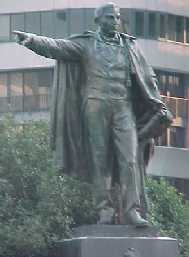 |
1969 - Statue of Benito Juarez, Foggy Bottom, Virginia & New Hampshire Avenues, Washington, DC. (USA). Sculpted by Enrique Alciati. Gift from Mexico in exchange for a statue of Abraham Lincoln. Juarez is the 'George Washington of Mexico,' and the statue points to the bust of Washington at George Washington University. Benito Pablo Juarez Garcia [1806-1872] was a full-blooded Zapotec Indian who became the first president of Mexico. He corresponded with Abraham Lincoln to get advice on how to establish a democracy, particularly one plagued with interracial problems.
|
April 4-8, 1968 - Race riots along 14th Street, NW, & in other parts of the District of Columbia following the assassination of Martin Luther King, Jr., in Memphis, Tennessee. (Civil unrest affected at least 110 US cities; Washington, Chicago & Baltimore were among the most affected.)
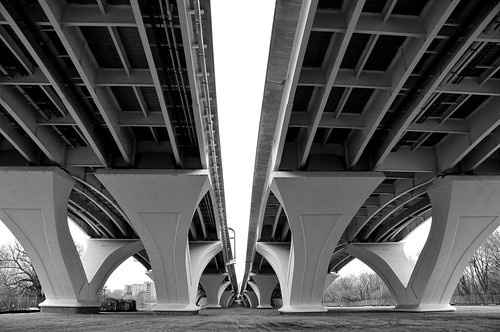
| December 28, 1961 - Woodrow Wilson Memorial Bridge, Potomac River, between Alexandria, Virginia, & Oxon Hill, Maryland (USA). Woodrow Wilson [1856-1924] was president of Princeton University 1902-1910 & president of the USA 1913-1921. He received the 1919 Nobel Peace Prize. Bridge carries Interstate Highways 95 & 95 and opens for ships. Reconstructed 2006-2008. Wilson's widow died the same day that she was scheduled to dedicate the original bridge.
|


| October 27, 1967 - Theodore Roosevelt Island National Memorial, Theodore Roosevelt Island, Potomac River, Arlington, Virginia (USA).
"Designed by Eric Gugler, the memorial includes a 17-foot statue by sculptor Paul Manship, four large stone monoliths with some of Roosevelt's more famous quotations & two large fountains. From Susan Ives: "I would have expected something belligerent for TR -- maybe him charging up San Juan Hill -- but it is instead reflective about nature, character, manhood & the State. The one quote specifically about peace is ambivalent: 'If given the choice between Righteousness and Peace, I choose Righteousness.' But at least it makes you think.'" /// This is "Monday's Monument" #136.
|


|
1971 - "War or Peace," Kennedy Center, Washington, DC (USA). By Jurgen Weber [1928-2007].
"On the east side of the plaza at the entrance to the Kennedy Center. A gift from the West German government. [Figures representing peace include] a seated female nursing a baby & a male figure standing behind them (represents the family as a shield against War); a group embracing male & female figures dancing to music created by a nearby figure of Pan playing his flute, (represents Peace in the form of dancing lovers); an amphitheater filled with performers such as a conductor, Louis Armstrong & other jazz musicians, can-can girls, Hamlet with his mask, Mephistopheles with his mask of Faust, Pan playing the saxophone, and characters from the Three-Penny Opera with Diogenes carrying his lantern in search of an honest man (represents Peace as a creative arena)." 
|

|
1974 - Mary McLeod Bethune Memorial, Lincoln Park, East Capitol & 12th Streets, Washington, DC (USA). Sculpted by Robert Berks (who also did DC statues of JFK and Einstein). Mary McLeod Bethune [1875-1955] was an American educator and civil rights leader best known for starting a school for black students in Daytona Beach, Florida, that eventually became Bethune-Cookman University and for being an advisor to FDR. Faces the Emanciphiation Monument which depicts Lincoln & a freed slave. Also see Mary McLeod Bethune Council House National Historic Site (National Park Service).
|
| U S E U M |
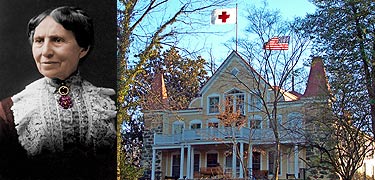
1975 - Clara Barton National Historic Site, National Park
Service (NPS), 5801 Oxford Road (at MacArthur Boulevard), Glen Echo, Washington, DC (USA). "The first NPS site dedicated to the accomplishments of a woman." Clara Barton [1821-1912] founded the American Red Cross on May 21, 1881. This bulding is a former Red Cross field hospital used by Barton for relief following the Johnstown Flood on May 31, 1889. After being moved to Washington, the building became ARC headquarters, and Barton lived here the last 15 years of her life (1897-1912).
|

 | January 30, 1976 - Gandhi Memorial Center, 4748 Western Avenue, Bethesda, Maryland (USA). Across the street from Washington, DC.
Houses headquarters for the Mahatma Gandhi Memorial Foundation, a library & special meeting rooms for lectures & films depicting the life and activities of Mahatma Gandhi [1869-1948] & the cultural heritage of India.
The foundation was founded in the USA in 1959 by Swami Premananda. He, Srimati Kamala & His Excellency Ambassador T.N. Kaul dedicated the center on January 30, 1976. Ambassador Kaul said that Mahatma Gandhi belonged not only to India but to the whole world. America could also claim him as its own because of his universality. Swami Premananda stated that Mahatma Gandhi was India’s greatest contribution to the 20th century. 
|


| 1976 - Yamaki Bonsai, National Bonsai & Penjing Museum, National Arboretum, Washington, DC (USA).
"Japanese white pine (Pinus parvifolia). Donated as a sign of friendship from Japan. Represents peace between Japan & the USA... Donated by bonsai master Masaru Yamaki. Part of a 53-specimen gift to the USA for its 1976 bicentennial. Little was known about the tree until March 8, 2001, when - with no advance notice - two brothers visiting from Japan showed up at the museum to check on their grandfather’s tree... One of the things that makes it so special is [that] somebody has attended to that tree every day since 1625...
When the atomic bomb dropped in Hiroshima on Aug. 6, 1945, Yamaki and his family were inside their home less than 2 miles away from the explosion. The devastating event killed around 140,000 people, but Yamaki and his family survived largely unhurt, with only some minor injuries from flying glass fragments. Sitting just outside of their house, in a walled nursery, the bonsai tree stood, unharmed."
|
 | April 22, 1979 - Einstein Memorial at the National Academy of Sciences (NAS), NAS Building, Constitution Avenue, NW, Washington, DC (USA). Sculpted by Robert Berks and based on a bust he sculpted from life in 1953. Created for the 100th anniversary of the birth of Albert Einstein [1879-1955].
|
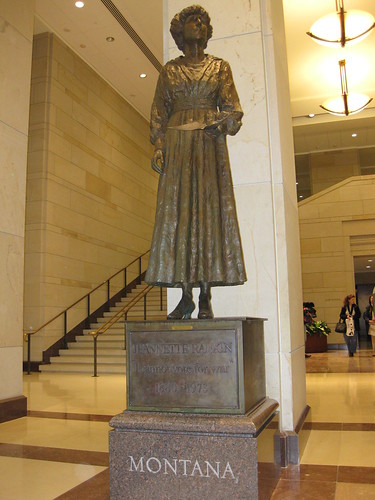
| 1985 - Statue of Jennette Rankin, Statuary Hall, US Capitol, Washington, DC (USA). Duplicate of statue by Terry Mimnaugh honoring Jennette Rankin [1880-1973] in state capitol, Helena, Montana (USA). Entry #1117 in the "Peace Movement Directory" by James Richard Bennett (2001).
| 
|  1980 - Statue of Jennette Rankin, Second Floor, State Capitol, Helena, Monana (USA). Original of statue by Terry Mimnaugh honoring Jennette Rankin [1880-1973] in Statuary Hall, US Capitol, Washington, DC (USA). Entry #576 in the "Peace Movement Directory" by James Richard Bennett (2001). 1980 - Statue of Jennette Rankin, Second Floor, State Capitol, Helena, Monana (USA). Original of statue by Terry Mimnaugh honoring Jennette Rankin [1880-1973] in Statuary Hall, US Capitol, Washington, DC (USA). Entry #576 in the "Peace Movement Directory" by James Richard Bennett (2001).
|

| About 1985 - Peace House, 1233-12th Street, NW, Washington, DC (USA). Constructed about 1864. Purchased by William & Ellen Benjamin at a tax auction & named "Peace House." Used by |
 | A T E | 1986 - Friendship Gate, Chinatown, H Street at 7th Street, NW, Washington, DC (USA). Gift from Beijing (China) to its sister city Washington, DC. Said to be the largest gate of its type in the world. 
|

| U S E U M | 1987 - National Museum of Women in the Arts (NMWA), 1250 New York Avenue, NW, Washington DC (USA). "The only museum in the world dedicated exclusively to recognizing the contributions of women artists." Click hee for the Wikipedia article.
|
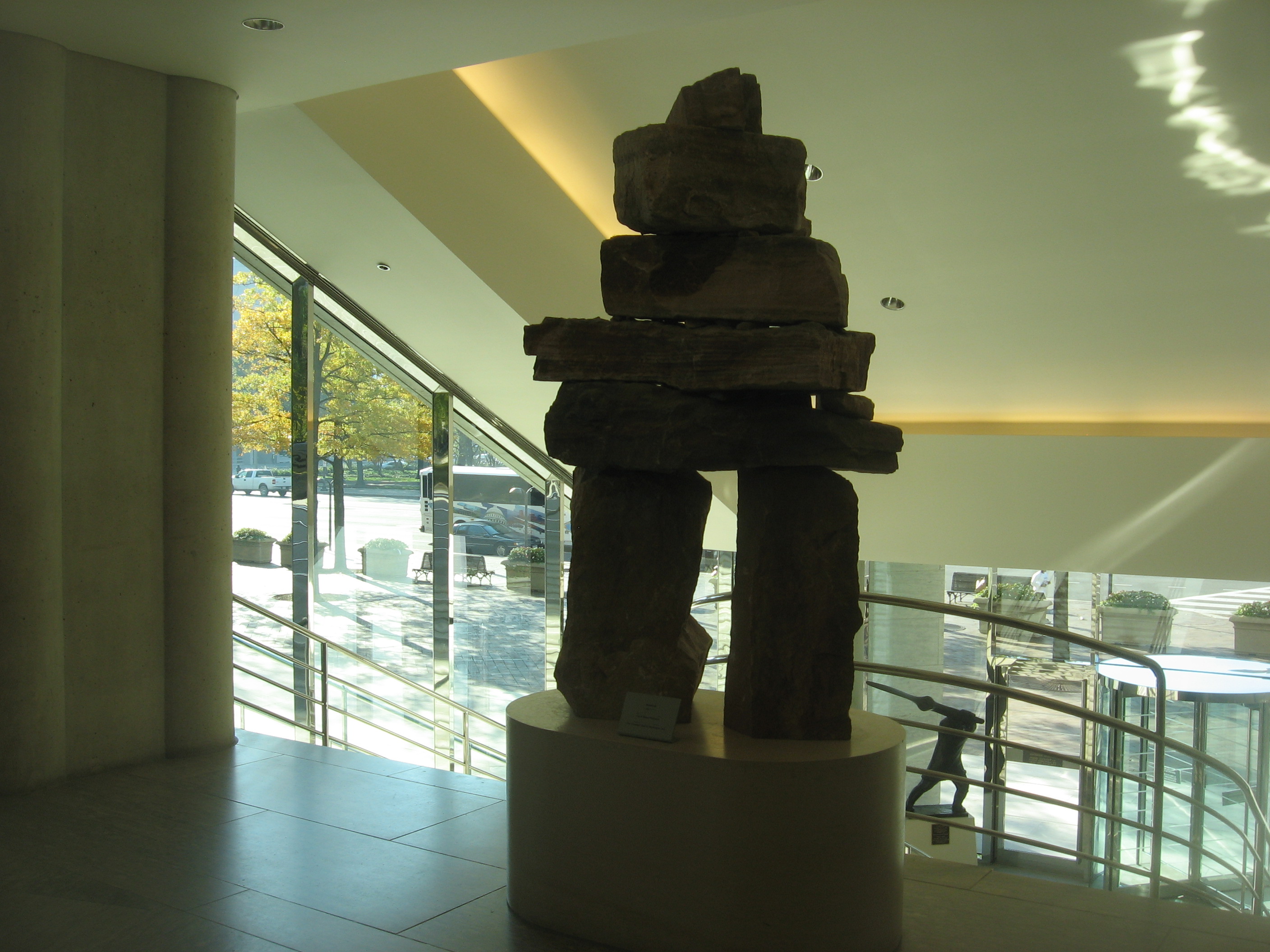
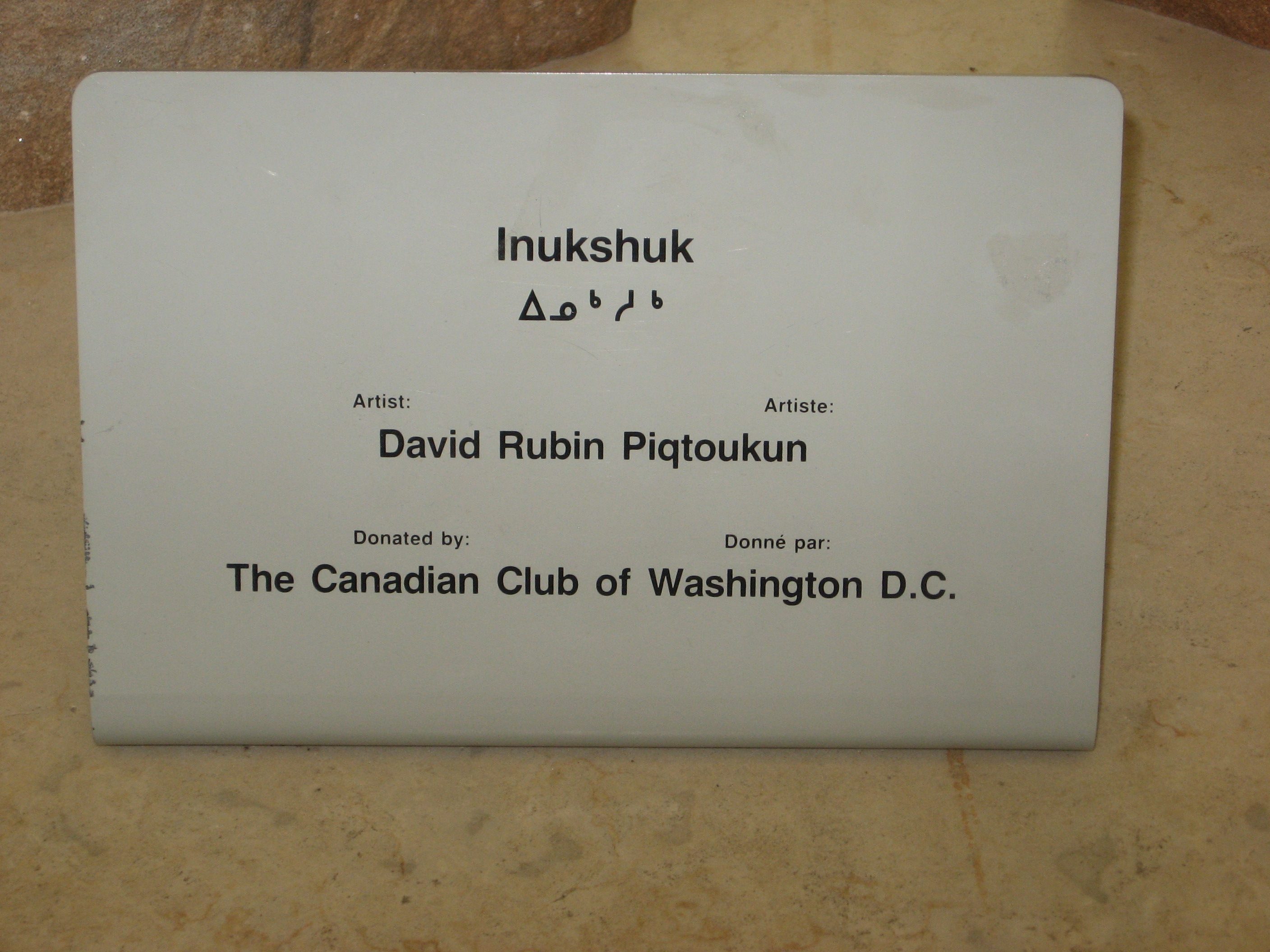
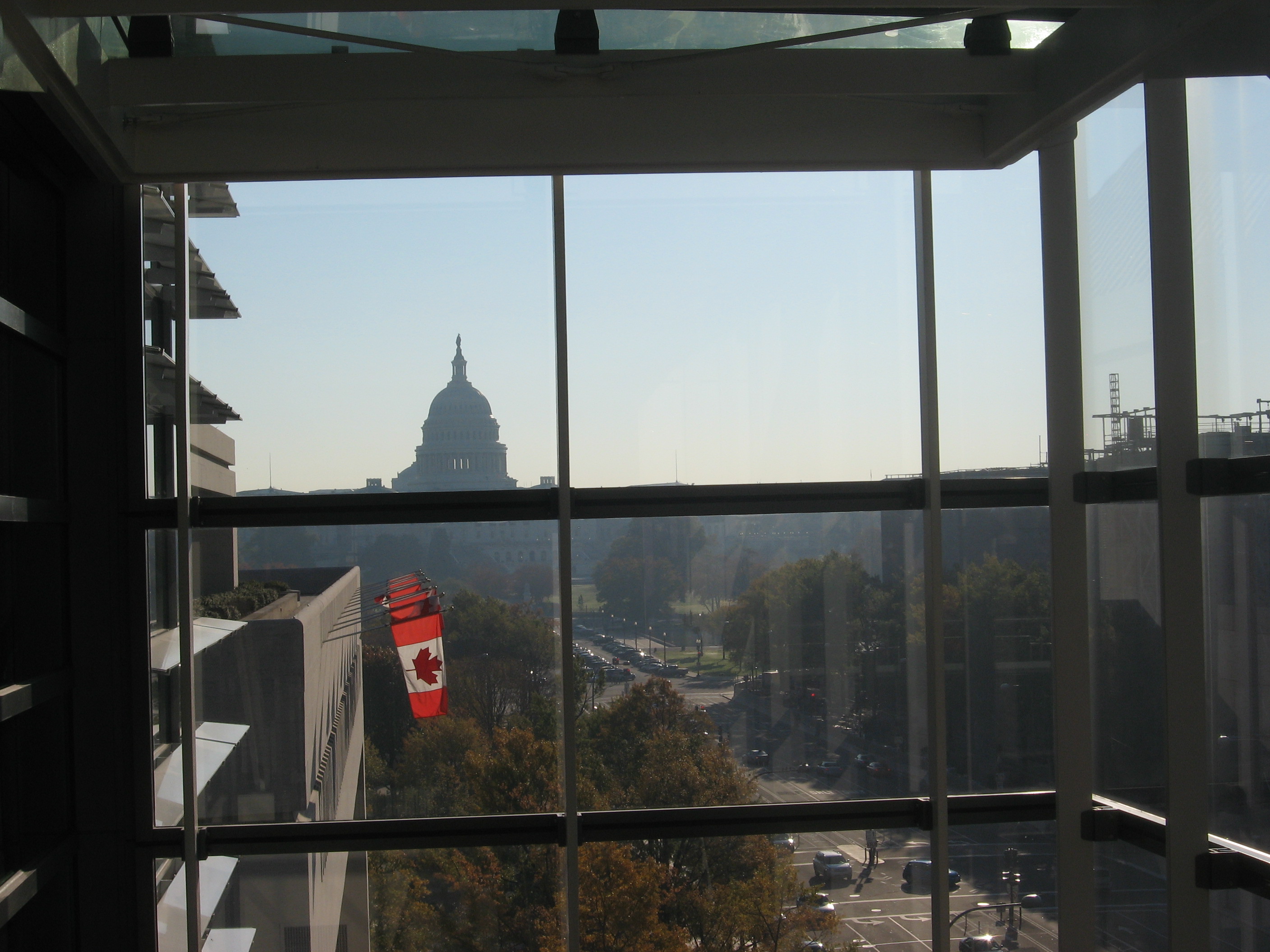 | 1988 - Inuksuit, Consular Section, Canadian Embassy, Pennsylvania Avenue, NW, Washington DC (USA). According to an embassy brochure, "this Inuit sculpture mimics the figure of a solitary man. The rocks are balanced one on top of the other, only the bottom two are fixed. Such Inukshuit, built by the people of Canada's northernmost region, are used to mark trailheads and to pen caribou [sic]. When snowfall creates whiteout conditions, the Inukshuk serves as the only distinguishing feature between land and sky. The Artist, David Rubin Piktoukin, lived on site at the Embassy while building this piece in 1988." Click here for this & other inuksuit.
Right image overlooks the Canadian Embassy from the neghboring Newseum (qv). Photos by EWL.
|

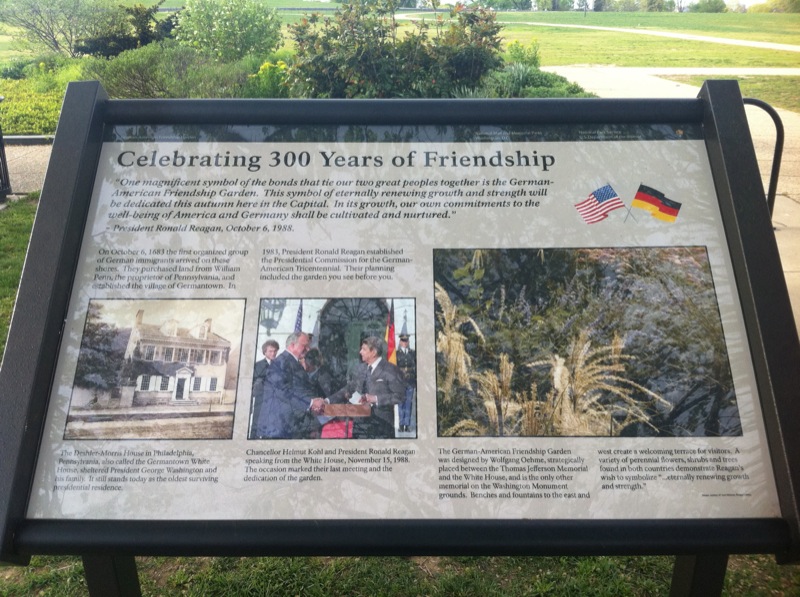 | November 15, 1988 - German-American Friendship Garden, Constitution Avenue between 15th & 17th Streets, Washington, DC (USA). "Commemorates the 300th anniversary of German immigration to America. Symbolizes the positive & cooperative relations between the USA & the Federal Republic of Germany. Features plants native to both countries."
|
 | Early 1990's - Nyingma Tibetan Buddhist Temple & Stupa Peace Park, Kunzang Palyul Choling (KPC) of Maryland, 18400 River Road, Poolesville, Montgomery County, Maryland (USA), near Washington, DC. 65-acre peace park. See similar stupa & peace park in Sedona, Arizona (USA).
|


| April 13, 1991 - First International Peace Garden, near the Tidal Basin, Washington, DC (USA). One of many International Peace Gardens in different countries. 4000 tulip bulbs presented to Washington, DC, by Ottawa (Canada).
|
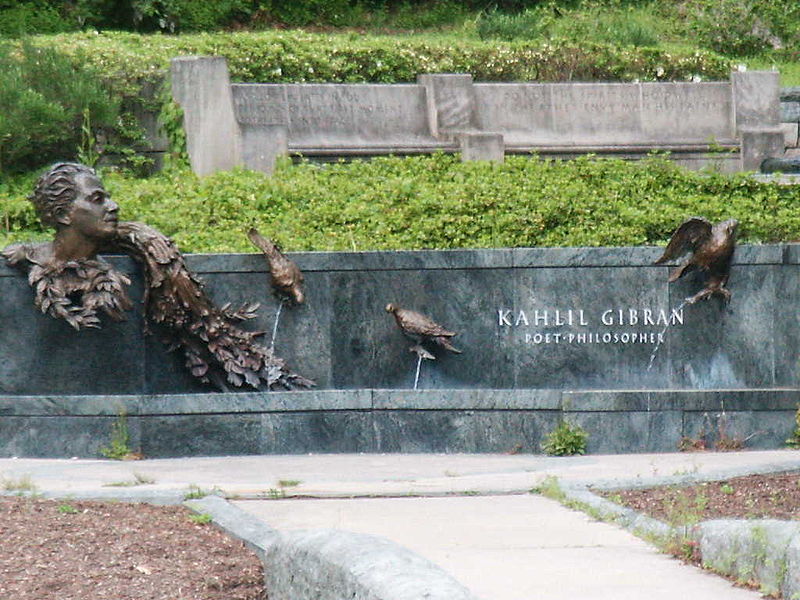 | May 24, 1991 - Kahlil Gibran Memorial, Massachusetts Avenue, NW (Embassy Row), Washington, DC (USA). "President George H.W. Bush ceremoniously cut the ribbon to the memorial garden stating, 'All who contributed to this memorial offer it as a real tribute to Gibran’s legacy – his belief in brotherhood, his call for compassion, and, perhaps above all, his passion for peace.' Some people may have questioned the sincerity of those remarks, given that a few months earlier Bush spearheaded an international coalition to wage war against Saddam Hussein’s invasion of Kuwait." Click here for the Wikipedia article on Kahlil Gibran [1883-1931]. See other Gibran memorials in Bsharri (Lebanon) and Boston, Massachusetts (USA).
|
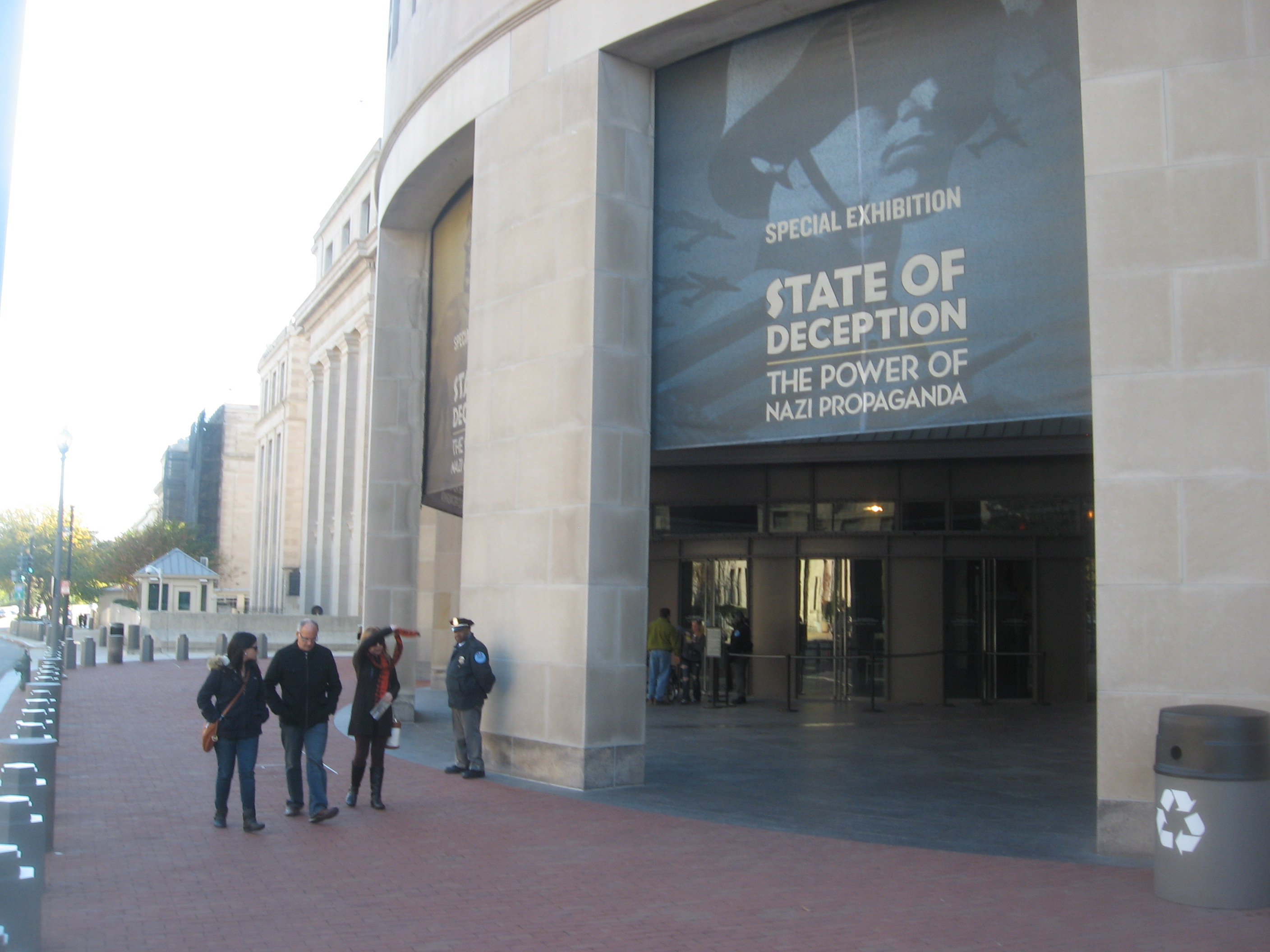
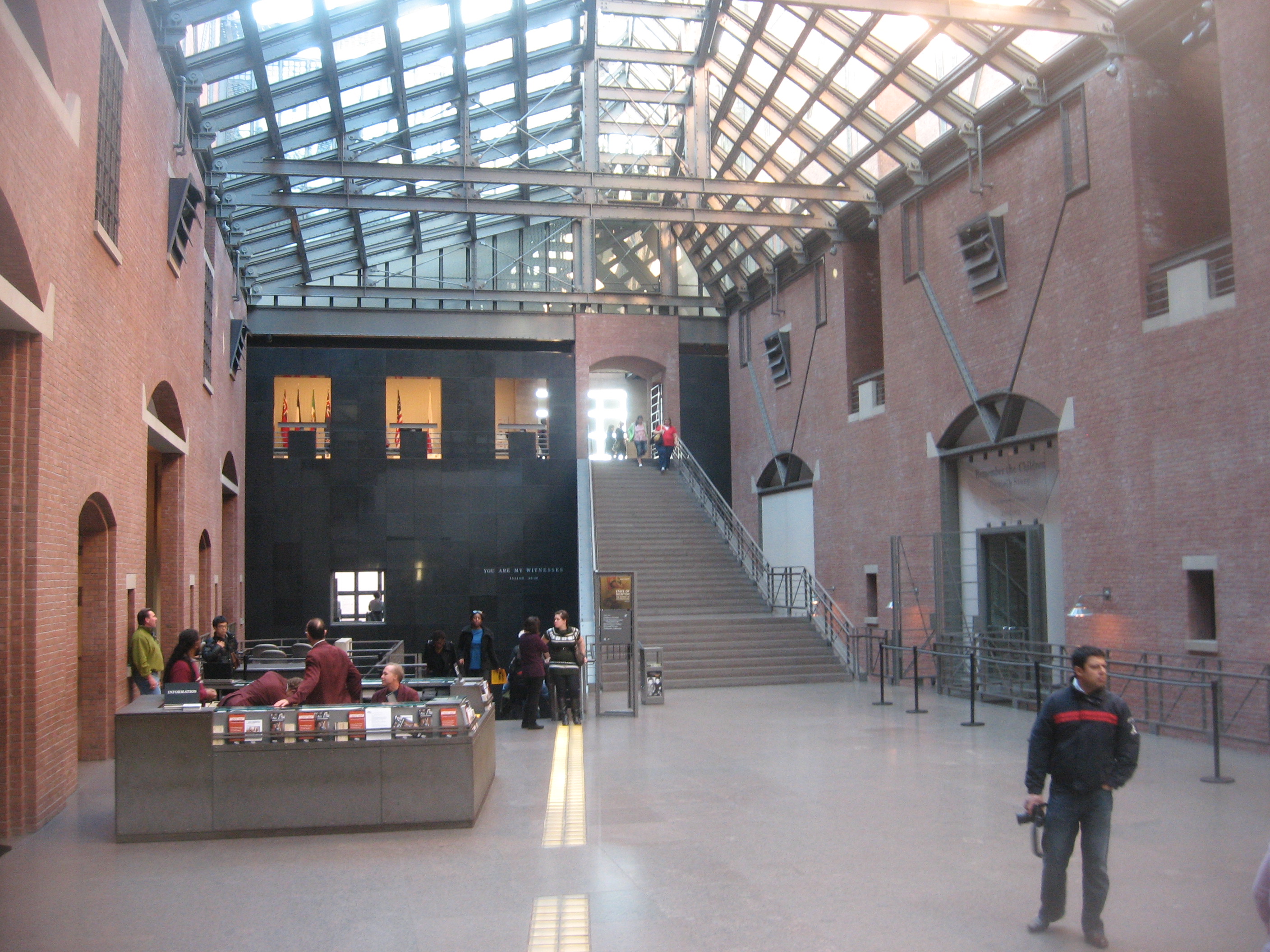
| U S E U M | April 22, 1993 - United States Holocaust Memorial Museum (USHMM), 100 Raoul Wallenberg Place, SW, Washington, DC (USA). "Provides for the documentation, study, and interpretation of Holocaust history. Dedicated to helping leaders and citizens of the world confront hatred, prevent genocide, promote human dignity, and strengthen democracy." Entry #967 in the "Peace Movement Directory" by James Richard Bennett (2001). One of 27 US museums in "Museums for Peace Worldwide" edited by Kazuyo Yamane (2008). Both images by EWL.
|

|
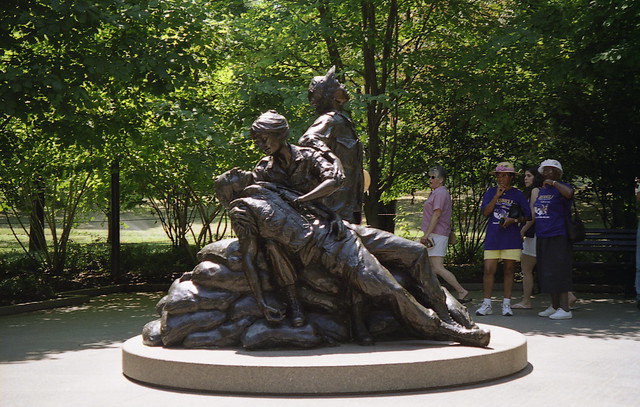
November 11, 1993 - Vietnam Women's Memorial, National Mall, Washington, DC (USA). Part of the Vietnam Veterans Memorial. "Dedicated to US women who served in the Vietnam War, most of whom were nurses. Depicts 3 uniformed women. The woman looking up is named Hope, the woman praying is named Faith, & the woman tending to a wounded soldier is named Charity. Designed by Glenna Goodacre. There is a scale model of the statue at the Vietnam Veterans Memorial State Park in Angel Fire, New Mexico."
|
| 1994 - "May We Have Peace," National Museum of the American Indian, Smithsonian Institution, Washington, DC (USA). 11-foot bronze statue by Native American artist Allan Houser [1914-1994]. Features a Chiricahua Apache man with a peace pipe. "Temporarily installed at the residence of Vice President & Mrs. Al Gore in 1994." Then stored at the Smithsonian collections facility in Suitland, Maryland (right image) before the museum opened on September 21, 2004.
Duplicate of a statue at Oklahoma University, Norman, Oklahoma (qv).
|
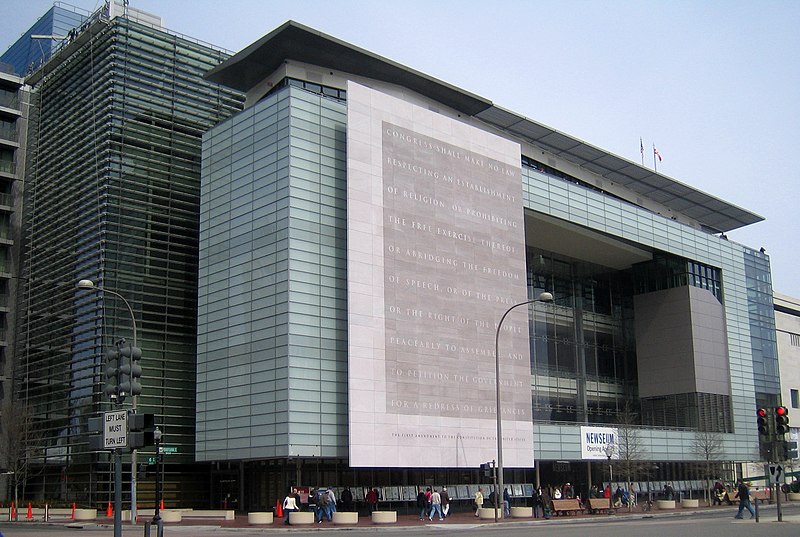
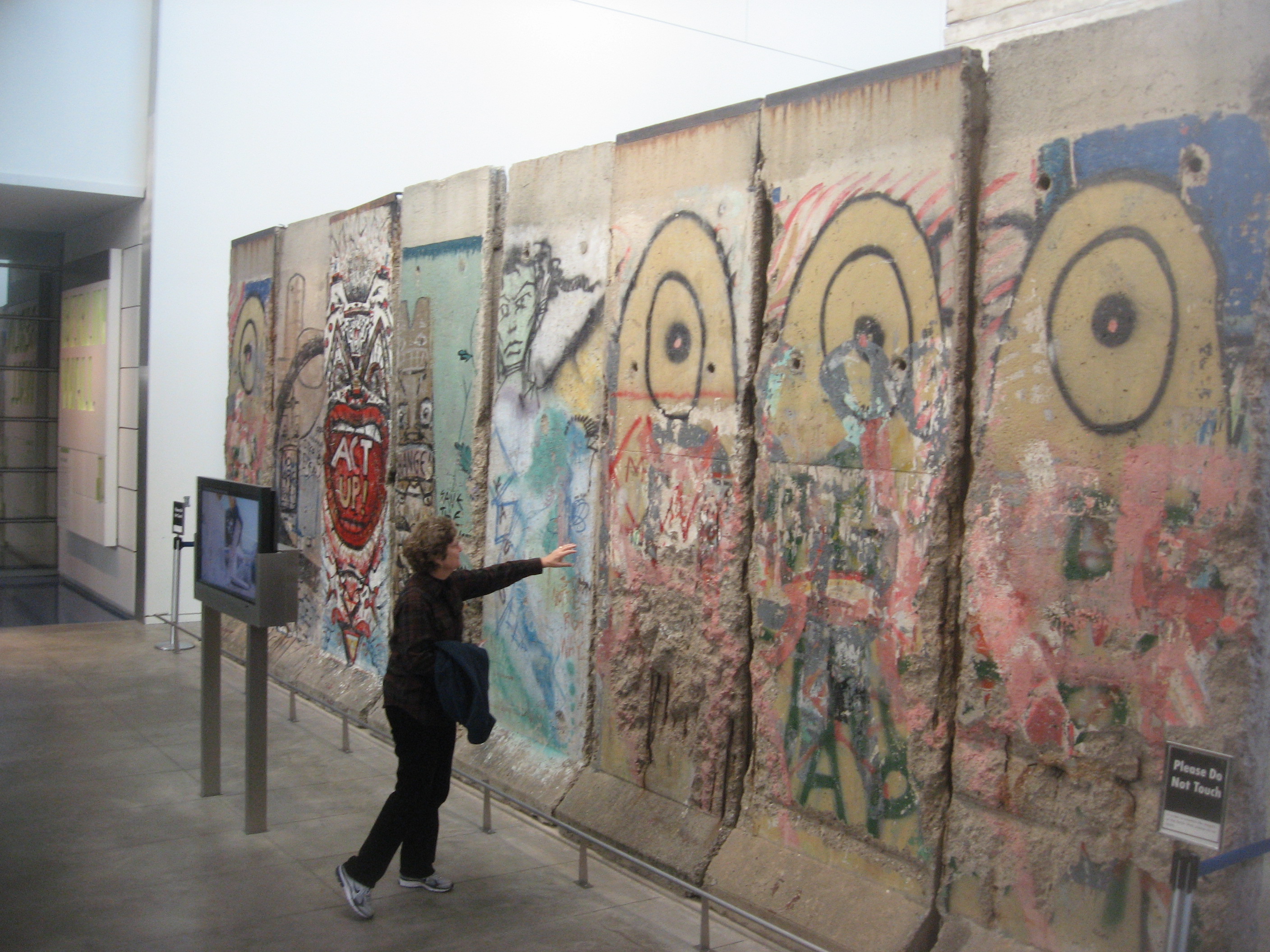
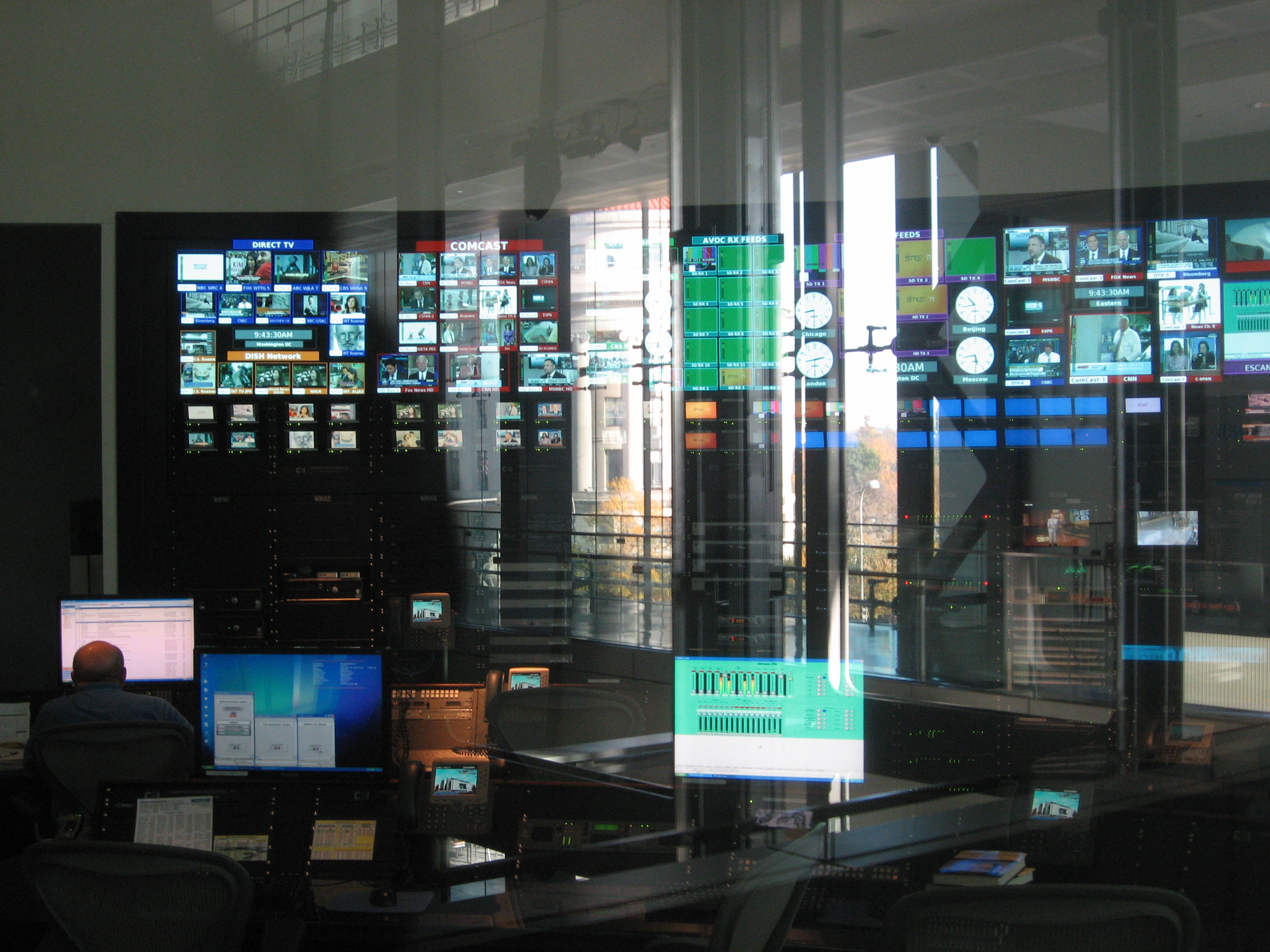
| U S E U M | April 18, 1997 - Newseum, 555 Pennsylvania Avenue, NW, Washington, DC (USA). "The world's most interative museum." Funded by the Freedom Forum, a nonpartisan foundation dedicated to "free press, free speech and free spirit for all people." The original Newseum in Arlington, Virginia, was closed on March 3, 2002, in order to allow its staff to concentrate on building the new, larger museum. The new museum, built at a cost of $450 million, opened its doors to the public on April 11, 2008. Middle image is segment of the Berling Wall. Right image is control room for TV monotors & for receiving news from around the world. Right two images by EWL. Click here for the Wikipedia article.
|
| May 2, 1997 - Franklin Delano Roosevelt Memorial, Tidal Basin, Washington, DC (USA). Vast 7.5-acre memorial has four outdoor "rooms" (one for each of Roosevelt's four terms as president). Click here for all 21 FDR quotes. |  |
|
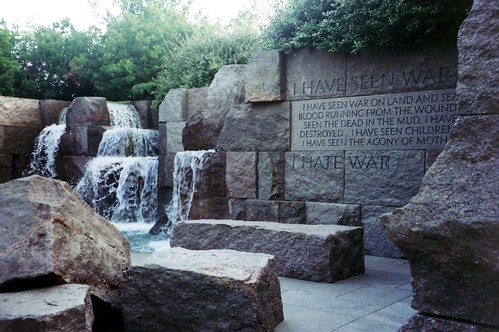
May 2, 1997 - Franklin Delano Roosevelt Memorial, Tidal Basin, Washington, DC (USA). Here is the "war quote" in room 3 (next to jumbled stones representing the destruction of war):
"I have seen war. I have seen war on land and sea. I have seen blood running from the wounded. I have seen the dead in the mud. I have seen cities destroyed. I have seen children starving. I have seen the agony of mothers and wives. I hate war." (From an address at Chautauqua, NY, August 14, 1936.) Entry #1160 in the "Peace Movement Directory" by James Richard Bennett (2001).
|

|
May 2, 1997 - Franklin Delano Roosevelt Memorial, Tidal Basin, Washington, DC (USA). Here is the "peace quote" in room 4 (next to satue of Eleanor Roosevelt): "The structure of world peace cannot be the work of one man, or one party, or one nation... It must be a peace which rests on the cooperative effort of the whole world." (From an address to Congress after his return from Yalta, March 1, 1945.) Entry #1161 in the "Peace Movement Directory" by James Richard Bennett (2001).
|

| P L A Q U E 1997 - Jean Monnet Plaque, Willard Hotel, 1401 Pennsylvania Avenue, NW, Washington, DC (USA). Jean Monnet [1888-1979] is regarded by many as a chief architect of European Unity. He maintained an office in the Willard Hotel as a member of the British Mission in Washington during World War II.
|
 | 1997 - Guns to Plowshares, Judiciary Square Metro Stattion, Washington, DC (USA). Sculpture by Mennonite artists Esther K. Augsburger and her son Michael D. Augsburger: 20-foot plowshare with 3,000 welded handguns donated by the Metropolitan Police. Entry #1111 in the "Peace Movement Directory" by James Richard Bennett (2001).
|
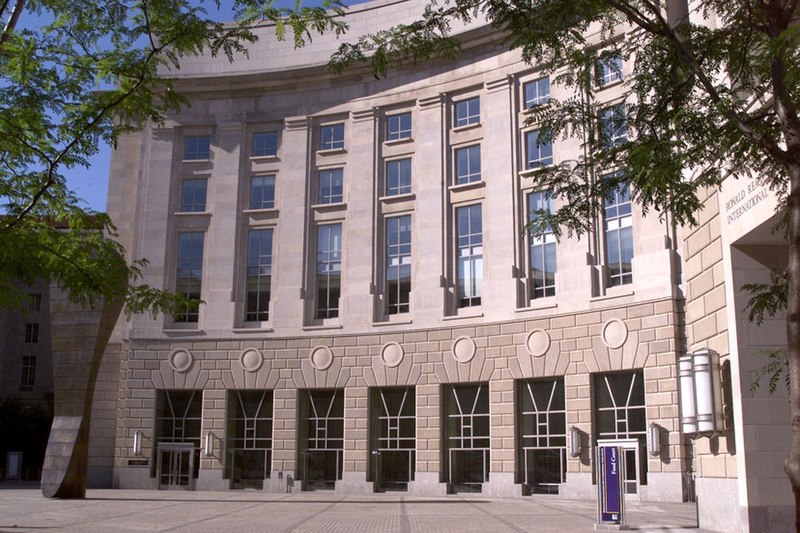

| May 5, 1998 - Woodrow Wilson International Center for Scholars, One
Woodrow Wilson Plaza, 1300 Pennsylvania Avenue, NW, Washington, DC (USA). A wing of the Ronald Reagan Building. At Federal Triangle Metro Station. "The nation's living memorial to Woodrow Wilson, president of the United States from 1913 to 1921. Created by law in 1968. Washington's only independent, wide-ranging institute for advanced study where vital cultural issues & their deep historical background are explored through research & dialogue."
|

| June 1999 - Alexander Pushkin Monument (left image), The George Washington University, H & 22nd Steets, NW, Washington, DC (USA). Reciprocal for the statue of Walt Whitman that was placed by US Secretary of State Hilary Rodham Clinton (right image) at Moscow State University, Moscow (Russia) in October 2009. 
|
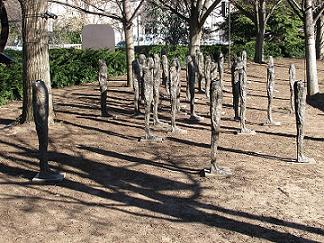
| 1999 - Puellae / Girls, Sculpture Garden, National Gallery of Art, Washington, DC (USA). "Testament to a story Polish artist Magdalena Abakanowicz heard about children who froze to death being tansported from Poland to Germany during World War II."
|

| 2000 - "Ethics of Peace," Georgetown University Medical Center, Washington, DC (USA). Bronze, 3' x 3' x 3' (1/2 Life Size) by Michael Malfano who wrote: "As depicted in the sculpture, the central figure seeks inner peace by questioning, by living non-judgementally, and by having the courage to make the hard changes necessary to attain the innocence of children. Since the problem of violence is man-made, the solution must also be man-made."
|

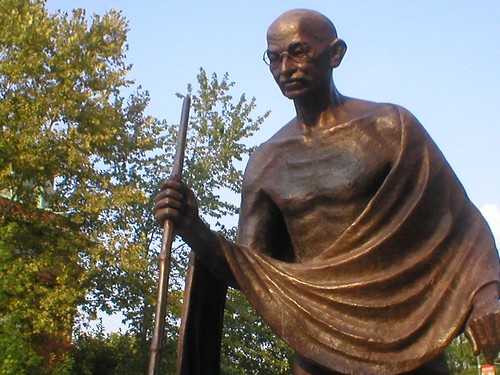
| September 16, 2000 - Mahatma Gandhi Memorial, Dupont Circle, Washington, DC (USA). Text of plaque: "GANDHI LED INDIA TO FREEDOM FROM BRITISH RULE IN 1947.
HE IS HAILED AS THE FATHER OF THE NATION.
CRUSADER FOR HUMAN RIGHTS AND LIBERTY, THINKER, WRITER
REFORMER, APOSTLE OF TRUTH AND NON-VIOLENCE (AHIMSA),
GANDHI SUCCEEDED IN UNITING MILLIONS OF PEOPLE OF ALL FAITHS
ACROSS INDIA IN A MASS MOVEMENT OF CIVIL DISOBEDIENCE.
ON GANDHI'S SEVENTIETH BIRTHDAY, ALBERT EINSTEIN WROTE,
"GENERATIONS TO COME, IT MAY BE, WILL SCARCE BELIEVE THAT SUCH A ONE
AS THIS EVER IN FLESH AND BLOOD WALKED UPON THIS EARTH"." Entry #1107 in the "Peace Movement Directory" by James Richard Bennett (2001).
|
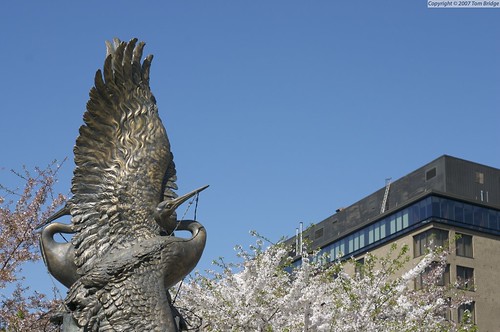

| November 9, 2000 - National Japanese American Memorial to Patriotism During World War II, Washington, DC (USA). Pays homage to the thousands of Japanese men & women who were imprisioned 1942-1945 in ten American relocation camps:
Amache (Granada), Heart Mountain, Gila River, Jerome, Manzanar, Minidoka, Poslon, Rohwer, Topaz & Tule Lake. At the center of the memorial is a bronze sculpture by Nina A. Akamu of two cranes ensnared in barbed wire. Rising above the confines of the memorial wall, the crane is meant to symbolize "rising beyond limitations." Click here for "Japanese Americans Disunited: How a memorial to unify the Japanese American community became a symbol of disunity" by Francis Y. Sogi & Yeiichi (Kelly) Kuwayama.
|

 | April 9, 2002 - George Mason Memorial, Tidal Basin, NW, Washington, DC (USA). "Dedicated to the author of the Virginia Declaration of Rights, which inspired Thomas Jefferson while drafting the Declaration of Independence. George Mason [1725-1792] persuaded our forefathers to include individual rights as a part of the Bill of Rights." Features a 72-foot (22 m) long stone wall with a one-third larger than life-sized statue of a sitting Mason, his legs crossed, & a circular pool. The landscape architect was Faye B. Harwell. The sculptor was Wendy M. Ross.
|

| October 27, 2003 - First Children's International Peace Garden, Pope John Paul II Cultural Center, 3900 Harewood Road, NE, Washington DC (USA). "Honors Pope John Paul II’s Peace Efforts...during the Silver Jubilee of his extraordinary pontificate." One of many International Peace Gardens in different countries.
|

| Spring 2004 - Statue of Ignacy Jan Paderewski, Polish Embassy, Washington, DC (USA).
Life-sized, weighs approximately 400 pounds. Created by renowned sculptor Jessie Corsaut at the Monterey Sculpture Center in California. Heroic size statue of Paderewski as a young man. "Temporarily installed in the embassy garden until it can be relocated to a permanent public setting in the city." Donated by Harry E. Blythe III, a well known philanthropist, who owns a significant portion of Rancho San Ignacio in Paso Robles, California, formerly owned by Paderewski. Blythe is a lover of Paderewski's music & a collector of his memorabilia. Similar monuments at University of Southern California, at Rancho San Ignacio, & at Jagiellonion University in Krakow (Poland). /// Ignacy Jan Paderewski [1860-1941] was a legendary Polish pianist, composer and statesman. "At the 1919 Paris Peace Conference, which formally concluded WW-I, Paderewski & US President Woodrow Wilson reestablished the borders of Poland with the signing & ratification of the Treaty of Versailles. Shortly thereafter, Paderewski became Poland's Prime Minister & Minister of Foreign Affairs."

|  |  October 4, 2007 - Paderewski Monument, Flora L. Thornton School of Music, University of Southern Californa, Los Angeles, California (USA). October 4, 2007 - Paderewski Monument, Flora L. Thornton School of Music, University of Southern Californa, Los Angeles, California (USA).
|  | June 24, 2011 - Paderewski Monument, Institute of Musicology, Jagiellonion University, Krakow (Poland). "Features a replica of a statue of Paderewski donated by Paso Robles resident Harry E. Blythe."
|

| 2004 - Portrait of Jeannette Rnkin, House of Representatives, Washington, DC (USA). By Sharon Sprung. Jeannette Rankin [1880-1973] was "the first woman to hold national office in the USA when she was elected to the House of Representatives in 1916 by the state of Montana as a member of the Republican Party. She won a second House term 24 years later, in 1940.
Each of Rankin's Congressional terms coincided with initiation of US military intervention in each of the World Wars. A lifelong pacifist, she was one of 50 House members (total of 56 in both chambers) who opposed the war declaration of 1917, and the only member of Congress to vote against declaring war on Japan after the attack on Pearl Harbor in 1941."
|

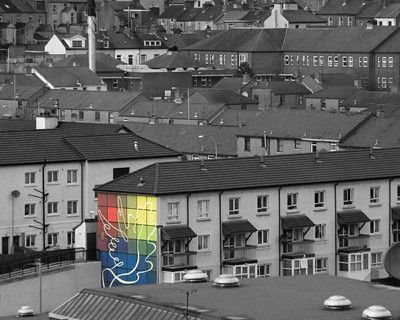
| 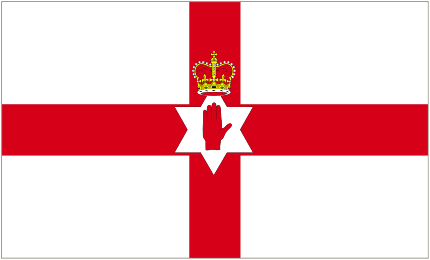 July 30, 2004 - Peace Mural, Bogside, Derry (Northern Ireland). In 2007, brothers Tom & William Kelly and their friend Kevin Hasson from Derry, collectively known as the 'Bogside Artists', recreated their famous 'Peace' mural on the Mall in Washington, DC (USA). The original depicts a dove of peace. Click here for distant view. July 30, 2004 - Peace Mural, Bogside, Derry (Northern Ireland). In 2007, brothers Tom & William Kelly and their friend Kevin Hasson from Derry, collectively known as the 'Bogside Artists', recreated their famous 'Peace' mural on the Mall in Washington, DC (USA). The original depicts a dove of peace. Click here for distant view.
|

| U S E U M | September 21, 2004 - National Museum of the American Indian (NMAI), Smithsonian Institution, 4th Street & Independence Avenue, SW, Washington, DC (USA). Dedicated to the life, languages, literature, history & arts of the native peoples of the Western Hemisphere. Also operates the George Gustav Heye Center in New York City (qv). Click here for the Wikipedia article. 
|
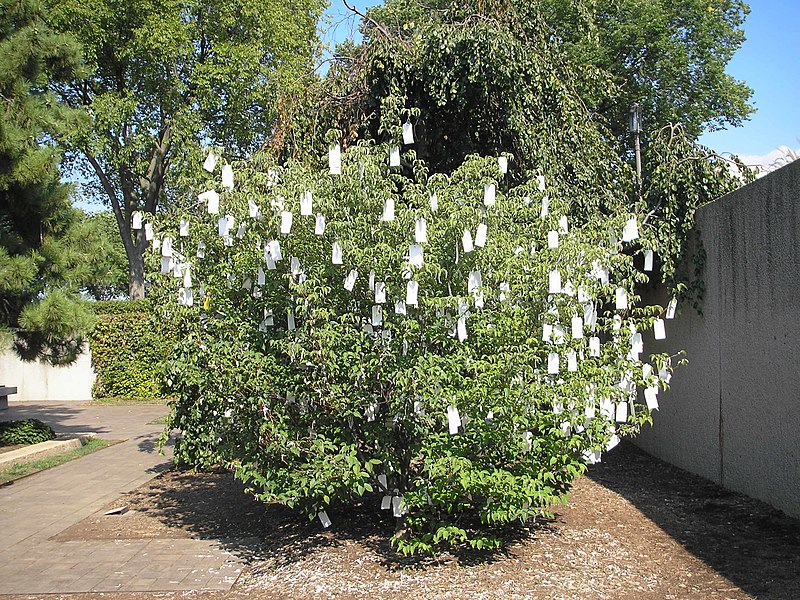 | R E E | April 2, 2007 -"Wish Tree for Washington, DC," Hirshhorn Museum & Sculpture Garden, Smithsonian Institution, Washington, DC (USA). "A public art work by Yoko Ono. Installed during the 2007 National Cherry Blossom Festival as part of her 'Imagine Peace' project.
Paper is provided for the visitor to tie a wish to the tree. The work builds on the Japanese tradition of tying prayers to trees. Returning the paper back to its source evokes an offering." Click here for other John Lennon & Yoko Ono monuments.
|  | R E E |  July 2010 -
"Wish Tree," Sculpture Garden, Museum of Modern Art (MOMA), New York City, New York (USA). "Has become very popular with contributions from all over the world." July 2010 -
"Wish Tree," Sculpture Garden, Museum of Modern Art (MOMA), New York City, New York (USA). "Has become very popular with contributions from all over the world."
|
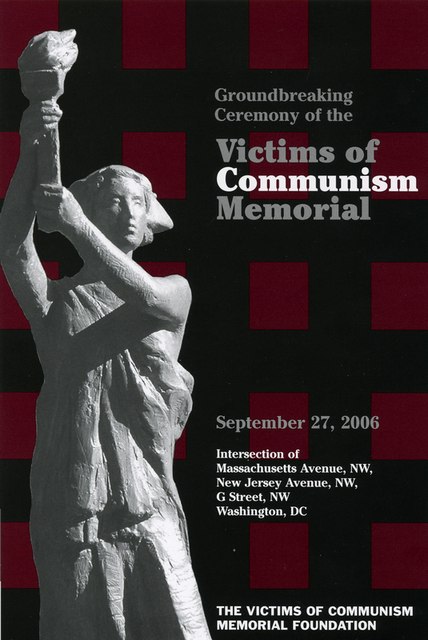
  | June 12, 2007 - "Goddess of Democracy," Victims of Communism Memorial, Washington, DC (USA). "A tribute to more than 100 million people who died as a result of revolutions, wars & atrocities committed by various communist regimes." Modeled on the 10-meter-tall (33 ft) statue created in Beijing (China) during the Tiananmen Square protests of 1989. Click here for other Goddess of Democracy statues.
|  | 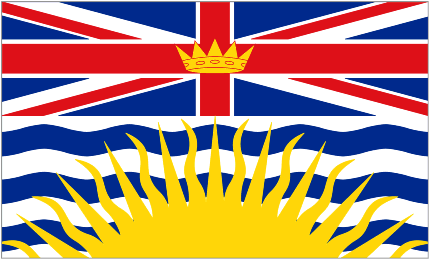 1991 - "Goddess of Democracy," SUB Plaza, University of British Columbia (UBC), Vancouver, British Columbia (Canada). Other replicas are in Arlington, Calgary, Hong Kong, San Francisco & Toronto. 1991 - "Goddess of Democracy," SUB Plaza, University of British Columbia (UBC), Vancouver, British Columbia (Canada). Other replicas are in Arlington, Calgary, Hong Kong, San Francisco & Toronto.
|

| U S E U M | February 18, 2008 - President Lincoln's Cottage, Soldiers' Home, Washington, DC (USA). The cottage & about 2.3 acres (9,300 m²) of the Home was proclaimed a National Monument by President Bill Clinton on July 7, 2000. Now managed through a cooperative agreement between the Armed Forces Retirement Home and the National Trust for Historic Preservation in consultation with the National Park Service, the cottage was restored & opened to the public on February 18, 2008.
|

| U S E U M | May 2008 - National Museum of Crime & Punishment (NMCP), 575-7th Street, NW, Washington, DC (USA). Explores the history of crime, law enforcement, forensic science, crime scene investigation (CSI), and the consequences of committing a crime. Co-owned and operated by Orlando businessman John Morgan in partnership with John Walsh, host of "America's Most Wanted" television program. Click here for a critique by the Washington Post.
|
| R A I L | 2009 -
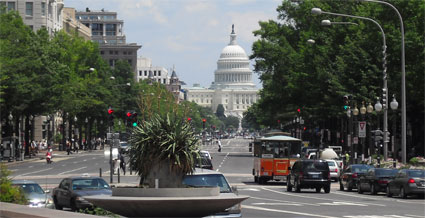
Robert G. Ingersoll Washington, D.C., Walking Tour, Washington Area Secular Humanists (WASH), Washington, DC (USA).
Eleven tour stops related to famous orator, political speechmaker & outspoken agnostic Robert G. Ingersoll [1833-1899]. Original tour Gary C. Grassl, Silver Hill, Maryland. Second Edition updated & digitized in 2009
by Steven C. Lowe, Washington, DC.
|
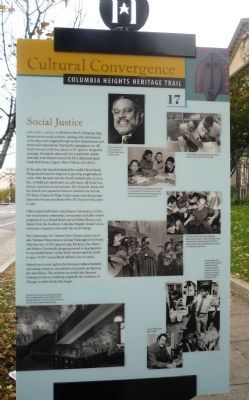
| A R K E R | 2009, "Cultural Convergence" Marker, Columbia Heights Heritage Trail, 16th Street, NW (south of Harvard Street), Washington, DC (USA).
Inscribed: "Social Justice. Straight ahead is All Souls Church, Unitarian, long known for its social activism, starting with abolitionism in the 1820s and ranging through nuclear disarmament and interracial cooperation. During the segregation era, All Souls was one of the few places in DC open to integrated meetings. During the 1980's and '90s it (and other neighborhood churches) even hosted concerts by DC's influential punk bands Bad Brains, Fugazi, Minor Threat, and others. In the 1960's, the church launched the model Girard Street Playground Project in response to growing neighborhood crime. After the 1968 riots, the church worked with Change, Inc. to build 406 apartments on 14th Street. All Souls' first African American senior minister, Rev. David H. Eaton led the church as it opened its doors to Antioch Law School, DC Music Center, DC Rape Crisis Center, and other groups. Eaton also became president of the DC Board of Education in 1982..."
|

| O V E | March 22, 2011 - Amsary Peace Dove, US Institute of Peace (USIP), Constitution Avenue at 23rd Street, NW, Washington, DC (USA). "Between the Lincoln Memorial & Capitol & passing by the Kennedy Center stands the USIP with its white roof that evokes the wings of a dove. Visible as a dove only from above. World's largest peace dove? The structure has been named after Hushang Ansary, the [Iranian-American] philanthropist & business leader from Houston, Texas." By coincidence, the monument was inaugurated by President George HW Bush at exactly the time US warplanes had started bombing Libya on orders from the incumbent Barack Obama. At a ceremony the following night, all four former presidents still living were present.
The guests might have remembered that, in one way or another, all four had been involved in wars.
In fact, all 44 men who have served as US president so far have been involved in at least one war." |

|
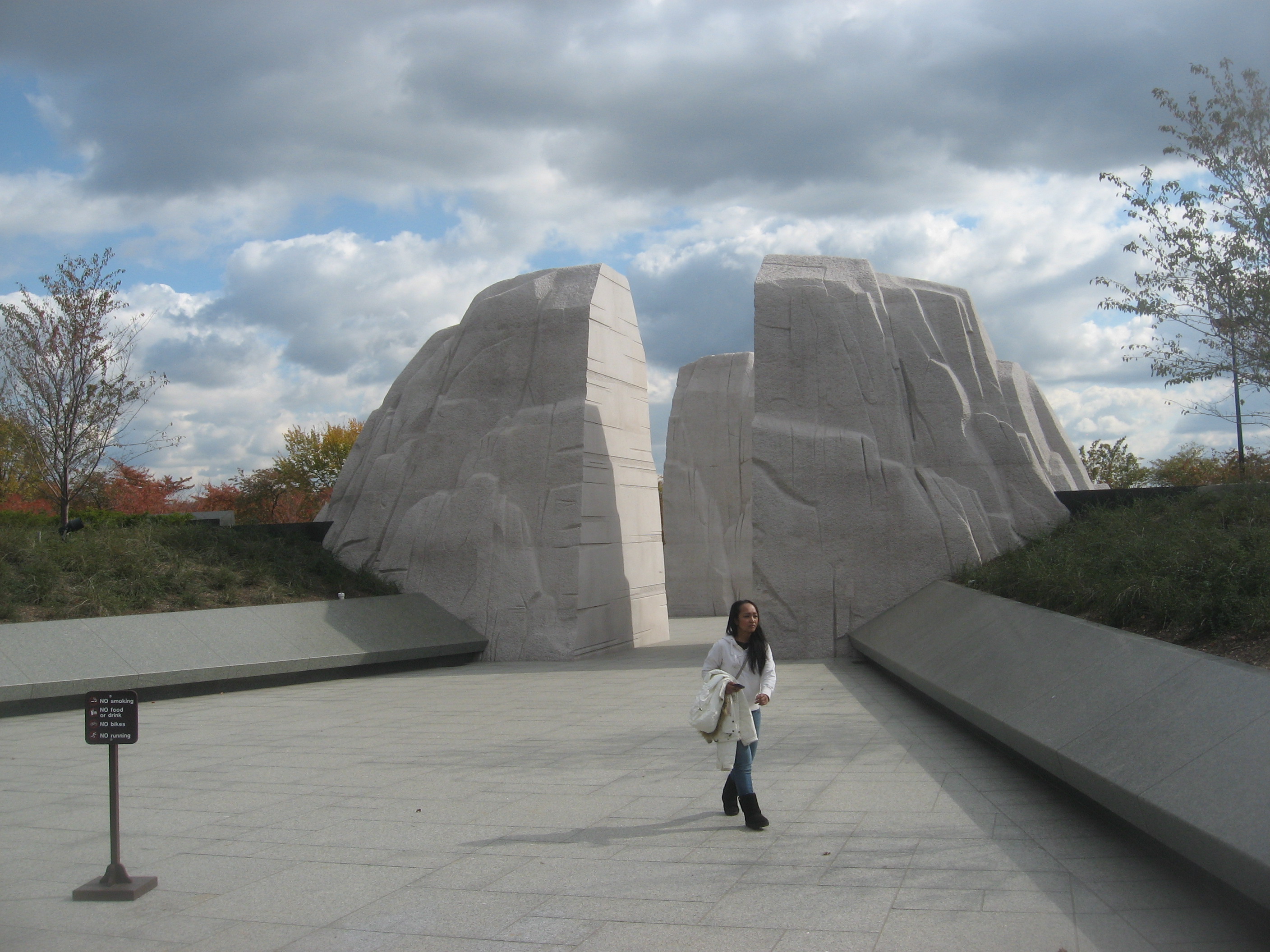
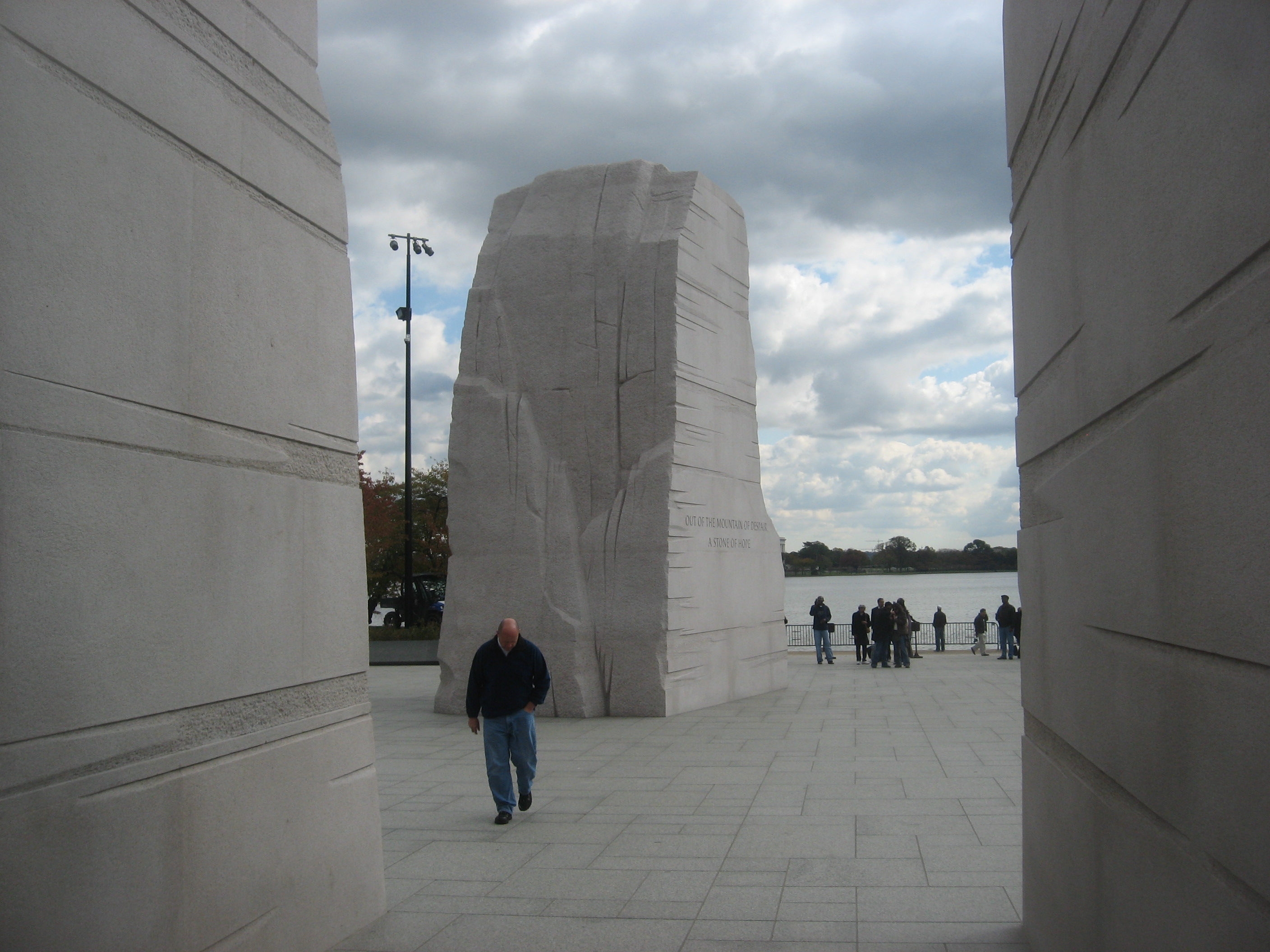 October 16, 2011 - Washington, DC Martin Luther King, Jr., National Memorial, 4-acre site on the Tidal Basin, Washington, DC (USA). Designed by Roma Design Group, San Francisco, California (USA). A project of the Washington, DC Martin Luther King, Jr. National Memorial Project Foundation, Inc. Ceremonial groundbreaking took place November 13, 2006, in West Potomac Park. Opened to the public on August 22, 2011. The official dedication was scheduled for August 28, 2011, but had to be postponed due to Hurricane Irene. Click here for the Wikipedia article. October 16, 2011 - Washington, DC Martin Luther King, Jr., National Memorial, 4-acre site on the Tidal Basin, Washington, DC (USA). Designed by Roma Design Group, San Francisco, California (USA). A project of the Washington, DC Martin Luther King, Jr. National Memorial Project Foundation, Inc. Ceremonial groundbreaking took place November 13, 2006, in West Potomac Park. Opened to the public on August 22, 2011. The official dedication was scheduled for August 28, 2011, but had to be postponed due to Hurricane Irene. Click here for the Wikipedia article.
| 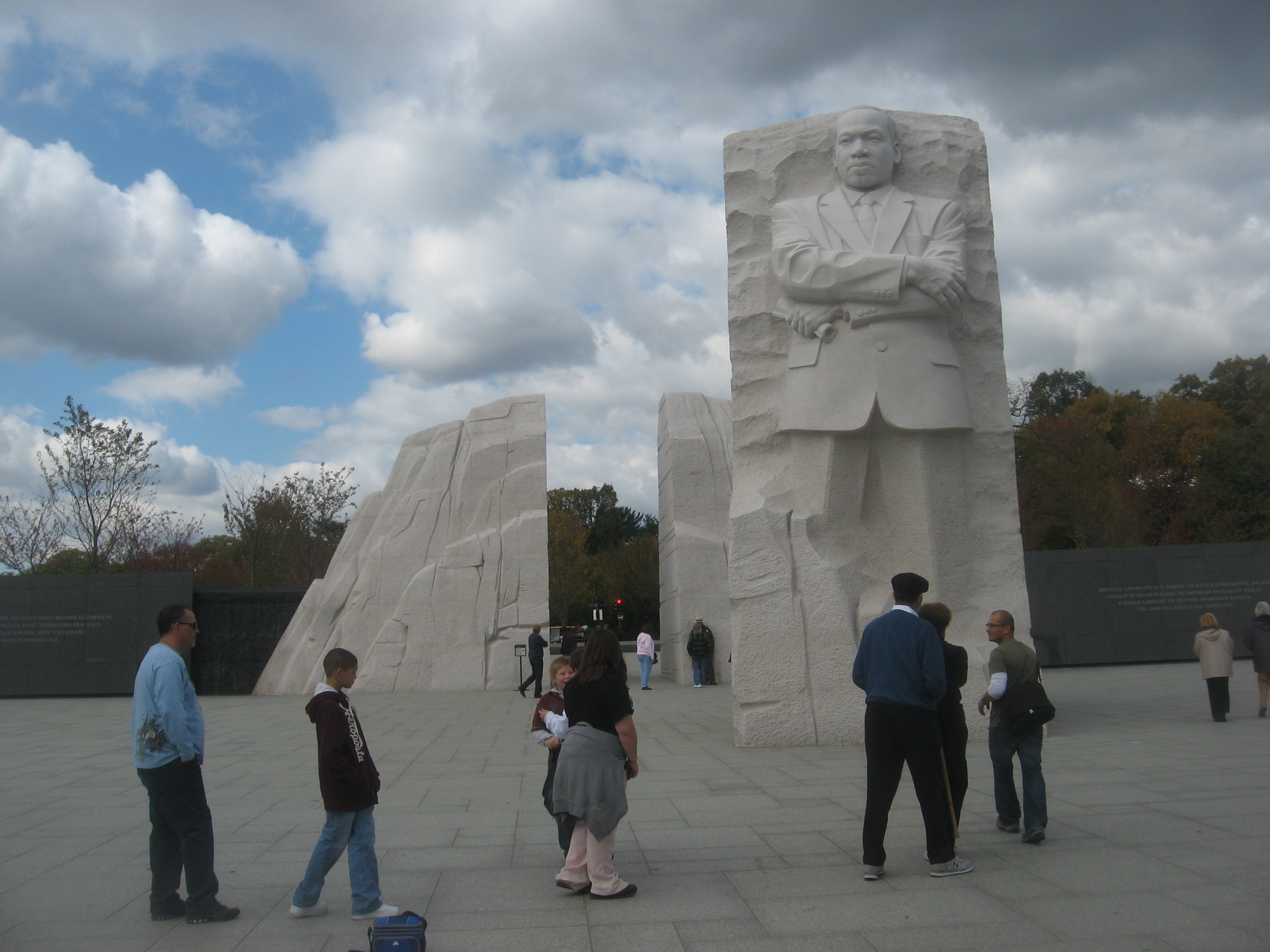
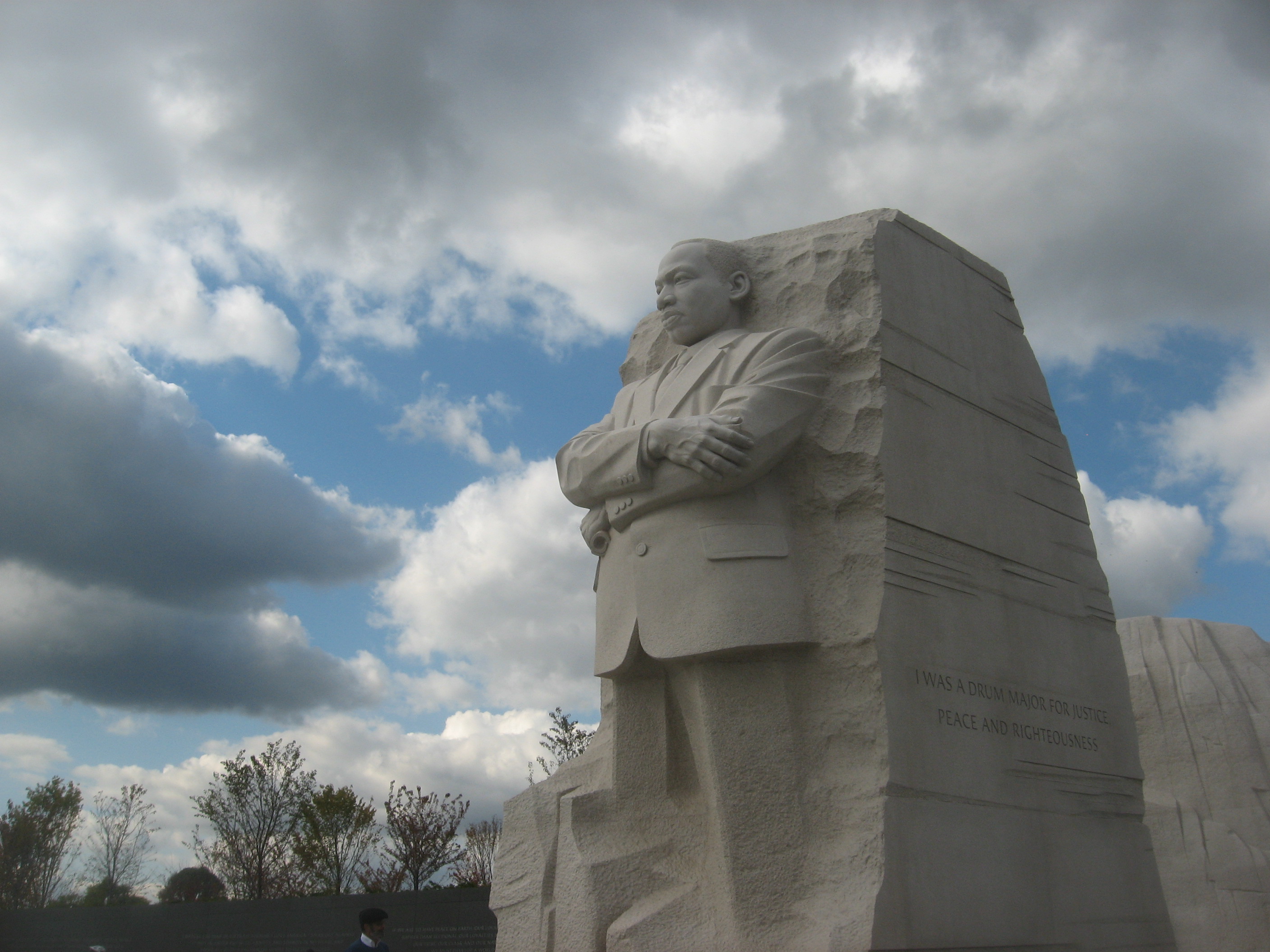 August 2011 - Statue of Martin Luther King, Jr., Washington, DC (USA). NYTimes, May 18, 2008: "Twenty-eight feet tall & carved from Chinese granite, the statue [sculpted by Lei Yixin] could resist almost any attack but the one that came recently from the panel whose approval it needs to proceed. The US Commission of Fine Arts, which must sign off on every inch of the $100 million memorial, from typeface to tree variety to color scheme, said in a letter that 'the colossal scale & Social Realist style of the proposed sculpture recalls a genre of political sculpture that has recently been pulled down in other countries.'"
| 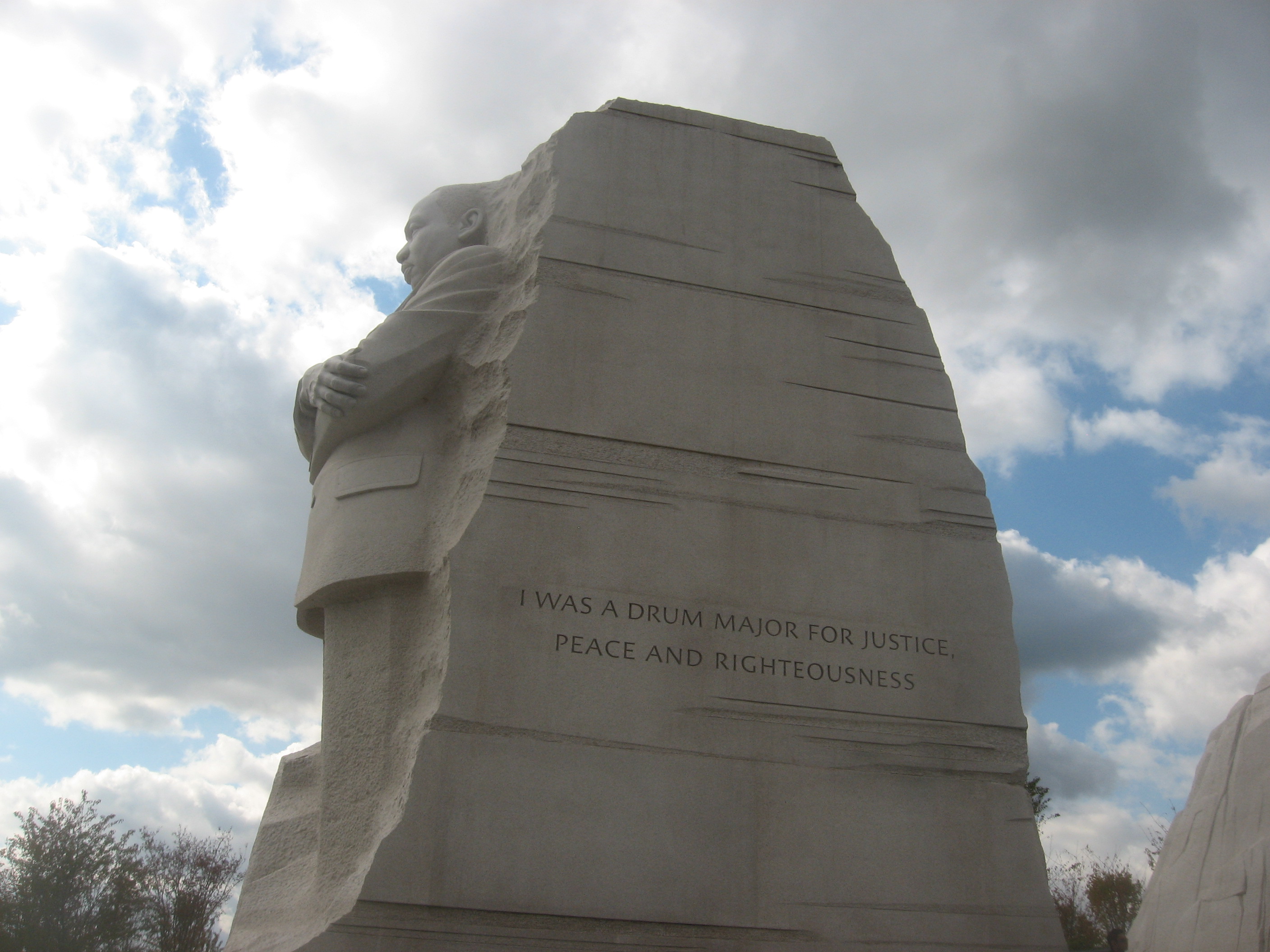
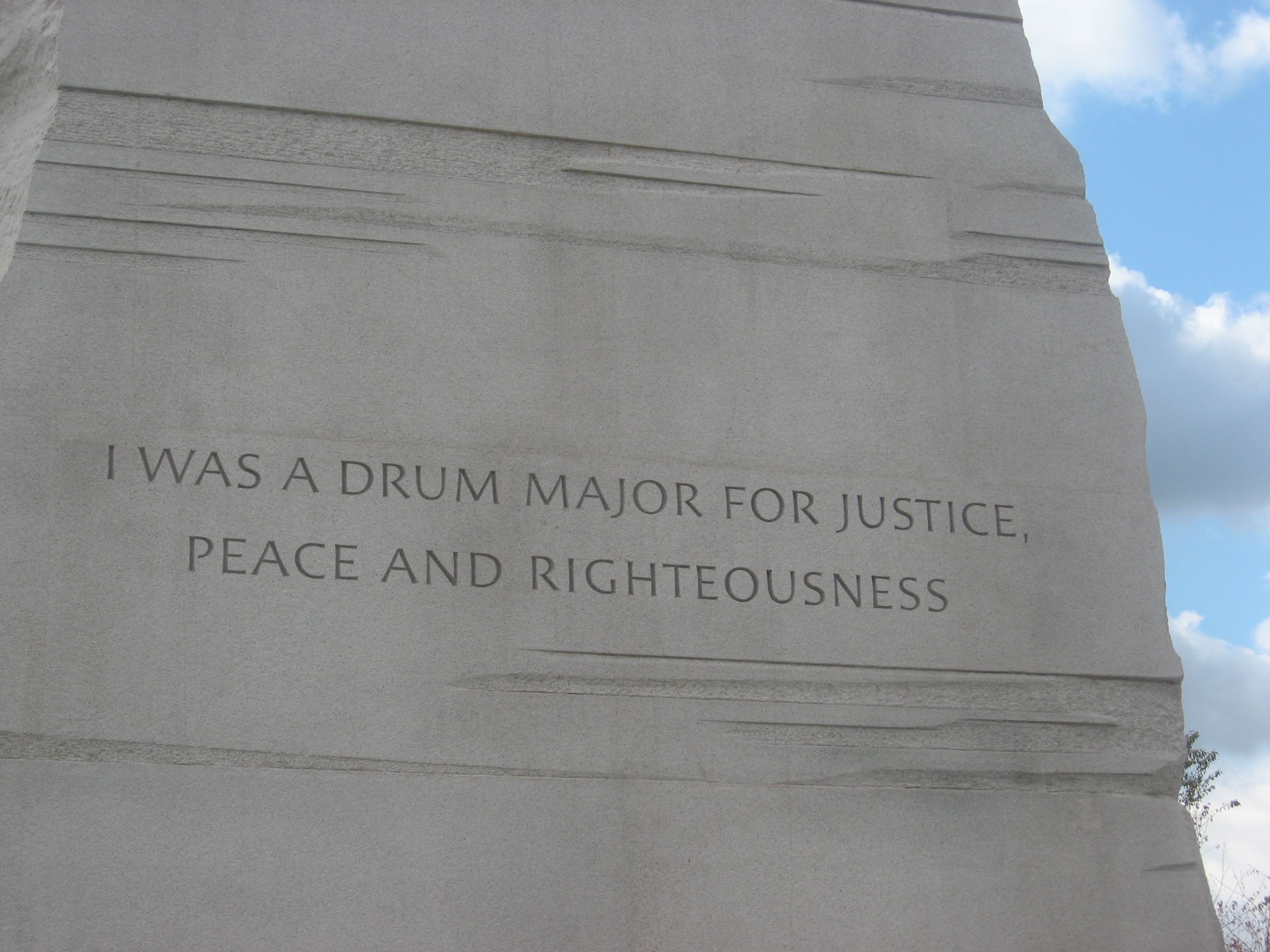 "I was a drum major for peace, justice and righteousness." "Renowned poet Maya Angelou told The Washington Post, 'The quote makes MLK look like an arrogant twit. The full quote is "If you want to say that I was a drum major, say that I was a drum major for justice. Say that I was a drum major for peace. I was a drum major for righteousness. And all of the other shallow things will not matter."
Angelou says not only did the memorial officials remove the 'if you want to say' part, but they condensed the entire quote, which is not what the historians charged with choosing which quote should be on the memorial had in mind, as they chose the quote in its entirety." "I was a drum major for peace, justice and righteousness." "Renowned poet Maya Angelou told The Washington Post, 'The quote makes MLK look like an arrogant twit. The full quote is "If you want to say that I was a drum major, say that I was a drum major for justice. Say that I was a drum major for peace. I was a drum major for righteousness. And all of the other shallow things will not matter."
Angelou says not only did the memorial officials remove the 'if you want to say' part, but they condensed the entire quote, which is not what the historians charged with choosing which quote should be on the memorial had in mind, as they chose the quote in its entirety."
|
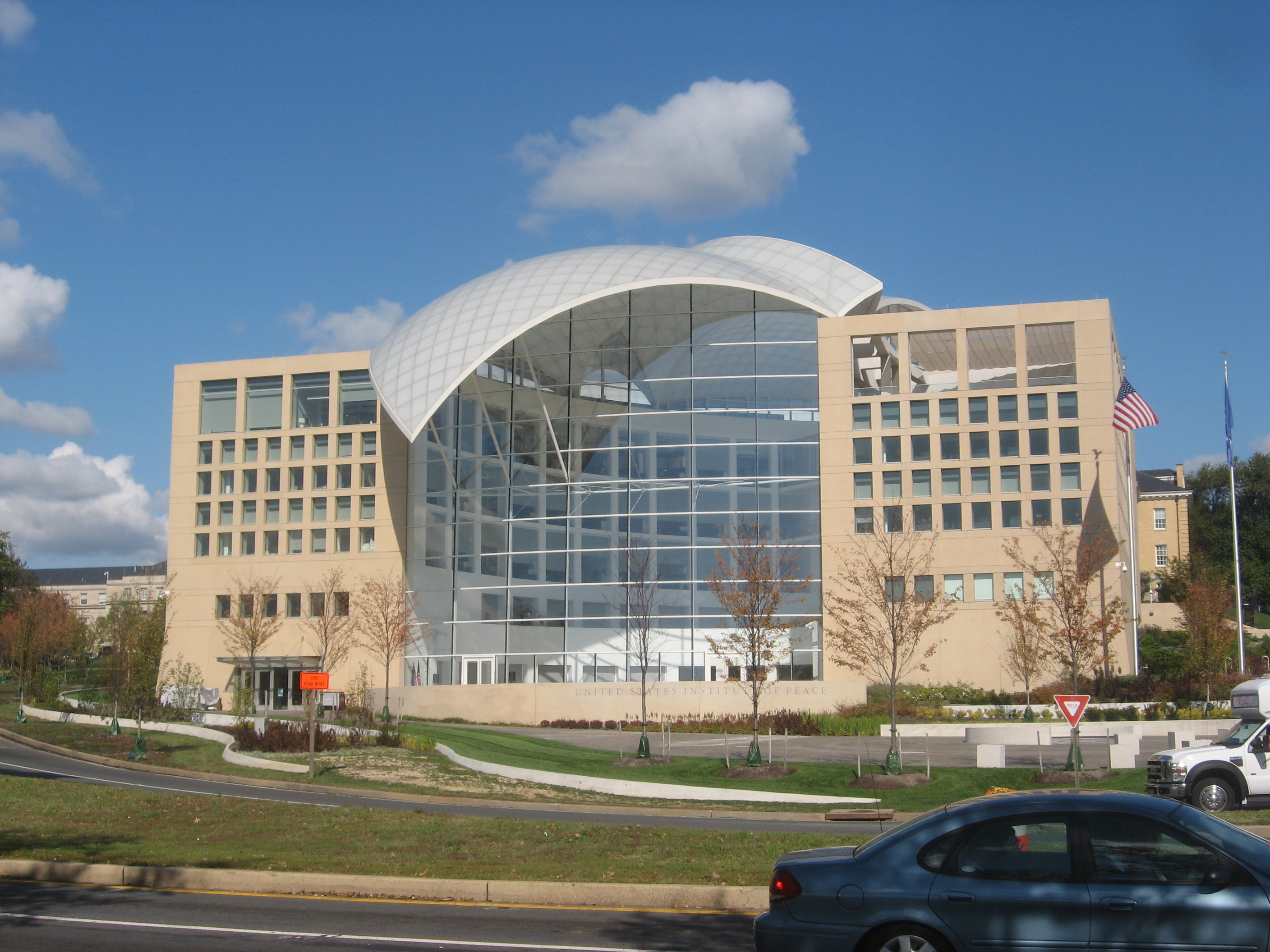
 | U S E U M | March? 2012 - Peace Well, Global Peacebuilding Center (GPC), US Institute of Peace (USIP), 23rd Street & Constitution Avenue, NW, Washington, DC (USA). "Viewed over a railing, the Peace Well presentation appears on a series of six large rear-projected screens, featuring powerful imagery, music, sound effects & projected text. Its purpose is to provide a dynamic introduction to key themes in conflict management & peacebuilding & to USIP’s work around the world [sic]." Right image shows Georgetown Day School students along with USIP Executive Vice President Tara Sonenshine, during a visit on March 12, 2012. /// Apparently the Peace Well can be seen by appointment only & is the only exhibit so far opened in the vast space (left image) which is the otherwise incomplete GPC.
|
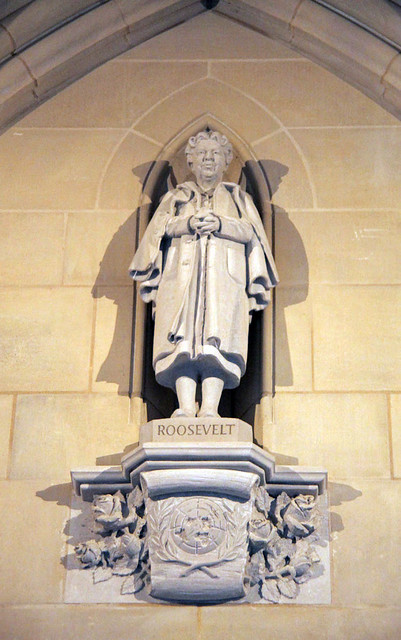
 | A R V I N G | May 10, 2012 - Stone Carving of Rosa Parks, Human Rights Porch, Narthex, Washington National Cathedral, Washington, DC (USA). "The area includes likenesses of Oscar Romero, Eleanor Roosevelt & John T. Walker (first African American bishop of the Episcopal Diocese of Washington once arrested at a protest rally against apartheid at the South African Embassy)... The statue of Rosa Parks [1913-2005] was commissioned along with a carving of Mother Teresa that will be dedicated later this year." /// Right image shows statue of Eleanor Roosevelt which is about two feet (0.6 m) tall & above the archway leading to the west narthex.
|  |
 | A L L | August 22, 2012 - Wall for Peace 2011, Concourse A/B, Washington Dulles International Airport, Chantilly, Virginia (USA). By Anil Revri. "7 feet long, 6 ½ feet high, free-standing rectangular sculpture that features a four-sided LED screen that displays English translations of scriptures related to peace from Buddhism, Christianity, Hinduism, Islam, Judaism, and Sikhism. Rays of light emanating from the unit are projected onto the viewers as they walk around the work... On display until March 2013." Still there as of August 2014. Information courtesy of Sharron King.
|
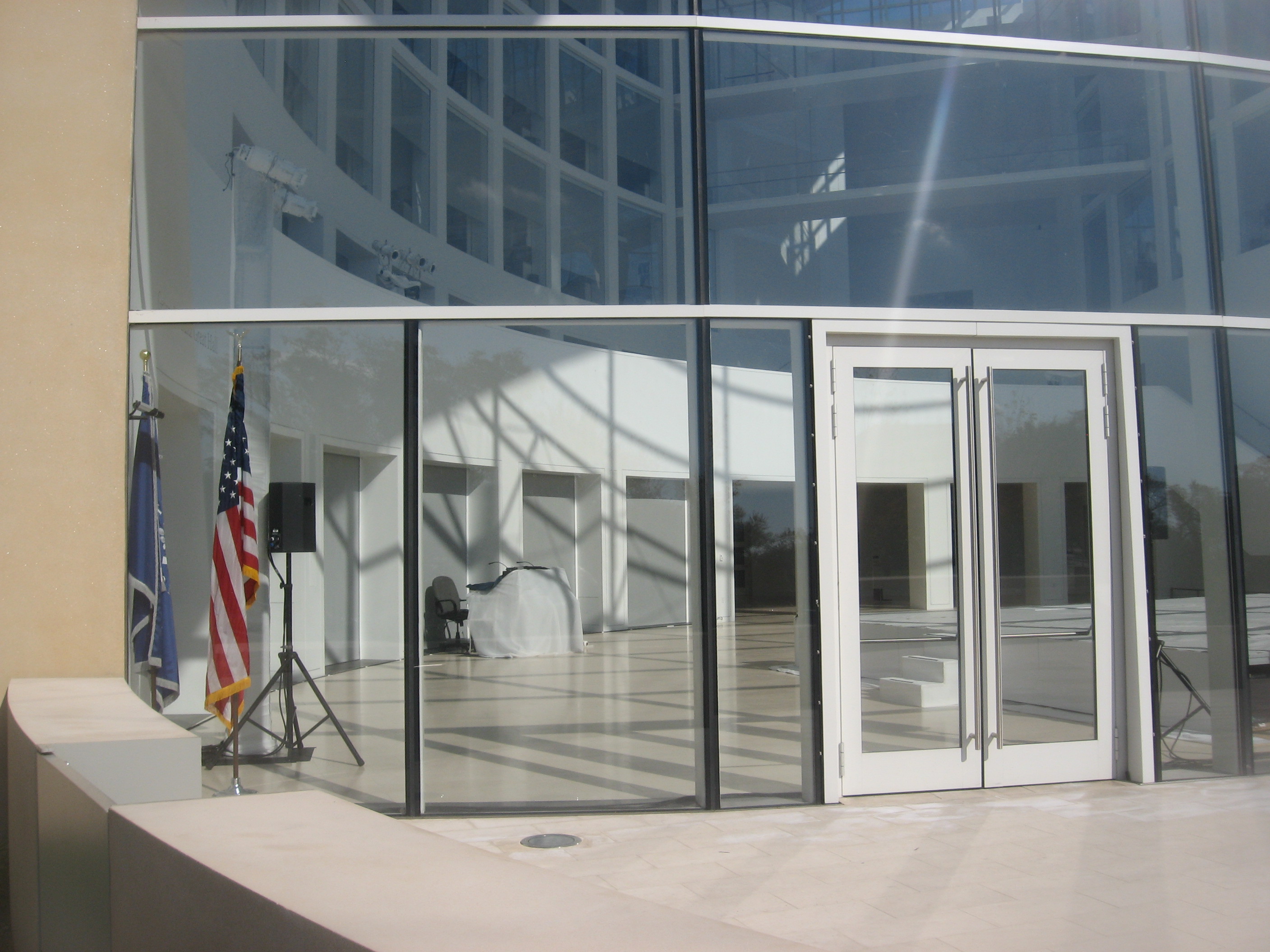

| U S E U M | December 2012? - Global Peacebuilding Center (GPC), US Institute of Peace (USIP), 23rd Street & Constitution Avenue, NW, Washington, DC (USA). Formerly called Public Education Center (PEC). Official ground breaking for new USIP headquarters building took place June 5, 2008 -- 24 years after the creation of USIP. Building opened in 2011. It includes a training center for professional conflict managers, conference space for public & private meetings & office space for USIP staff. But 20,000 square fee space for PEC remains empty (as seen in first two images made Nov. 1, 2011). Entry #1169 in the "Peace Movement Directory" by James Richard Bennett (2001). Discussed by Tom Flores (2008). Click here for the Wikipedia article. |
|


| June 19, 2013 - Statue of Frederick Douglass, US Capitol Building, Washington, DC (USA). "The sculpture of Douglass, completed by the artist Steven Weitzman in 2007, and one of Pierre L’Enfant, both paid for by the District of Columbia, have been sitting at One Judiciary Square [left image]. For years, Congress has wrangled over their placement, interjecting fights over gun laws and voting rights into the debate..." But Congress agreed in September 2012 to allow both statues to be placed in the Capitol building, just NOT in Statuary Hall (where each state has two statues). Right image shows VP Joseph Biden & Congressional leaders during the dedication ceremony. Click here for all Douglass monuments.
|
.JPG)
| August 19, 2013 - "Dunbar Alumni and Faculty on US Postage Stamps," Paul Laurence Dunbar High School, Washington, DC (USA). "Giant posters of all 8 have been placed on a wall of the media center, where their visages can serve to inspire incoming Dunbar students... There are also 118 plaques placed around the school honoring various alumni for achievements ranging from being the 1st elected US Senator [sic] to starring as an all-pro NFL tight end... It's a historic week for historic Dunbar High School. The school, recognized during the 1st half of the 20th Century as the finest African-American high school in America, is celebrating its new $122 million facility with 5 days of special events..." /// Who are the eight? Four of them must be Carter G. Woodson (historian), W. Allison Davis (anthropologist), Charles R. Drew (surgeon) & Anna Julia Cooper (scholar). Also Charles Hamilton Houston (Dean of Howard University School of Law) & Mary Church Terrell (civil rights/suffrage activist)?
|


| U S E U M | December 2015 - National Musuem of African American History & Culture (NMAAHC), The Mall, Washington, DC (USA). Under discussion since 1915. Architectural design announced April 14, 2009. "Will memorialize and honor the victims of slavery and provide their descendants a concrete place for remembrance and reflection. A place of refuge and introspection for all people to contemplate the past, present and future with the hope of finding answers and hope."
Described on page 14 of "A Traveller's Guide to the Civil Rights Movement" by Jim Carrier (2004).
|
|
| U S E U M | April 12, 2016 - Belmont-Paul Women's Equality National Monument, 144 Constitution Avenue, NE, Washington, DC (USA). Proclaimed a National Monument by President Barak Obama on "Equal Pay Day." Operated as Sewall-Belmont House & Museum since 1929. "Explores the evolving role of women & their contributions to society through the continuing, and often untold, story of women's pursuit for equality. The museum is the headquarters of the historic National Woman's Party (NWP) and was the Washington home of its founder and Equal Rights Amendment (ERA) author Alice Paul [1885-1977]. Also named for Alva Belmont [1853-1933],
multi-millionaire socialite & major benefactor of the women's suffrage movement.
|
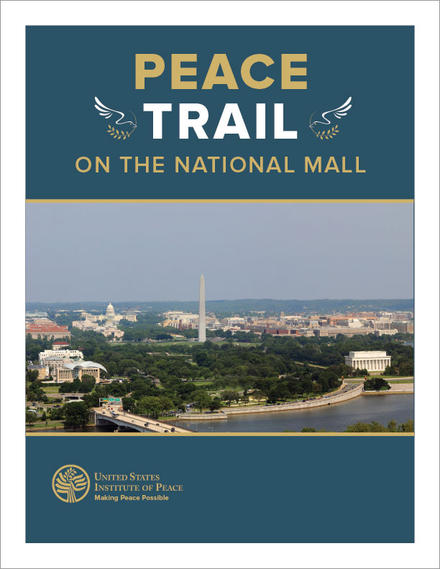 
| March 2, 2017 - Peace Trail on the National Mall, Washington, DC (USA). "A collaboration between the US Institute of Peace (USIP) & colleagues at the Guild of Professional Tour Guides of Washington, DC, & at the National Park Service (NPS). Anchored at USIP & tracing a path to a dozen other key sites in the vicinity, it brings a 'peace lens' to the experience of visiting the National Mall. It may be used as a self-guided walking tour or a reference guide, elevating stories of key figures, institutions & moments in history that demonstrate America’s enduring commitment to peace... The northwest corner of the National Mall could be considered the 'War & Peace Corner' of our nation’s capital. It is home to this country’s most famous war memorials, which draw tens of millions of visitors each year. It is also home to the headquarters of the US Institute of Peace (USIP) & to other symbols & sites with peace themes, which, while generally less prominent, offer an important & complementary narrative." Click here to upload an 18-page brochure about the trail. NO DATE IN BROCHURE. Trail was simply "announced" March 2 on Facebook page, apparently with no inaugural event. Information courtesy of Susan Ives. (PS: Until 2017, I used this space for an unofficial peace trail including the Naval Peace Monument (1878) which is far east of the USIP trail &
entries #1074-1178 in the "Peace Movement Directory" by James Richard Bennett (2001). /// NB: In May 2014, David J. Smith expressed interest in developing a "peace tour" of monuments in Washington, DC.)
|

| U S E U M | "Before 2011" - Armenian Genocide Museum of America (AGMA), 615-14th Street, NW, Washington, DC (USA). "Will be the premier institution in the USA dedicated to educating American and international audiences about the Armenian Genocide and its continuing consequences. Visitors will come to understand the Armenian Genocide as the prototype for modern crimes against humanity, including the Holocaust, Cambodia, Rwanda & Darfur." Financed by Gerard Cafesjian family. Click here for Wikipedia article. 
|

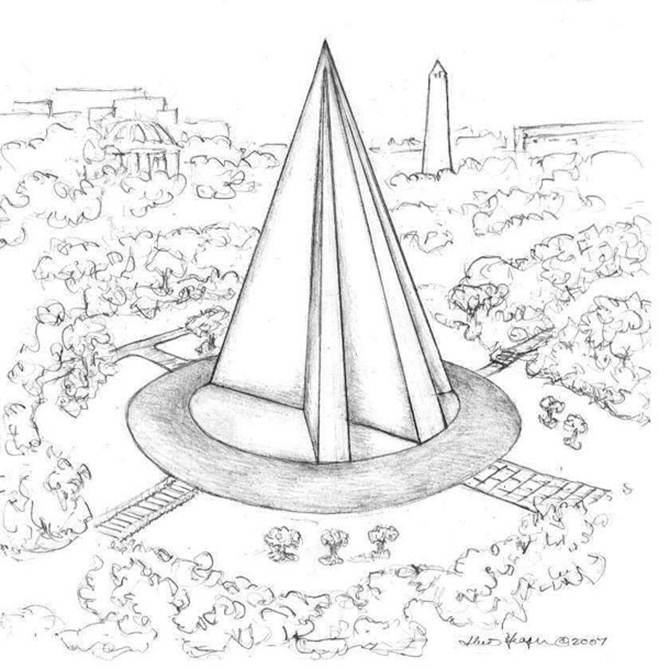
| Future - US Peace Memorial, Washington, DC (USA). A project of Dr. Michael D. Knox, Tampa, Florida. (Click here to see "peace activist" Mike Knox compared to "wrestling superstar" Mike Knox.) In plan view (left image), this monument represents the famous CND peace symbol. Click here to see 11 American peace quotations being considered for inscription on the future monument.
|
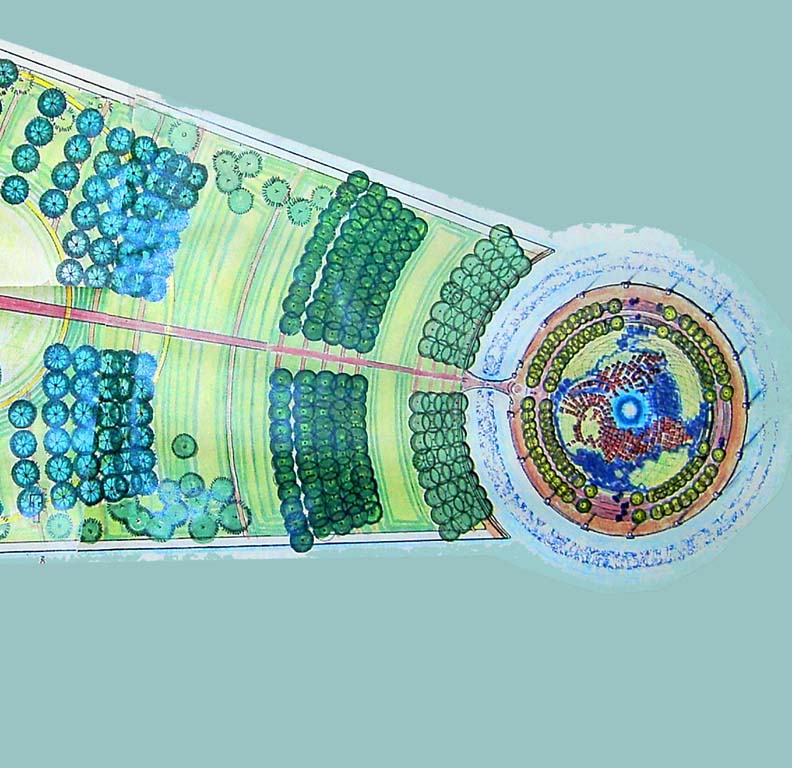

| Future - National Peace Garden, Hanes Point, Potomac River, Washington, DC (USA). Congress authorized this memorial in 1987. The waterfront site, approved in 1988, embraces 10-acres about two miles south of the Jefferson Memorial. The concept of the garden by the landscape architecture firm of Royston Hanamoto Alley & Abey was approved July 1993." This project displaces the popular statue of "The Awakening" (right image). /// Click here for a history of this project. Click here for one design.
|
 | Future - A-Bomb Museum, Washington, DC (USA). "The 'NPT Promotion Committee,' composed of Japanese parliamentarians from various parties, is pursuing the idea of establishing, in Washington, DC, a monument to express the hope of eliminating nuclear weapons as well as a permanent museum to convey the consequences of the atomic bombings of Hiroshima and Nagasaki. The committee aims to unveil the monument at the Nuclear Non-proliferation Treaty (NPT) Review Conference next spring and open the museum sometime next year [2010]."
|

|
Future - National Women's History Museum (NWHM), National Mall, Washington, DC (USA). Video | Website | "Founded" in 1996. "Our mission is to build the first ever national museum in Washington, DC, dedicated exclusively to women’s history. It will be centrally located near the world’s most prestigious museums & monuments in our Nation’s Capital. On March 25, 2009, Representative Carolyn Maloney introduced HR 6548 that identifies a different site at 12th Street & Independence Avenue as the museum’s home... NWHM plans to hire a female architect. The Museum will be the first museum on the Mall designed by a woman."
|
|
Future -
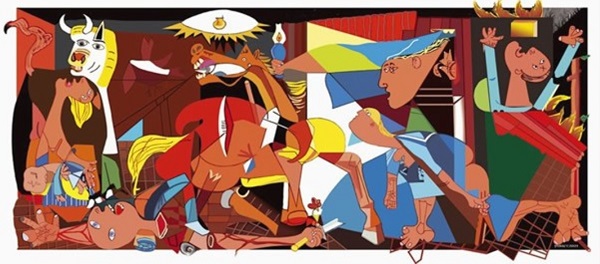
Peace Monument, Washington, DC (USA). Proposed by David Swanson (Co-founder & Director of WorldBeyondWar), August 24, 2017: "Washington, D.C., needs a three-dimensional, sculptural Guernica dedicated to & with explanatory information about the victims of US bombings in over 30 countries that the US has bombed.
And it needs such a monument to the victims of wars now, to help move the country away from war. We can’t wait to create the monument after having achieved a society willing to make room for it among the war-glorification monstrosities gobbling up more and more space in the US capital.
With land unavailable for peace in the land of war temples, the obvious solution is a rooftop. The Methodist Building across from the Capitol & the Supreme Court, or the nearby FCNL [Friends Committee on National Legislation] building, or any other prominent building with a roof could radically alter the DC skyline & worldview.
Bureacratic hurdles would have to be cleared, height kept below that of the Capitol dome, etc. But a rooftop could make a monument more visible, not less. An external elevator could take people close-up to view, learn more & photograph.
A plan to build such a monument would allow a design competition that could attract major artists, which in turn could attract major donations sufficient to fund the project."
|
 This is just one page from "Peace Monuments Around the World." To navigate the entire website:
|
Then page down & choose a link to one of more than 400 web pages. |  powered search engine: powered search engine:
Loading
|